


General information
1. Even at the dawn of automobile manufacturing, when designing internal combustion engines, the dependence of combustion efficiency and, accordingly, the return of internal energy of the working mixture on the proportion of fuel and air in its composition was revealed. For maximum efficient operation, a strictly defined proportion is required, which must be maintained in all engine operating modes. This, in turn, leads to fuel savings.
2. Maintaining this proportion is especially important for gasoline engines. Today, all gasoline engines from leading automotive manufacturers are equipped with an electronically controlled injection system.
3. With this method of mixture formation, the air necessary for fuel combustion enters through the air filter and through the throttle valve into the intake manifold. The amount of incoming air is determined by the corresponding sensor.
4. Fuel is sucked from the fuel tank by an electric pump, passed through a fuel filter and fed into the fuel distribution line. Through injectors, the fuel is injected into the intake manifold, located in front of the intake valves of the cylinders, where it mixes with the air flow.
5. The engine control module, observing the ignition sequence, regulates the opening time of the injector channels and thus the amount of fuel injected depending on the amount of air and engine load. In addition, the ECM controls the throttle valve, regulating the amount of air supplied if necessary.
6. Initially, to determine the amount of fuel supplied to the engine cylinders, only the incoming air flow was measured. But gradually new dependencies were identified that affected the efficiency of fuel combustion, and the requirements for the toxicity of exhaust gases became more stringent, which entailed the complication of engine control systems.
7. Modern fuel injection control systems are a complex set of sensors, control units, actuators and electronic circuits (see accompanying illustrations). Below is a description of the operating principles of some of them:
- The accelerator pedal position sensor is mounted in the pedal assembly. From the sensor, the corresponding electrical signal is sent to the engine control module (ECM), setting the values for the desired driving mode of the car;
- The throttle control module contains the actuator (stepper motor) and a throttle potentiometer. The electric motor regulates the position of the throttle valve and allows maintaining a constant idle speed regardless of the connection of additional consumers. The potentiometer sends information to the ECM about the current value of the throttle valve installation angle;
- The camshaft position sensor provides the ECM with information about the ignition timing in the first cylinder of the engine to synchronize the ignition timing and injection sequence in the other cylinders;
- The air mass sensor housing contains a thin sensor plate through which an electric current is passed. The plate is cooled by the air flow. The control unit regulates the heating current so that the plate temperature remains constant. Current fluctuations during heating allow the ECM to determine the engine load condition and regulate the amount of fuel injected accordingly.
- The coolant temperature sensor is installed in the thermostat housing (see Chapter 3). It is an NTC resistor - as the coolant temperature increases, its resistance decreases and the corresponding signal is sent to the ECM;
- The knock sensor is mounted under the exhaust manifold in the cylinder block. It sets the ignition timing at the start of detonation combustion of the fuel, thereby, on the one hand, preventing the process of detonation combustion of the fuel mixture, and on the other hand, ensuring the most complete combustion of the fuel and reducing its consumption;
- The lambda probe allows monitoring the composition of the working mixture by measuring the residual oxygen in the exhaust gases. As a result of the measurement, a certain voltage is created on the sensitive element of the lambda probe, by the value of which the ECM determines the need to change the composition of the fuel mixture. Corsa C/Meriva models are equipped with two oxygen sensors - pre-catalytic and post-catalytic.
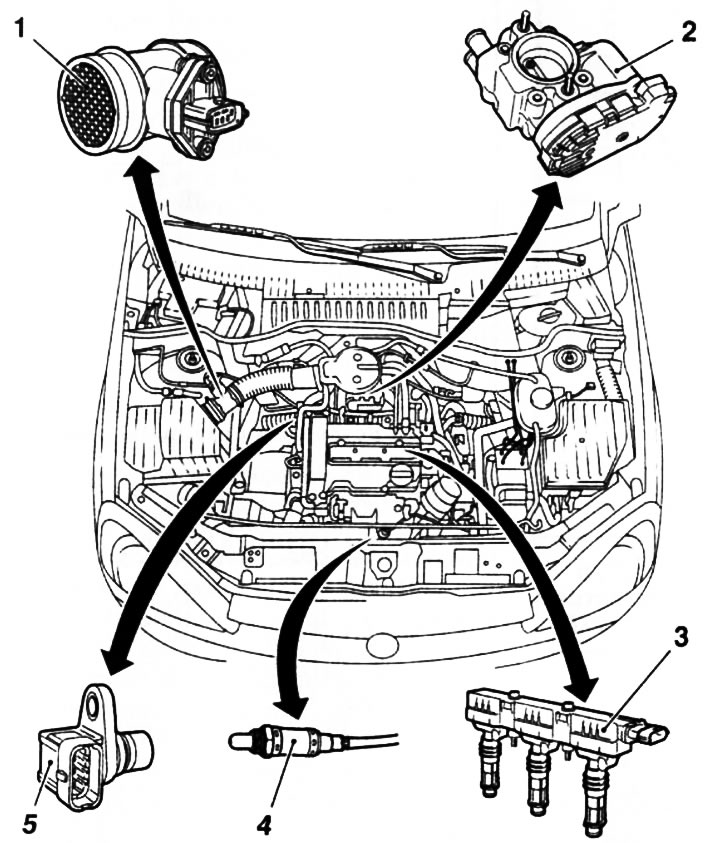
12.7a. Some sensors and modules of the gasoline engine control system (using the Z1 OXE(P) engine as an example): 1. Air mass measurement sensor; 2. Throttle control module; 3. Ignition module; 4. Pre-catalytic lambda probe; 5. Camshaft position sensor
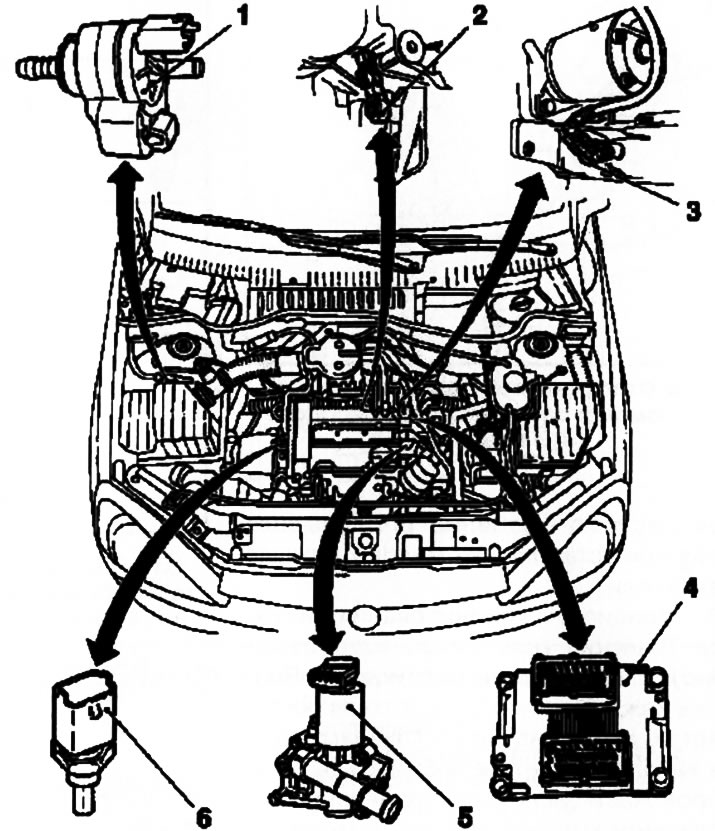
12 7b. Some sensors and modules of the gasoline engine control system (using the Z1 OXE(P) engine as an example): 1. EVAP system valve; 2. Knock sensor; 3. Crankshaft position sensor; 4. Electronic Engine Management Module (ECM); 5. Exhaust gas regeneration system valve; 6. Coolant temperature sensor
8. Various systems may differ from each other in the number of elements involved, depending on the design of the power unit and the requirements for a specific engine. Independent intervention in the adjustment and configuration of these systems is not allowed. For this, special diagnostic and adjustment devices are used, which are usually available only at specialized service stations.
Twinport System (engines Z10XEP/Z12XEP/Z14XEP)
9. The models described in this Manual can be equipped with engines with the Twinport system. This system is designed to improve the engine's fuel efficiency and reduce the toxicity of exhaust gases when the engine is running at low speeds and idling speeds. This system is especially effective when installed on small-capacity engines.
10. Operating principle of the Twinport system (see accompanying illustration) is as follows: Air enters each engine cylinder through two air channels. One of the channels can be closed by a control valve, the position of which is controlled by a drive rod from the vacuum regulator. When the channel is closed by the valve, a vortex flow of the air-fuel mixture is created, which allows lean mixtures to be used at low engine loads and when idling, as well as increasing the percentage of exhaust gases entering through the recirculation system (EGR). Due to this, overall fuel consumption is reduced and the content of harmful substances in the exhaust gases is reduced.
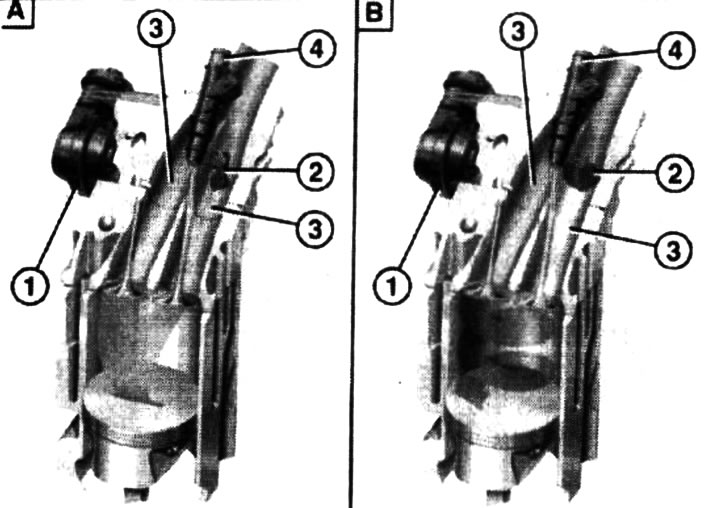
12.10. Operating principle of the Twinport system: A. The control valve is open (at full load); B. The control valve is closed (when the engine is idling and when the vehicle is stopped); 1, 2. Direction of air-fuel mixture flow; 3. Inlet ports; 4. Vacuum regulator; 5. Injector; 6. Regulating valve
Visitor comments