OpelBook.ru
Cars AvtoVAZ Cars Mitsubishi Cars BMW Cars Mercedes Cars Nissan Cars Toyota Cars Chevrolet
English Русский
Български
Беларускі
Український
Српски
Hrvatski
Română
Polski
Slovenský
Magyar
 |  Sitemap  |  Contacts  |    


Main Astra Corsa Insignia Kadett Omega Vectra Zafira Others Articles
Kadett D (1979-1984) Kadett E (1984-1995)
  • Main
  • Kadett
  • Kadett E
  • OHC power unit
  • Ignition system
  • The principle of operation of a contactless ignition system

The principle of operation of a contactless ignition system (Opel Kadett E)

            0

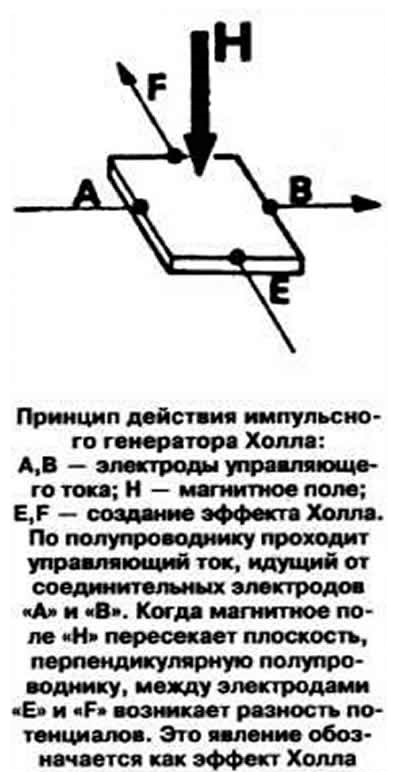
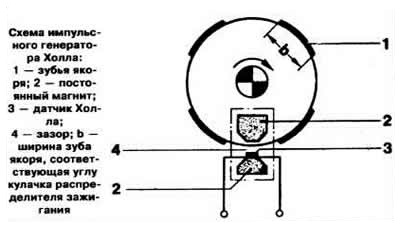
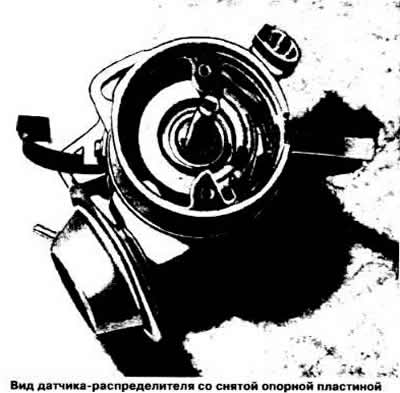
The magnetic part of the ignition distributor sensor, called the generator control pulse sensor, consists of the actual magnetic Hall sensor and a toothed anchor fixed to the rotor.

The magnetic part of the ignition distributor sensor, called the generator control pulse sensor,…


The magnetic part of the ignition distributor sensor, called the generator control pulse sensor,…


The magnetic flux in the ignition coil changes depending on the passage of the anchor teeth rotating in the interpolar gap of the magnetic sensor. When the anchor tooth enters the interpolar gap, the magnetic field in the integrated circuit of the Hall sensor is absent, and there is no induced current. When the anchor tooth leaves the interpolar gap, in accordance with the law of induction, an alternating voltage arises in the Hall sensor circuit, the circuit closes and a voltage pulse is formed.

The width of the anchor teeth corresponds to the angle of the cam.


The switch controls the ignition depending on the rotation speed of the ignition distributor shaft, the battery voltage, the total resistance of the ignition coil, and in any engine operating mode it produces constant voltage pulses.

Interruption of the current in the primary winding of the ignition coil by the commutator causes a sharp change in the magnetic flux in the coil and the appearance of a high voltage current in the secondary winding of the ignition coil.

Warning. It is not recommended to touch the low-voltage and high-voltage components of the contactless ignition system with your hands when the engine is running, as they are under higher voltage than the components of the contact ignition system. Before any work on the ignition system, disconnect the wires from the battery.


In the engine compartment of vehicles with contactless ignition systems there is a yellow plate with a warning inscription in German: "High-voltage ignition system - do not touch with hands".

It is prohibited:
  • replace the ignition coil with a different type of coil;
  • connect a suppression capacitor or a test lamp to terminal "1" of the ignition coil;
  • connect the positive terminal of the battery to terminal "1" of the ignition coil, as this will cause the switch to fail;
  • use an ohmmeter or any other voltage generating device to test the Hall sensor;
  • use a charger with a voltage greater than 16 V to start the engine;
  • connect terminal "1" of the ignition coil to ground when connecting the anti-theft device;
  • disconnect the high-voltage wire from terminal "4" of the ignition coil with the engine running.

When checking engine compression, before turning the crankshaft with the starter, disconnect the connector from the switch or connect terminal "4" of the ignition coil to ground with a wire.


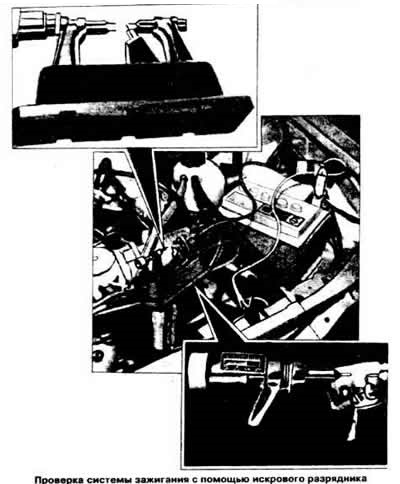
When checking spark formation using a spark gap, connect a 5 kOhm resistor in series to the high voltage terminal of the ignition coil.

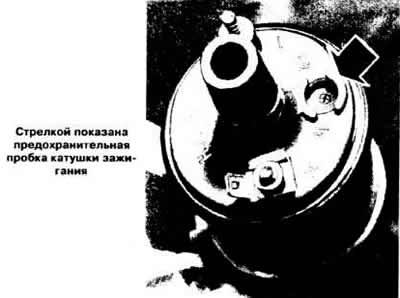
When checking the speed of the distributor shaft or the cam angle, to obtain accurate results, connect a 0.9-1.0 Ohm resistor in series with terminal "15" of the ignition coil. After checking, be sure to disconnect the resistor. If it remains in the target, the engine will start with difficulty and the ignition system will not function properly.
When checking the speed of the distributor shaft or the cam angle, to obtain accurate results,…


When checking the speed of the distributor shaft or the cam angle, to obtain accurate results,…


When checking the speed of the distributor shaft or the cam angle, to obtain accurate results,…


Text copied from an internet website [OpelBook.ru]


This article is available at russian, bulgarian, belarusian, ukrainian, serbian, croatian, romanian, polish, slovak, hungarian
Checking the article: Shapovalov Yaroslav

Share information:

Previous articles
Opel Kadett E: Ignition system
Next articles

Contactless ignition system device
Fully electronic ignition system
Ignition distributor sensor device
Scheme for troubleshooting and troubleshooting contactless ignition system


See similar ones from other Opel car manuals:
▶ Operation of the variable ignition system Opel Vectra A (1988-1995)
▶ Contactless ignition system — troubleshooting Opel Ascona C (1981-1988)
▶ Ignition system of carburetor engines — check Opel Astra F (1991-1998, petrol)
▶ Troubleshooting the ignition system Opel Corsa C (2000-2006)
▶ Ignition system of gasoline engines Opel Insignia A (2008-2017)
Link to this page in different formats

Visitor comments


No comments yet


How much will 22 + 40 =


Kadett E (1984-1995) 
  • General information
  • Vehicle description
  • Operation and maintenance
  • OHV power unit
  • Engine design
  • Check and repair
  • Engine work
  • OHC power unit
  • Engine design
  • Engine repair
  • Ignition system
  • Cooling and lubrication
  • Supply system
  • Fuel injection «LE-Jetronic»
  • Fuel injection «LE3-Jetronic»
  • Motronic ML4.1 system
  • Motronic M1.5 system
  • Motronic M2.5 system
  • Transmission
  • Clutch
  • Gearbox F10 and F13
  • Gearbox F16 and F20
  • Automatic gearbox
  • Drive shafts
  • Chassis
  • Front suspension
  • Rear suspension
  • Steering
  • Brake system
  • Electrical equipment
  • Equipment and devices
  • Electrical circuits
Kadett D (1979-1984) 
  • General information
  • Car care
  • Maintenance
  • Power unit
  • Gasoline engines
  • Lubrication system
  • Cooling system
  • Power system (gasoline)
  • Carburetor Solex 35 PDSI
  • Carburetor Varajet II
  • Carburetor 1B1
  • Fuel injection (gasoline)
  • Diesel engines
  • Fuel system (diesel)
  • Transmission
  • Clutch
  • Manual gearbox
  • Chassis
  • Front suspension
  • Rear suspension
  • Steering
  • Brake system
  • Wheels and tires
  • Body
  • Body elements
  • Doors and windows
  • Electrical equipment
  • Equipment and devices
  • Lighting system
  • Power devices
  • Ignition system
  • Electrical circuits
OpelBook.ru © 2017–2026 · Mobile version · · Sitemap: EN BG BY UA RS HR RO PL SK HU · Feedback · Site search
Astra F, petrol · Astra G, petrol · Astra G · Astra H · Astra J, petrol · Corsa B · Corsa C, petrol · Corsa C · Insignia A · Kadett D · Kadett E · Omega A · Omega B · Omega B2 · Vectra A, petrol · Vectra A · Vectra B, petrol · Vectra B · Vectra C · Zafira A, petrol · Frontera A, petrol · Frontera B · Ascona C · Vivaro A ·
We want your visit to be comfortable 🤝! We use cookies 🍪 to make that happen.