OpelBook.ru
Cars AvtoVAZ Cars Mitsubishi Cars BMW Cars Mercedes Cars Nissan Cars Toyota Cars Chevrolet
English Русский
Български
Беларускі
Український
Српски
Hrvatski
Română
Polski
Slovenský
Magyar
 |  Sitemap  |  Contacts  |    


Main Astra Corsa Insignia Kadett Omega Vectra Zafira Others Articles
Astra F (1991-1998, petrol) Astra G (1998-2004, petrol) Astra G (1998-2004) Astra H (2004-2009) Astra J (2009-2015, petrol)
  • Main
  • Astra
  • Astra H
  • Transmission
  • Mechanical gearbox
  • Removal, inspection and installation of clutch components

Removal, inspection and installation of clutch components (Opel Astra H)

            0

Contents: Removal ⬇ Examination ⬇ Installation ⬇ Features of removal/installation of…⬇
Caution: Remember that dust generated during wear of the clutch slave disk friction linings may contain asbestos, which is harmful to health. Do not blow off dust with compressed air and try not to inhale it. Do not use petroleum-based solvents to wipe clutch components - use only special brake cleaners or pure methyl alcohol. Place used rags in a hermetically sealed container.


Removal


1. To gain access to the clutch assembly, it is necessary to first remove gearbox.

Note: If the engine was not removed from the vehicle, it is recommended to additionally support the unit with a jack or install special stands under it.


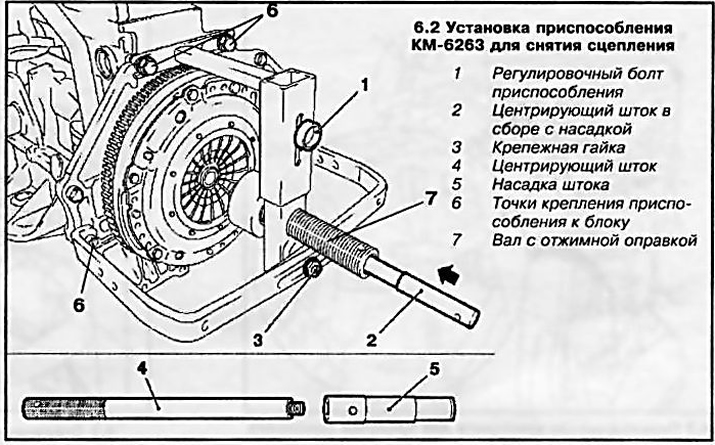
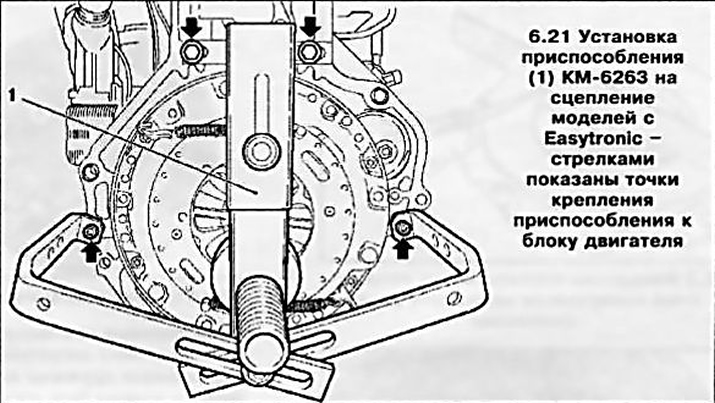
2. Install the special device KM-6263 (see accompanying illustration), be careful - the lower mounting bolts of the device must be attached to the engine block, and in no case to the oil pan.

2. Install the special device KM-6263 (see accompanying illustration), be careful - the lower…


Note: When installing the fixture, the mounting bolts are not tightened, allowing the fixture elements to move.


3. Insert the centering rod with the appropriate attachment through the hole in the shaft with the pressing mandrel (see illustration 6.2) into the central journal of the engine crankshaft and tighten the mounting bolts of the device.


Note: Each box has its own centering attachment.


If you plan to reuse the same clutch basket, mark its position on the flywheel (in the absence of factory marks).

4. Screw in (clockwise) shaft with a release mandrel until the latter comes into contact with the working edges of the diaphragm spring petals. Continue screwing the shaft in until it stops - the mandrel will compress the spring and separate the clutch discs.

5. Remove the 6 bolts securing the clutch to the engine flywheel.

6. Smoothly turning inside out (counterclockwise) shaft with the release mandrel, completely release the diaphragm spring. Holding the basket, remove the centering rod and remove the clutch assembly - use an assistant if necessary.

7. After completing the procedure, remove the device from the engine block.

Examination


8. Most often, the malfunction of the clutch is associated with wear of the friction linings of the driven disk. However, it is necessary to carefully examine the condition of all other components of the assembly.

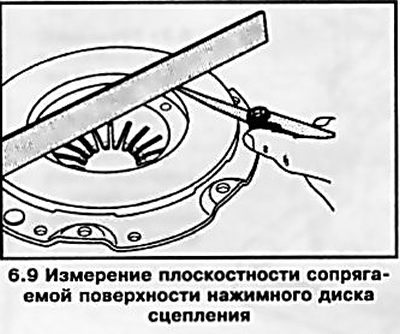
9. Examine the flywheel working surface for cracks, traces of overheating, grooves and other damage - replace the flywheel if necessary (see Chapter 2). Also check the condition and evaluate the flatness of the mating surface of the clutch pressure plate (see accompanying illustration).

9. Examine the flywheel working surface for cracks, traces of overheating, grooves and other damage…


10. Assess the degree of wear of the friction linings of the driven clutch disc. The surface of the linings should rise above the rivet heads by at least 1.6 mm. Make sure that all rivets are tightly seated, check the torsion springs/dampers for cracks, signs of deformation and other mechanical damage (see accompanying illustration). Oiling of friction linings most often occurs due to failure of the crankshaft oil seal, damage to the integrity of the oil pan gasket, the sealing element of the slave cylinder assembly, or the oil seal of the primary shaft of the manual transmission - replace the damaged components.
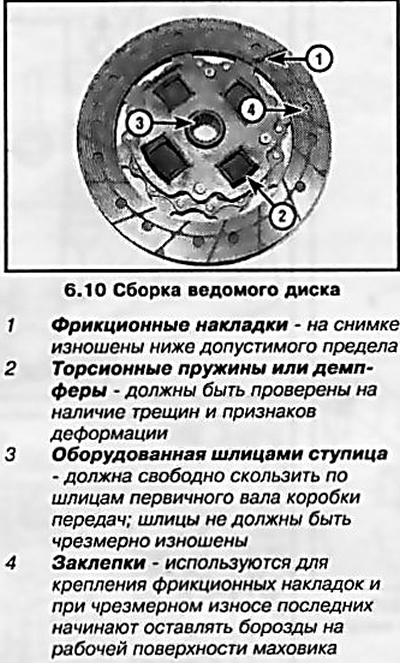


10. Assess the degree of wear of the friction linings of the driven clutch disc. The surface of the…


11. It is advisable to replace the release bearing together with the driven disk (see Section 3). If the driven disk is OK, check the condition of the release bearing - the bearing should rotate smoothly, without signs of jamming. The mating surfaces should be absolutely smooth and undamaged, without cracks, burrs or dents. If you are not sure of the bearing condition, replace the slave cylinder assembly (see Section 3).

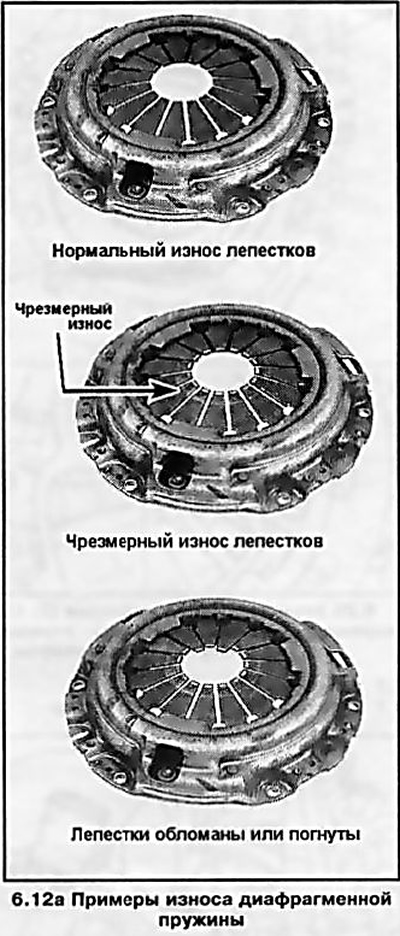
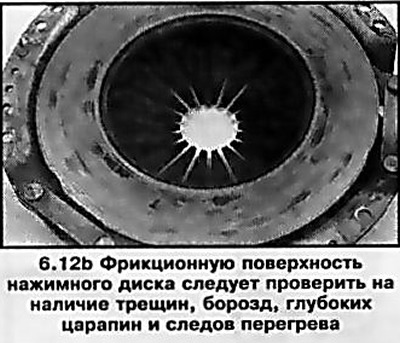
12. Assess the condition of the machined surfaces and petals of the diaphragm spring of the pressure plate (see accompanying illustrations). If defects are detected, replace the basket assembly. Light polishing traces can be removed with fine-grained sandpaper. A restored clutch assembly can always be purchased on an exchange basis through Opel branded service stations.

12. Assess the condition of the machined surfaces and petals of the diaphragm spring of the…


12. Assess the condition of the machined surfaces and petals of the diaphragm spring of the…


Installation


13. Make sure that the mating surfaces of the flywheel and clutch discs are absolutely clean and dry; if necessary, wipe the working surfaces with solvent.

14. Install the friction disc with the protruding part of the hub away from the flywheel. The disc is usually marked at the factory indicating which side it should be installed towards the flywheel.

15. Install the clutch basket - if you are installing an old basket, make sure that the alignment marks made during dismantling are correct. Screw in the basket mounting bolts and tighten them only by hand for now to ensure that the driven disk can be centered without any obstacles.

16. Install the KM-6263 device, insert the centering rod.

Note: Alignment is necessary so that when installing the gearbox, its input shaft passes through the splines in the disc and enters the guide sleeve in the crankshaft journal.


17. Using a pressing mandrel, completely unload the clutch discs (see above) and, in several steps, in a diagonal order, evenly tighten the basket mounting bolts to the required force. Remove the centering rod and remove the device.

18. Install the gearbox in place.

Features of removal/installation of the Easytronic clutch system


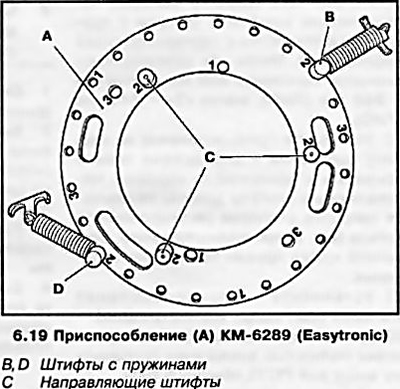
19. These models require the installation of an additional device KM-6289 to prevent the clutch discs from turning (see accompanying illustration). Before installation, the device must be adjusted to the size and type of clutch. To do this, insert the removable guide pins and pins with springs into the holes with the corresponding markings. Marks "1" correspond to a clutch diameter of 200 mm, marks "2" - 240 mm (RWD), marks "3" - 240 mm (FWD).


19. These models require the installation of an additional device KM-6289 to prevent the clutch…


20. Install the device on the clutch basket - it should fit tightly to the surface of the basket. The guide pins should be opposite the stoppers of the adjusting ring (see accompanying illustration). Fasten the spring hooks to the clutch basket.
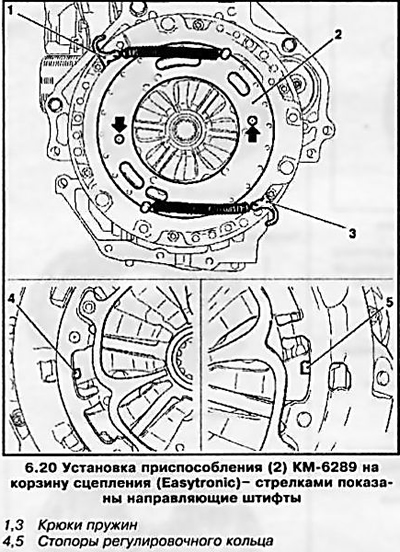
20. Install the device on the clutch basket - it should fit tightly to the surface of the basket.…


21. Install device KM-6263 (see accompanying illustration).

21. Install device KM-6263 (see accompanying illustration).


22. The further procedure for removal and installation is completely analogous to that described above for a conventional type manual transmission.


This article is available at russian, bulgarian, belarusian, ukrainian, serbian, croatian, romanian, polish, slovak, hungarian
Checking the article: Simonov Timofey

Share information:

Previous articles
Opel Astra H: Mechanical gearbox
Next articles

Removal and installation the clutch pedal
Bleeding air from the hydraulic circuit of the clutch release drive
Removal and installation the clutch slave cylinder assembly with release bearing
Removal and installation the clutch master cylinder
Clutch. General information
Manual Transmission and Clutch Specifications
Removal and installation the Easytronic clutch control module
Manual transmission (MT). General information
Adjusting the gear shift drive
Removal and installation gear shift drive components
Transmission oil change
Removal and installation of manual transmission


See similar ones from other Opel car manuals:
▶ Design of the clutch and its drive components Opel Corsa B (1993-2000)
▶ Removal, inspection and installation of clutch components Opel Vectra C (2002-2008)
▶ Brake and clutch fluids Opel Insignia A (2008-2017)
▶ Clutch Opel Kadett E (1984-1995)
▶ Engine Components — Inspection and Refurbishment Opel Omega A (1986-1993)
Link to this page in different formats

Visitor comments


No comments yet


How much will 21 + 35 =


Astra J (2009-2015, petrol) 
  • General information
  • Vehicle device
  • User manual
  • Faults en route
  • Maintenance
  • Power unit
  • Engine repair
  • Cooling and lubrication system
  • Engine power system
  • Exhaust system
  • Transmission
  • Clutch
  • Car gearbox
  • Drive shafts
  • Chassis
  • Front suspension
  • Rear suspension
  • Steering
  • Brake system
  • Wheels and tires
  • Body
  • Exterior
  • Interior
  • Doors and windows
  • Body Care
  • Heating and air conditioning
  • Security systems
  • Electrical equipment
  • Equipment and devices
  • Lighting and signaling
  • Power devices
  • Electrical circuits
Astra H (2004-2009) 
  • General information
  • Introduction to the guide
  • Troubleshooting
  • User manual
  • Maintenance
  • Power unit
  • Engine repair
  • Cooling and heating
  • Power and exhaust system
  • Ignition system
  • Launch and charge system
  • Transmission
  • Mechanical gearbox
  • Automatic gearbox
  • Drive shafts
  • Chassis
  • Brake system
  • Car suspension
  • Steering
  • Body
  • Interior
  • Exterior
  • Electrical equipment
  • Equipment and devices
  • Electrical circuits
Astra G (1998-2004) 
  • General information
  • Introduction to manual
  • User manual
  • Maintenance
  • Power unit
  • SOHC gasoline engines
  • DOHC gasoline engines
  • Diesel engines 1.7 and 2.0
  • Engine repair
  • Cooling system
  • Supply system
  • Injection system (gasoline)
  • Injection system (diesel)
  • Exhaust system
  • Charge and launch system
  • Ignition system (gasoline)
  • Preheat system (diesel)
  • Transmission
  • Manual gearbox
  • Automatic gearbox
  • Clutch
  • Drive shafts
  • Chassis
  • Brake system
  • Wheel suspension
  • Steering
  • Body
  • Exterior
  • Interior
  • Doors and windows
  • Ventilation and heating
  • Electrical equipment
  • Equipment and devices
  • Electrical circuits
Astra G (1998-2004, petrol) 
  • General information
  • User manual
  • Car care
  • Maintenance
  • Power unit
  • Single shaft engines
  • Twin shaft engines
  • Engine repair
  • Cooling and heating
  • Fuel and exhaust systems
  • Starting and charging system
  • Ignition system
  • Transmission
  • Clutch
  • Mechanical gearbox
  • Automatic gearbox
  • Drive shafts
  • Chassis
  • Brake system
  • Car suspension
  • Steering
  • Body
  • Interior
  • Exterior
  • Electrical equipment
  • Equipment and devices
  • Wiring diagrams Opel Astra
  • Wiring diagrams Opel Zafira
Astra F (1991-1998, petrol) 
  • General information
  • Maintenance
  • Power unit
  • Engine in car
  • Engine removed
  • Cooling system
  • Heating and ventilation
  • Fuel supply (carburetor)
  • Fuel supply (injector)
  • Emission control
  • Ignition system
  • Transmission
  • Clutch
  • Mechanical gearbox
  • Automatic gearbox
  • Drive shafts
  • Chassis
  • Brake system
  • Car suspension
  • Steering
  • Body
  • Exterior
  • Interior
  • Electrical equipment
  • Equipment and devices
  • Electrical circuits
OpelBook.ru © 2017–2026 · Mobile version · · Sitemap: EN BG BY UA RS HR RO PL SK HU · Feedback · Site search
Astra F, petrol · Astra G, petrol · Astra G · Astra H · Astra J, petrol · Corsa B · Corsa C, petrol · Corsa C · Insignia A · Kadett D · Kadett E · Omega A · Omega B · Omega B2 · Vectra A, petrol · Vectra A · Vectra B, petrol · Vectra B · Vectra C · Zafira A, petrol · Frontera A, petrol · Frontera B · Ascona C · Vivaro A ·
We want your visit to be comfortable 🤝! We use cookies 🍪 to make that happen.