


Caution: Remember that dust generated during wear of the clutch slave disk friction linings may contain asbestos, which is harmful to health. Do not blow off dust with compressed air and try not to inhale it. Do not use petroleum-based solvents to wipe clutch components - use only special brake cleaners or pure methyl alcohol. Place used rags in a hermetically sealed container.
1. The slave cylinder assembly with the release bearing is attached to the inside of the clutch dome and to remove it you need to dismantle the box gear shifting.
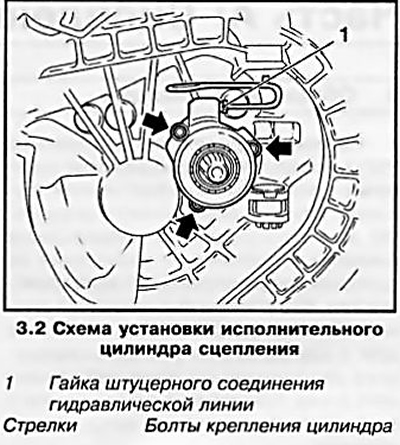
2. On models with manual transmission F13, F17+, F17+MTA, F23, carefully wipe the outside of the cylinder, then loosen the union nut and disconnect the hydraulic line from the cylinder (see accompanying illustration) - immediately wipe up any traces of spilled brake fluid with a rag. Unscrew the 3 mounting bolts and remove the cylinder from the input shaft.
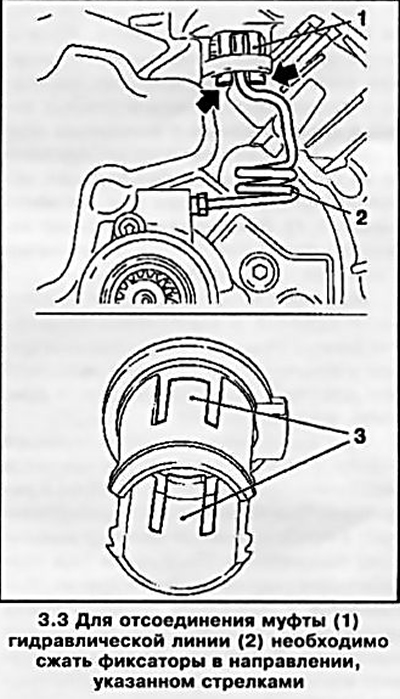
3. On models with the M32 manual transmission, the hydraulic line must be disconnected from the outside and removed together with the actuator cylinder assembly, for which it is necessary to loosen the nut of the external nipple connector and then remove the coupling (see accompanying illustration) hydraulic line.
4. Remove the sealing ring installed between the cylinder and the manual transmission housing - the ring must be replaced without fail. Take precautions against dirt getting into the box.
5. A failed slave cylinder cannot be repaired. If brake fluid leaks develop, replace the cylinder assembly.
6. Before installation, make sure that the mating surfaces of the cylinder and the gearbox housing are absolutely clean and dry. Place a new sealing ring in the receiving groove on the transmission housing. When installing a new slave cylinder assembly, it is necessary to remove the protective clamp (red color). Lubricate the cylinder with clean transmission oil.
7. Installation is carried out in the reverse order of removal. Do not forget to bleed the hydraulic circuit (see Section 4).
Visitor comments