


Contents: Engine Z16XE/Z18XE (without air…⬇ Features of the Z19DT(H) engine ⬇ Features of Y20DTH/Y22DTR engines ⬇ Features of the Z20NET engine ⬇ Features of Z22SE/ Z22YH engines ⬇
Caution! Any maintenance or repair work on the cooling system must be carried out on a cold engine! See also the warnings at the beginning of Section 2.
The basis is the operation of removing the radiator on models with Z16XE/Z18XE engines without air conditioning. For other engines, only additional operations or features of this procedure.
Engine Z16XE/Z18XE (without air conditioning)
Removal
1. Disconnect the battery (see Chapter 5).
2. Remove the engine cover (see Chapter 2), front bumper (see Chapter 11) and drain the coolant (see Section 3).
3. Loosen the bolts securing the lower radiator bracket - there is no need to remove the bracket itself.
4. Release the left and right upper spring supports (see accompanying illustration) from the mounting points and carefully tilt the radiator forward. Unscrew the 2 bolts securing the condenser to the radiator assembly and tie it with wire to the body elements.
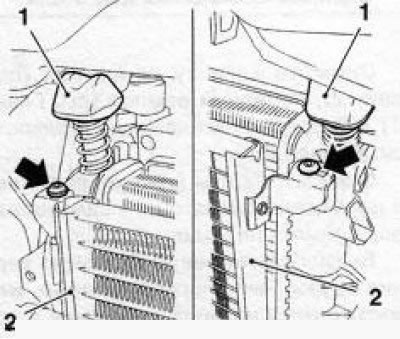
7.4 Upper spring supports (1) of the radiator - the bolts securing the condenser to the radiator are indicated by arrows: 2. Capacitor
5. Loosen the mounting clamps, disconnect the overflow hose from the expansion tank, the upper radiator hose from the thermostat housing and the lower cooling system hose from the radiator.
Note: When removing the lower hose, some coolant may leak out; place a suitable container underneath.
6. Disconnect the connector (see illustration 6.4) wiring of the cooling system fan control module.
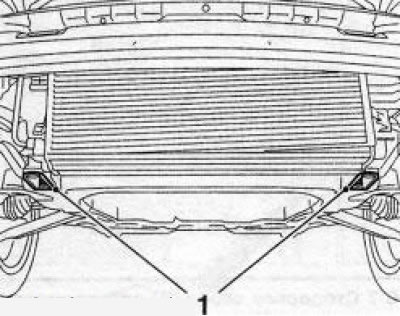
7.7 Lower holders (1) of the engine cooling system radiator
7. Tilt the radiator back and remove the mounting bolts (see accompanying illustration) lower radiator holders.
8. Carefully remove the radiator from the engine compartment from below. Loosen the mounting clamps and remove the overflow and upper cooling system hoses from the radiator.
9. If necessary, remove the fan housing from the radiator (see Section 6) upper spring supports.
Examination
10. After removal from the vehicle, the radiator can be checked for signs of leaks, damage and violations of the internal permeability of the heat exchanger.
11. Insect and vegetation debris can be removed from the space between the heat exchanger plates by blowing them out with compressed air (don't forget to wear safety glasses!), or cleaning with a soft brush. Try not to bend the thin heat exchanger plates or cut your fingers on them. If necessary, the radiator can be flushed before installation by spraying water from a garden hose (see Section 5).
12. Check the condition of the radiator rubber supports; if necessary, replace any faulty components.
13. Small leaks can be sealed with a suitable sealant (follow the product manufacturer's instructions). Any more complex repairs should be carried out only in a specialized workshop using the necessary equipment.
Installation
14. If the radiator is being replaced, reinstall all the attachments from the old radiator onto the new radiator and install the fan shroud.
15. Installation is carried out in the reverse order of dismantling the components. Upon completion of the work, fill the cooling system (see Section 3), remove air and make sure the system is tight.
Features of the Z19DT(H) engine
16. Loosen the 2 clamps securing the upper charge air pipe.
17. Release the vacuum line from the holders on the fan housing.
18. Unscrew the bolt securing the lower charge air pipe.
19. Remove the engine crankcase guard (see Chapter 2).
20. Remove the headlight (see Chapter 12).
21. Remove 1 upper and 2 lower bolts securing the intake air duct housing.
22. Disconnect the receiver-dryer and tie it with wire to the body elements.
23. Remove 2 bolts and separate the charge air cooler (intercooler).
Features of Y20DTH/Y22DTR engines
24. Remove the battery cover caps
25. Press the latches and disconnect the connector (see accompanying illustration) wiring of the cooling system control module.
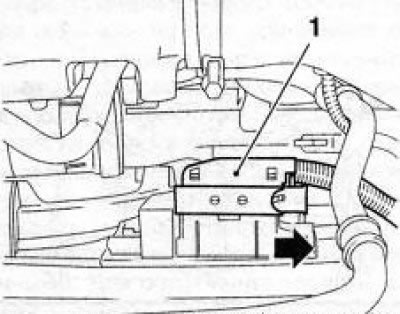
7.25 Connector (1) of the wiring harness of the cooling system control module - the arrow indicates the direction of pressing the lock (y20DTH/Y22DTR engines)
26. Remove the mounting bolt (see accompanying illustration) and disconnect the pipe from the charge air cooler (intercooler).
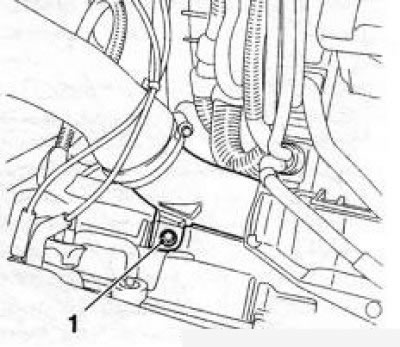
7.26 Loosen the mounting bolt (1) and disconnect the pipe from the charge air cooler (y20DTH/Y22DTR engines)
27. Loosen the 2 mounting clamps and remove the hose (see accompanying illustration) turbocharger.
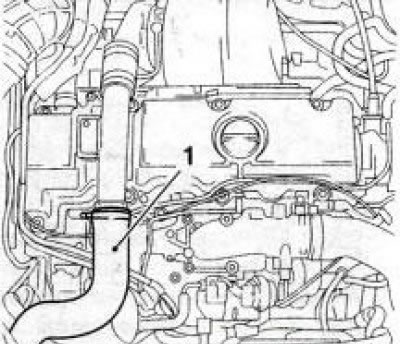
7.27 Turbocharger hose (1)(y20DTH/Y22DTR engines)
28. Loosen the 2 fastening clamps and remove the connecting hose (see accompanying illustration) air intake tract. Remove the 2 mounting bolts and remove the air intake tract pipe from the turbocharger.
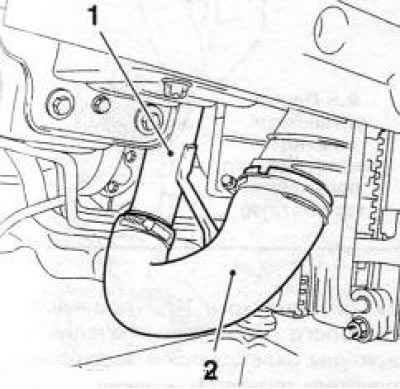
7.28 Connecting hose (2) and branch pipe (1) of turbocharger (y20DTH/Y22DTR engines)
29. Loosen the fastening clamps and remove the second connecting hose (see accompanying illustration) intercooler. Unscrew the lower mounting bolt, separate it from the intercooler and move the air intake pipe to the side.
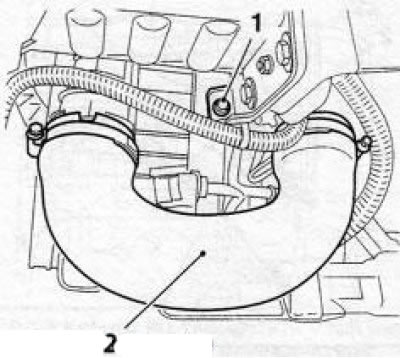
7.29 Intercooler connecting hose (y20DTH/Y22DTR engines)
30. Disconnect the lower coolant hose from the radiator.
31. Remove the lower radiator bracket mounting bolts and, with the help of an assistant, carefully remove the radiator assembly downwards from the engine bay. If necessary, remove the mounting bolts and the intercooler from the radiator.
32. Before installing the radiator, carefully place the intercooler in place and tighten the bolts to the required torque (see Specifications).
33. Further installation is carried out in the reverse order of removal.
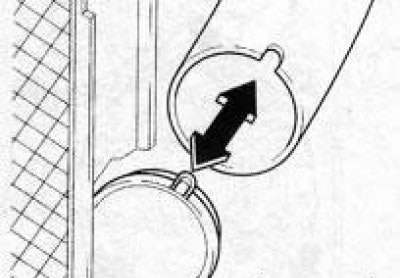
7.33 When installing the air intake hoses, it is necessary to align the protrusions of the pipes with the grooves on the hoses (y20DTH/Y22DTR engines)
Caution: When installing the air intake tract connecting hoses, make sure that the protrusions (see accompanying illustration) on the pipes they were aligned with the grooves on the hoses!
Features of the Z20NET engine
34. Remove the charge air intake hose and pipe.
35. Unscrew the intercooler (see accompanying illustration).
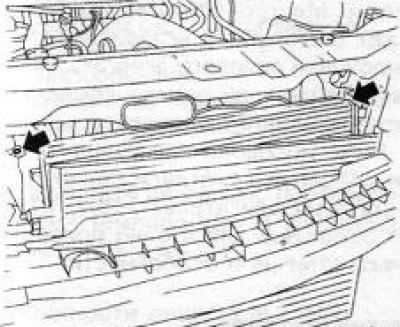
7.35 Bolts (indicated by arrows)intercooler mounts
36. Remove the battery protective casing covers, after disconnecting the cooling system hose
Features of Z22SE/ Z22YH engines
37. The only difference is in the tightening force of the bolts securing the lower holders (see Specifications).
Visitor comments