
OpelBook.ru
Cars AvtoVAZ Cars Mitsubishi Cars BMW Cars Mercedes Cars Nissan Cars Toyota Cars Chevrolet
English Русский
Български
Беларускі
Український
Српски
Hrvatski
Română
Polski
Slovenský
Magyar
 |  Sitemap  |  Contacts  |    


Main Astra Corsa Insignia Kadett Omega Vectra Zafira Others Articles
Corsa B (1993-2000) Corsa C (2000-2006, petrol) Corsa C (2000-2006)
  • Main
  • Corsa
  • Corsa B
  • Power unit
  • Cooling system
  • Removal and installation the cooling system radiator

Removal and installation the cooling system radiator (Opel Corsa B)

            0

Contents: Removal ⬇ Examination ⬇ Installation ⬇
Do not begin any procedures until the engine has cooled down completely.


Removal


Models without power steering and crankcase


On vehicles with automatic transmission, the oil cooler is built into the engine cooling system circuit. To remove, pinch the oil hoses near the radiator. Close the fittings and pipes with plugs to prevent oil leakage. After installing the radiator, fill the transmission with oil (see Chapter Vehicle settings and routine maintenance).


1. Drain the coolant into a clean container by disconnecting the lower hose from the radiator.

2. On gasoline engines remove the air intake sleeve.

3. On x14XE and X16XE engines remove the additional air pump.

4. On diesel engine remove the fan motor together with the fan cover.

5. Disconnect the electrical wiring connector of the fan electric motor (1) and the thermal switch (2).

Connectors for wiring of electric fan motor (1) and D/V temperature (2)
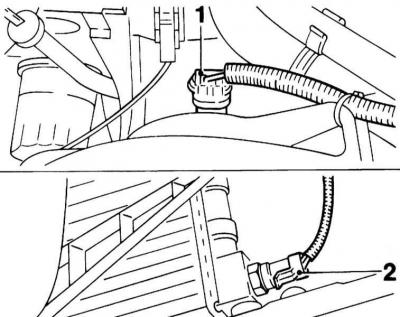
Connectors for wiring of electric fan motor (1) and D/V temperature (2)


6. Disconnect the upper radiator hose and the connecting hose going to the expansion tank.

Coolant hoses
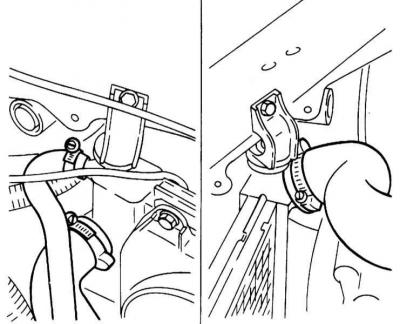
Coolant hoses


7. Loosen the mounting bolts and detach the radiator bracket.


Radiator Bracket Mounting Bolts
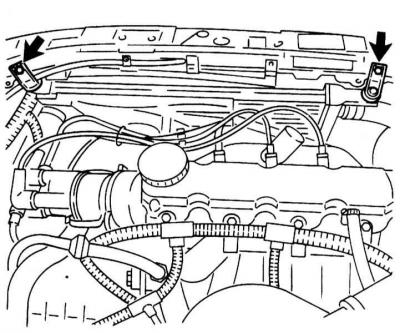
Radiator Bracket Mounting Bolts


8. Remove the radiator together with the fan upwards from the lower rubber supports.

9. If the radiator is being replaced, relocate the fan and thermal switch to the new radiator.

Features for cars with power steering and crankcase


1. Disconnect the wiring from the second thermal switch on the radiator.

2. Remove both thermal switches from the radiator.

3. Move the power steering fluid reservoir with the attached hoses to the side.

On 1.4L and 1.6L DOHC engines, carefully disconnect the high-pressure line from the power steering pump so that it can move slightly. To make room, tilt the high-pressure line toward the engine.


4. Remove the mounting bolts and detach the fan housing.

Examination


1. After removal from the vehicle, the radiator can be checked for signs of leaks, damage and violations of the internal permeability of the heat exchanger.

2. Insect and vegetation debris can be removed from the space between the heat exchanger plates by blowing with compressed air (don't forget to wear safety glasses!), or cleaning with a soft brush. Try not to bend the thin heat exchanger plates or cut your fingers on them. Before installation, the radiator should be flushed by spraying water into it from a garden hose (see Chapter Vehicle settings and routine maintenance).


3. Check the condition of the radiator rubber supports; if necessary, replace any faulty components.

4. Small leaks can be sealed with a suitable sealant (follow the product manufacturer's instructions). Any more complex repairs should be carried out only in a specialized workshop using the necessary equipment.

Installation


1. Installation is performed in the reverse order of dismantling the components. Please note the following points:
  • Make sure the rubber pads on the lower radiator supports are installed correctly;
  • Make sure all hoses are connected correctly and securely fastened with clamps;
  • Finally, fill the cooling system (see Chapter Vehicle settings and routine maintenance) and inspection of its components for signs of developing leaks.


This article is available at russian, bulgarian, belarusian, ukrainian, serbian, croatian, romanian, polish, slovak, hungarian
Checking the article: Trifonova Emilia

Share information:

Previous articles
Opel Corsa B: Cooling system
Next articles

Removal, installation and checking of the thermostat operation
Maintenance of the cooling system (emptying, flushing and filling)
Disconnecting and replacing cooling system hoses
Antifreeze — general information
General information and precautions
Engine Cooling System Specifications
Checking the proper functioning, removing and installing the cooling system fan
Checking the proper functioning of the coolant temperature sensor (ECT)
Checking the condition of the water pump
Removal and installation the water pump


See similar ones from other Opel car manuals:
▶ Removal and installation the cooling system radiator Opel Astra H (2004-2009)
▶ Removal and installation the cooling system radiator Opel Vectra C (2002-2008)
▶ Main electric fan (installed behind the cooling system… Opel Zafira A (1999-2005, petrol)
▶ Draining the cooling system Opel Insignia A (2008-2017)
▶ Carburetor engine cooling system Opel Kadett E (1984-1995)
Link to this page in different formats

Visitor comments


No comments yet


How much will 43 + 11 =


Corsa C (2000-2006) 
  • General information
  • Introduction to guide
  • Troubleshooting
  • Vehicle device
  • User manual
  • Maintenance
  • Power unit
  • Engine repair
  • Cooling system
  • Power and exhaust system
  • Control system
  • Engine electrical equipment
  • Transmission
  • Clutch
  • Mechanical gearbox
  • Automatic gearbox
  • Drive shafts
  • Chassis
  • Brake system
  • Wheel suspension
  • Steering
  • Body
  • Exterior
  • Interior
  • Doors and windows
  • Heating and air conditioning
  • Electrical equipment
  • Equipment and devices
  • Lamps and lighting
  • Electrical circuits
Corsa C (2000-2006, petrol) 
  • User manual
  • Car access
  • Governing bodies
  • Seat control
  • Heating and air conditioning
  • Driving and maintenance
  • Engines 1.0 and 1.2 l
  • Engine repair
  • Cooling and lubrication system
  • Injection system
  • Engines 1.4, 1.6 and 1.8 l
  • Engine repair
  • Cooling and lubrication system
  • Injection system
  • Transmission
  • Clutch
  • Mechanical gearbox
  • Automatic gearbox
  • Drive shafts
  • Chassis
  • Wheels and tires
  • Wheel suspension
  • Steering
  • Brake system
  • Body
  • Exterior
  • Doors and windows
  • Electrical equipment
  • Equipment and devices
  • Lighting system
  • Electrical circuits
Corsa B (1993-2000) 
  • General information
  • Introduction to guide
  • User manual
  • Maintenance
  • Power unit
  • SOHC gasoline engines
  • DOHC gasoline engines
  • Diesel engines
  • Engine repair
  • Cooling system
  • Supply system
  • Injection system (gasoline)
  • Injection system (diesel)
  • Exhaust systems
  • Control system (gasoline)
  • Preheat system (diesel)
  • Charge and launch system
  • Transmission
  • Mechanical gearbox
  • Automatic gearbox
  • Clutch and drive shafts
  • Chassis
  • Brake system
  • Front suspension
  • Rear suspension
  • Steering
  • Body
  • Ventilation and heating
  • Exterior
  • Interior
  • Doors and windows
  • Electrical equipment
  • Equipment and devices
  • Lamps and lighting
  • Electrical circuits
OpelBook.ru © 2017–2026 · Mobile version · · Sitemap: EN BG BY UA RS HR RO PL SK HU · Feedback · Site search
Astra F, petrol · Astra G, petrol · Astra G · Astra H · Astra J, petrol · Corsa B · Corsa C, petrol · Corsa C · Insignia A · Kadett D · Kadett E · Omega A · Omega B · Omega B2 · Vectra A, petrol · Vectra A · Vectra B, petrol · Vectra B · Vectra C · Zafira A, petrol · Frontera A, petrol · Frontera B · Ascona C · Vivaro A ·
We want your visit to be comfortable 🤝! We use cookies 🍪 to make that happen.