


Contents: Checking fuel pressure ⬇ Checking the injectors ⬇ Checking the Multec-S Throttle…⬇ Simtec Throttle Potentiometer Test ⬇ Checking the coolant temperature…⬇ Checking the intake air temperature…⬇ Checking the Multec-S Intake…⬇ Testing the Simtec hot-film air mass…⬇ Checking the lambda adjustment ⬇
The following sections describe tests of injection system components that you can perform yourself.
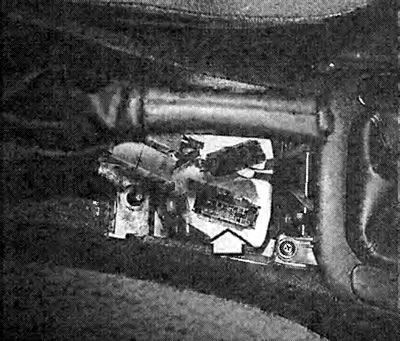
In our Vectra, the diagnostic socket (arrow) is located in the center console. After removing the trim, the diagnostic socket is visible under the handbrake handle.
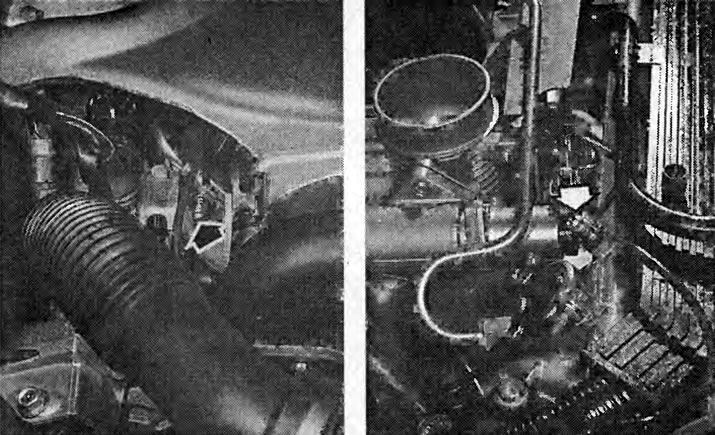
Checking fuel pressure: on the test connection shown here (left 16V 1.6 l, right 16V 1.8/2.0 l) the workshop uses measuring equipment to check the fuel pressure. If work needs to be done on the fuel system, this valve can be used to relieve pressure in the pipelines. To do this, press the valve pusher with a screwdriver - keep a rag handy.
Tip: When performing any work, remember that the fuel system remains under high pressure for a long time after the engine has been switched off. Therefore, before starting work on the fuel system, always release the pressure via the test connection on the fuel distribution line.
Checking fuel pressure
An accurate fuel pressure check can be performed using measuring equipment in a workshop.
Connect the test device to the fuel rail test connection.
Disconnect the vacuum hose at the fuel pressure regulator and plug with a suitable cap.
Start the engine and bleed the air from the control instrument.
Read the measurement value on the control device.
The required value is 3.0±0.2 bar.
Checking the injectors
If you suspect that one of the injectors is not working, you can first try to locate it by feeling it with your hand. Unlike the others, the inoperative injector does not vibrate. Although this test cannot be carried out on all injection systems due to their inaccessibility.
More in-depth checks require a voltage indicator with LEDs and an accurate ohmmeter.
Voltage check: strip the connecting wire to the injectors, see section "Removal injectors".
Where available, open the box with wires above the injectors.
Insert two thin needles into the connecting wires of the injector being tested. Connect the LED voltage indicator to the needles (do not use the test lamp!).
Start the engine: the voltage indicator LEDs should flash, otherwise there is no voltage or the control unit connecting to ground is faulty. This test cannot be performed with a measuring device.
Resistance check: expose the connecting wire to the injectors, see section "Removal injectors".
Loosen the fastening clamps on the injectors and, where applicable, remove the cable channel from the injectors.
Connect an ohmmeter to both valve contacts. When the engine is cold (control temperature is about 20°C), the measuring device should show 15 to 17 ohms.
If the value is outside the tolerance range, replace the injector.
Checking for leaks: remove the fuel distribution line together with the injectors, the fuel lines remain connected.
Paralyze the ignition, see chapter "Ignition system".
Have your assistant cycle the ignition on and off briefly to allow the fuel pump to operate and build up fuel pressure.
Observe the injectors: each one individually should release a maximum of two drops of gasoline per minute. Otherwise, replace the injector.
Regardless of this, you can check the injection stream and valve tightness if this is required by engine malfunctions.
Checking the injection jet: remove the fuel distribution line together with the injectors, the fuel lines remain connected.
Where available, reinstall the wire box onto the injectors.
Cover the injector holes in the intake manifold tightly.
Place a clean cloth under the injectors.
Have your assistant crank the engine with the starter.
Each nozzle should spray a uniform conical stream.
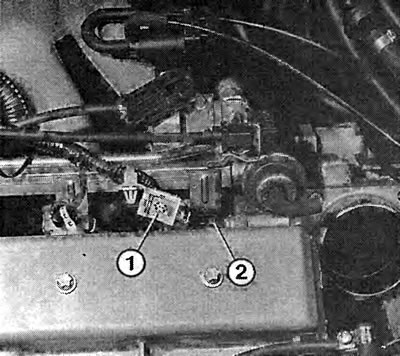
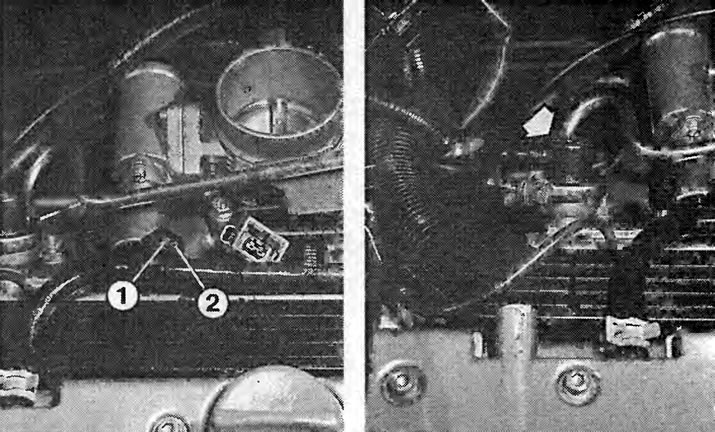
After disconnecting the wire connectors (1) on the 16V 1.6L engine or after opening the cable channel on the 16V 1.8/2.0L engine, you can check the voltage supply to the injection valves (2) using the LED indicator.
Checking the Multec-S Throttle Potentiometer
You can test the throttle potentiometer yourself as follows:
Expose the throttle potentiometer.
Disconnect the potentiometer connectors.
Connect an ohmmeter to the contacts being tested (pole markings are printed on the potentiometer).
If the specified values are not obtained, replace the potentiometer.

Simtec Throttle Potentiometer Test
You can test the throttle potentiometer yourself as follows:
ADD
up to 2 kOhm. Just before the full opening angle the device will show ∞ Ohm.
Take measurements on the remaining contacts, see table.
If the specified values are not obtained, replace the potentiometer.

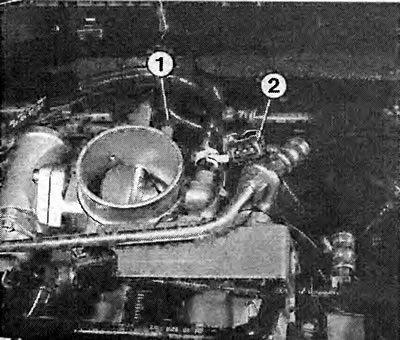
The photo shows the Simtec injection system of the 16V 1.8/2.0 l engine. The throttle potentiometer is marked with the number "1". "2" is the disconnected wire connector.
Left: Checking the idle speed control valve: Disconnect the wire connector on the idle speed control valve and connect a 6V charger to terminals "1" and "2" alternately. The plunger should extend and retract again. The photo shows the idle speed control valve of a 16V engine.
Right: The fuel pressure regulator (arrow) ensures constant fuel pressure. The photo shows the pressure regulator of the 16V 1.8/2.0 l engine.
Checking the idle speed control valve
Remove the idle speed control valve.
Disconnect the connector on the idle air control valve.
The idle speed control piston can be easily moved in and out with a light hand pressure.
Switch the charger to 6 V, and with the Multec-S ignition system, alternately connect to terminals "A" and "B" or "C" and "D". With the Simtec ignition system, alternately connect the charger to terminals "1" and "2". The plunger should extend and retract.
If so, the idle air control valve is OK. If not, replace it.
Those who do not trust the result, with the Multec-S ignition system can check the resistance of the regulator winding between terminals "A" and "B" or "C" and "D". It should be 55-65 Ohm (regulator cold) or 45-60 Ohm (the regulator is hot).
If a new regulator is being installed, make sure that the distance between the end of the plunger and the housing flange is not too large. If necessary, gently push the plunger in.
Insert the bolts with the safety mass and tighten.
Checking the coolant temperature sensor
With the built-in thermometer you can check the correct operation of the temperature sensor. The sensor in cars with Simtec is located on the DIS ignition module, and in cars with Multec-S - on the thermostat housing.

Disconnect the wire connector on the temperature sensor and unscrew the sensor. To do this, with Simtec, unscrew the DIS ignition module. Collect the leaking coolant in a container.
Hang the sensor in a pan of water, heat the water and connect an ohmmeter to the connector contacts.
Check the corresponding resistance values at the temperatures indicated above.
If the values match, the temperature sensor is OK.
Checking the intake air temperature sensor
The intake air temperature sensor is checked in the same way as the coolant temperature sensor.

To check, remove the sensor. To do this, disconnect the wire connectors on the temperature sensor.
Remove or unscrew the temperature sensor from the air intake hose.
Note the mounting position (Simtec): the flat side of the sensor must match the flat side on the air intake hose. With Multec-S, slide the rubber ring onto the sensor and mount the sensor.
Checking the Multec-S Intake Manifold Pressure Sensor
To accurately check the intake manifold pressure sensor, the Opel workshop uses a special vacuum pump.
Connect the voltage indicator to the intake manifold pressure sensor. To do this, insert the needle into the green wire (terminal "B"). Make sure that the needle does not hit uninsulated metal (ground).
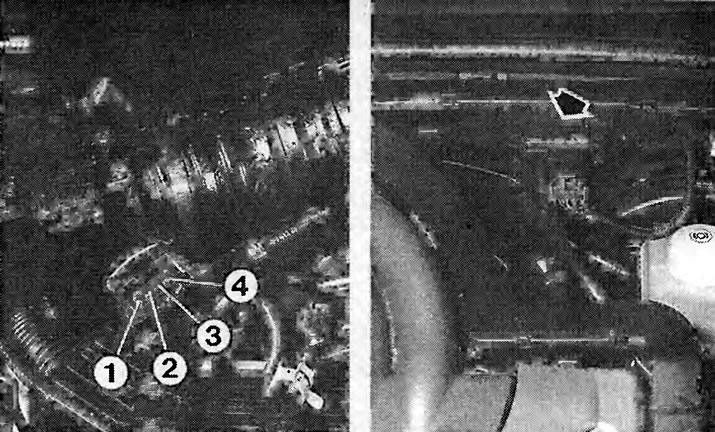
Left: Here we have designated the terminals of the contacts of the multi-pin connector of the hot-film air mass meter.
Right:The photo shows the air pressure gauge in the intake manifold of the 16V 1.6 l engine with the Multec-S injection system next to the brake booster. Read about the task it solves in the text on page 88.
Connect the positive terminal of the voltage indicator to the needle. Attach the negative terminal to ground.
Turn on the ignition.
The voltage indicator should show 4.2-5.3 V.
Start the engine and let it idle.
Voltage indicator now shows 0.52-1.7V
Increase the speed. The voltage value changes alternately up and down.
If the values match, then the intake manifold pressure sensor is OK.
Testing the Simtec hot-film air mass meter
The thermal anemometric film air mass flow meter has four connection terminals (see wiring colors in the section "Electrical diagrams"): "3" - voltage supply, "1" - ground connection, "2" and "4" - signal supply wires.
Actually, it is reasonable to measure the voltage supply only between terminals "1" and "3". There should be battery voltage there when the ignition is on. If not, the supply is interrupted. Do not disconnect the connectors for measurement, but "grab" them with a measuring needle.
To check the operation with the engine running at different speeds, the voltage value must be set at different heights on terminals "2" and "4", about which Opel does not provide information.
At idle (the engine is warmed up) this value should be 0.25-0.67 V.
Checking the lambda adjustment
For these purposes, a voltage indicator with a corresponding low measurement range is used, such as those available to amateur electronics enthusiasts.
Checking the voltage supply to the lambda probe: disconnect the lambda probe wire connector on the right rear of the gearbox flange. Connect a voltage indicator between the brown/gray signal wire (Multec-S) or yellow wire (Simtec) and ground.
Turn on the ignition. The voltage indicator should show 0.4-0.5 V. If the device shows nothing, then check the wire to the control unit along its entire length.
Checking the lambda probe: reconnect the wire connectors.
Warm up the engine.
Insert a needle into the probe signal wire. Connect a voltage indicator between the needle and ground.
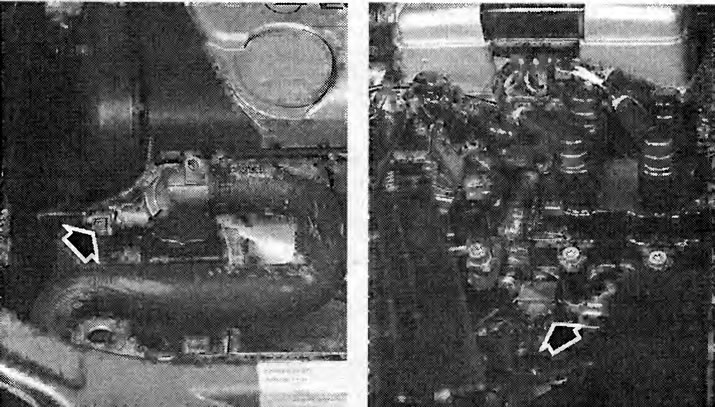
The coolant temperature sensor informs the injection system control unit about the current coolant temperature. The photo on the left shows the 16V 1.6L engine temperature sensor. On the right is the 16V 1.8/2.0L engine temperature sensor.
Make sure that the needle does not hit the ground (danger of short circuit).
Accelerate the engine to approximately 1500 rpm.
The voltage indicator should show short, steady voltage fluctuations between 0.1 and 0.9 V.
If only slow voltage fluctuations are observed, then the lambda probe heating or its power supply wire is faulty
No voltage fluctuations: the lambda probe is faulty (replace), the working mixture is constantly too lean or too rich (check the injection in the workshop), or the control unit is faulty (check in the workshop).
Checking the probe heating: Disconnect the lambda probe wire connector. Connect a voltage indicator between the voltage supply wire (red/blue wire) and mass (brown/gray wire) heating probe
Checking the probe heating: Disconnect the connector from the lambda probe. Connect a voltage indicator between the voltage supply wire (red/brown) and the ground wire (brown/gray) supplying heat to the probe.
Start the engine. The voltage indicator should show 12 V. If the voltage supply and ground connection are OK, but there is still only a slow voltage fluctuation (see previous text), the only possible source of malfunction remains the heating of the probe itself.
No voltage supplied to heater: check voltage supply from terminal 87 of fuel pump relay.
Tip: The main condition for a functioning lambda control is the correct basic idle setting, i.e. the CO content must be correct, otherwise the control will always be at one end of the control range. The same conditions arise if the working mixture is greatly depleted due to secondary air.
Visitor comments