


- Oil loss is often confused with consumption. Therefore, before criticizing oil consumption, you must first eliminate all illegal sources of oil loss.
- Anyone who fills the oil much higher than the upper mark on the dipstick automatically has increased oil consumption, since excess oil is blown out of the crankcase
- Thin oil burns faster than thick oil. If seasonal oil gets very hot, it flows "like water". On the contrary, all-season oil remains viscous and can reduce consumption when traveling, especially over long distances.
- Motor oil (first of all, all-season), which remains in the engine for too long, has a slightly increased need for topping up.
- A sharp driving style increases not only fuel consumption. In our experience, oil consumption also depends on the driver's preference for driving at high revs.
- The running-in process is not yet complete (minimum 5000 km)
- Engine defect; for example, defective valve stem gaskets, too much clearance between the guide and the valve stem, incorrectly installed or damaged piston rings, cylinder wall damaged by scoring on the piston.
Does the engine consume oil?
In winter, when driving short distances, it happens that the oil level rises instead of, as usual, slightly decreasing. This does not mean that you have discovered a new source of oil, but that the contents of the crankcase are diluted with fuel condensate, which - due to the over-enrichment of the fuel-air mixture - is forced past the piston rings. In this case, you smell gasoline in the oil even with the dipstick removed.
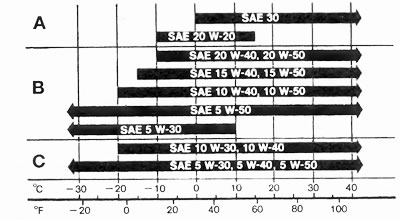
The graph shows the applicability of motor oils of different viscosities depending on the outside temperature:
"A" - seasonal oils;
"B" - all-season oils;
"C" - highly efficient and easy-flowing oils.
Due to this, the lubricating properties of the oil are significantly reduced. Additional oil change between the established intervals (often after just 3000 km of travel) is not a luxury, as it can save you from serious engine damage. Of course, there is no need to change the oil filter.
Text copied from this portal (www.opelbook.ru)
With a slight dilution of the oil, a long drive can restore the oil level and its lubricating properties. Oil temperatures above 100°C evaporate condensate particles in about half an hour. It is important to measure the oil level immediately! Due to evaporation, its level can drop significantly.
Visitor comments