


Contents: Maintenance work ⬇ Removal spark plugs ⬇ "Spark Plug Face" ⬇ Distance between electrodes ⬇
Maintenance work
The maintenance plan calls for replacing spark plugs every 30,000 km on 8-valve models and every 60,000 km on 16-valve models. This seems to us to be a realistic maintenance interval, with no reason to extend it. Particular attention should be paid to ensuring that the ignition system is in good working order, especially on vehicles with a catalytic converter.
Despite this, it is worth critically examining the removed spark plugs: in the next section, read about what the "face of the spark plug" says.
However: if the spark plugs are sometimes unscrewed for inspection, then, if possible, do not clean them by hand. This damages the insulating layer of the central electrode of the spark plug (steatite). But you can check the distance between the electrodes.
Removal spark plugs
To replace the spark plugs, you need an extended, narrow spark plug wrench with a jaw width of 16 mm. The workshop uses a special tool KM-194 B for this purpose.
16V: Remove the ignition wire cover mounting bolts.
Remove the ignition wire cover.
Install the spark plug connector removal tool and remove the connectors from the spark plugs upward. (The removal tool is located on one of the spark plug connectors.)
8-valve engine: Grasp the spark plug connectors and remove them from the spark plug pins. Do not pull on the spark plug wires.
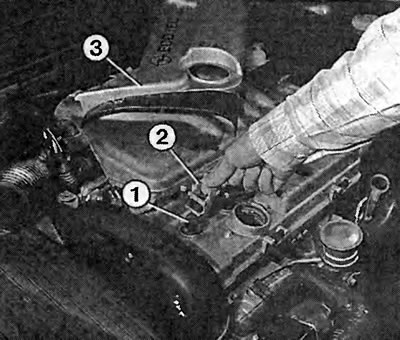
The photograph shows the removal tool (2) used to remove the spark plug connector (1) from the cylinder head of a 16V 1.6L engine. The number (3) indicates the coating on the spark plug wire.
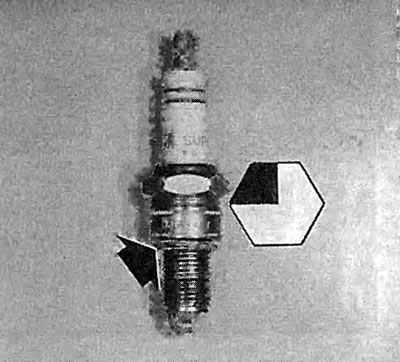
Spark plugs should be tightened to 25 Nm. If you don't have a torque wrench at hand: screw the plug in so that the sealing ring fits - the plug will not screw in any further by hand or with a spark plug wrench without applying force. Now use a spark plug wrench to screw in the new plug exactly a quarter of a turn more. A used spark plug is screwed in with a spark plug wrench by about 15 degrees, that's enough.
For all: Remove the spark plugs with a spark plug wrench.
Place the spark plugs in the order of the cylinders.
If the spark plugs are very tight, do not apply force, otherwise you may strip the spark plug threads in the light metal cylinder head.
Warm up the engine and then remove the spark plugs. Be careful not to burn your hands.
When installing, do not screw cold spark plugs into a heated cylinder head, otherwise they will then sit as if riveted.
Spark plugs should be tightened to 25 Nm. If you don't have a torque wrench at hand, tighten the spark plug so that the sealing ring fits - it will no longer be possible to tighten it without applying force by hand or a spark plug wrench.
Now tighten the new spark plug with a spark plug wrench exactly a quarter of a turn (= 90°), this is enough.
A used spark plug, the sealing ring of which is already flattened, can only be tightened by 15°.
Tips: To make the spark plug easier to screw in, you can scrape some graphite from a soft pencil onto the threads or coat them with a thin layer of copper grease. Oil or regular grease will bake the spark plug into the cylinder head threads.
A defective spark plug thread is not that bad! In such a case, the workshop inserts a special threaded bushing. The most well-known are the threaded inserts made of wire spiral from Bollhoff from Bielefeld.
"Spark Plug Face"
Spark plugs are, to a certain extent, witnesses of the combustion process in the engine. The appearance of the top of the plug (the "face of the plug") can determine how optimally the engine is working. Beforehand, you need to thoroughly warm up the Vectra on a country road or on the motorway. Checking after driving a short distance can lead to incorrect conclusions. Look at the top of the insulator with the central electrode and the side electrodes.
The top of the insulator is light gray or brownish: injection and ignition control are in order, the engine runs economically.
Heavy deposits: The cause may be additives in the engine oil or fuel, or increased oil consumption. Change the brand of oil and fuel.
Black deposits similar to soot: due to frequent movement over short distances, the spark plug does not reach the self-cleaning temperature, incorrect heat range, too high CO content.
The top of the insulator is whitish in color: the ignition timing is shifted too much towards the "advance" side, or the ignition timing adjustment or the detonation sensor is not working.
Melted areas on the central and side electrodes: glow ignition due to deposits in the combustion chamber, overheated valves, defective ignition timing, faulty knock sensor or heat stagnation due to insufficient cooling.
Destruction of the insulator tip, initially visible as hairline cracks: detonation combustion due to incorrect ignition timing, a defective knock sensor, insufficient engine cooling, or a lean fuel-air mixture due to secondary air.
Yellowish shiny layer on the top of the insulator: deposits formed due to additives in gasoline and motor oil, which, under a sharp full load on the engine, turned into a liquid state and became electrically conductive, and, as a result, ignition interruptions. When driving for weeks on short distances, you should not immediately subject the engine to full load.
Oil layer on the electrodes and inner surface of the spark plugs: defective piston rings, valve guides or valve stem gaskets.
If the spark plug does not show any special features in its appearance, but the engine starts poorly or jerks, the cause may still be in the spark plugs. When starting a cold engine, invisible cracks in the ceramic insulator can fill with fuel condensate, which diverts the spark. Spark plugs can also fail under pressure, although when dismantled, you can see how the spark jumps off.
Distance between electrodes
The fuel-air mixture and exhaust gases contribute to the corrosion of the metal electrodes of the spark plugs. And the high voltage during a spark breaks off the smallest particles of metal from them, as a result of which the distance between the electrodes of the spark plugs increases over time.
If the distance is too large, a higher ignition voltage is required, and this can lead to misfires. Sometimes the engine does not start at all. Therefore, you must adjust the distance between the electrodes in a timely manner. A template or a special template for spark plugs is used to measure the distance between the electrodes. Its thickness is 0.7-0.8 mm. If the distance is incorrect, then you need to carefully bend or approach the corresponding ground electrode accordingly.
Visitor comments