


Contents: Knock control function ⬇ Knock sensor ⬇
Detonation combustion of the fuel-air mixture due to the ignition timing being shifted too far in the direction of advancement is harmful to the engine. The consequences are overheating, damage to bearings and pistons.
On the other hand, the engine's power output is highest when the ignition timing is set as far ahead as possible, i.e. the engine operates hard at the detonation limit. This detonation limit is influenced by too many factors (fuel quality, deposits in combustion chambers, etc.), so that it can be determined accurately Therefore, with a traditional ignition setup, it is necessary to have a large "safety distance" or "observation post" that determines the detonation control if detonation combustion occurs.
Knock control function
Combustion in the cylinders is controlled electronically. For this purpose, a so-called detonation sensor is screwed onto the engine block at the height of the generator between the 2nd and 3rd cylinders. The sensor "feels" when combustion in the cylinders, instead of the usual uniform oscillations, gives a picture of uneven oscillations. The sensor transmits this information to the electronic control unit.
What happens there is this: when the signal "detonation combustion at the last ignition" is received, the next cylinders in line continue to receive the ignition timing calculated for them. But in the cylinder where detonation was detected, the ignition timing is shifted back by about 3°. As noted above, this only happens in one cylinder. In the others, the ignition timing calculated initially is retained. This is called "selective" ignition adjustment.
If detonation combustion in a given cylinder is maintained, then during the next working stroke the ignition timing is again shifted back by 3°. This can be done up to a maximum of 15° (the reference point is the specified theoretical ignition moment).
If ignition occurs normally again in the corresponding cylinder, then after a short time the ignition timing is again advanced. This is done by about 0.3°, then there follows a pause of several working strokes until the advancement of 0.3° occurs again.
This continues until the originally scheduled ignition timing is reached, or until the knock sensor again signals knock combustion.
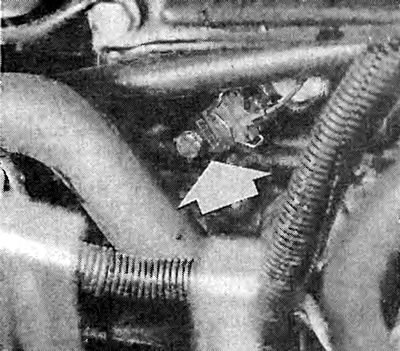
Shown here is the knock sensor (arrow), located on the right side of the engine.
Knock sensor
This sensitive element contains a piezoceramic part - a material that you know well from gas piezo lighters. Mechanical forces (stretching, pressure), acting on the piezoceramics, are converted by it into electrical voltage. To activate the sensor, uneven vibrations produced by detonation combustion are sufficient.
Visitor comments