
OpelBook.ru
Cars AvtoVAZ Cars Mitsubishi Cars BMW Cars Mercedes Cars Nissan Cars Toyota Cars Chevrolet
English Русский
Български
Беларускі
Український
Српски
Hrvatski
Română
Polski
Slovenský
Magyar
 |  Sitemap  |  Contacts  |    


Main Astra Corsa Insignia Kadett Omega Vectra Zafira Others Articles
Vectra A (1988-1995, petrol) Vectra A (1988-1995) Vectra B (1995-2002, petrol) Vectra B (1995-2002) Vectra C (2002-2008)
  • Main
  • Vectra
  • Vectra A
  • Power unit
  • Injection system
  • Diagnostics of faults in fuel injection systems

Diagnostics of faults in fuel injection systems (Opel Vectra A)

            0

Contents: Retrieving fault codes from memory ⬇ Checking system elements ⬇
When faults occur in the ignition and fuel injection systems, a control lamp lights up on the instrument panel. At the same time, the control computer switches to emergency mode and stores the code of the fault that has occurred. After the engine is stopped, this code can be read from the memory. For this, the Opel KM-602-2 diagnostic key and the Tech1 electronic device are used. If neither the key nor the device is available, the corresponding contacts of the diagnostic connector can be connected to each other using a piece of auxiliary wire.

Attention! When disconnecting the wires from the battery, all recorded fault codes are erased!


Retrieving fault codes from memory


Retrieving fault codes from memory


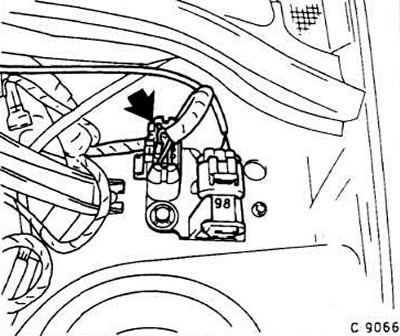
Remove the ALDL diagnostic connector (see arrow in fig.) from the socket. The ALDL connector is located behind the left shock absorber strut near the octane coding connector.
Remove the ALDL diagnostic connector (see arrow in fig.) from the socket. The ALDL connector is…


To recall a fault code from the computer's memory:


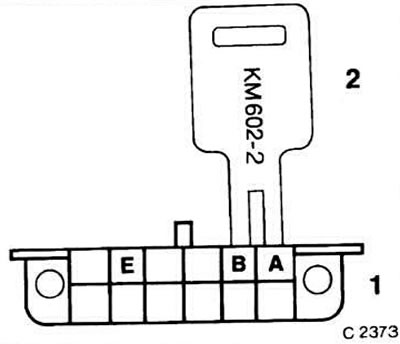
  • if you have a diagnostic key: insert the KM-602-2 key into the sockets of contacts A and B;
  • connect contact B with a piece of wire to the ground contact A.

Note: The contact designations are located on the connector body.


Warning! Contacts can be easily bent. Bad contacts in connections can damage the computer and cause memory failure. Therefore, it is necessary to pay special attention to the reliability of contacts.


Attention! Never connect terminal E ("+") to terminal A "ground", as this will cause a short circuit!


Turn on the ignition. The control lamp starts flashing, displaying the fault code.

The code is determined by a combination of flashes of the lamp and pauses between them. For example, code 131 is indicated as follows: a single flash, a pause, three quick flashes, a pause, a single flash, then a longer pause and a double repetition of the code.

First, code 12 is issued three times in a row, indicating that the code output mode is on (single flash, pause, two flashes, then (in 3 sec.) the code is repeated two more times).

After 3 seconds, fault codes start to appear (in the same way as described above).

Attention! The fault codes are issued in ascending order of their numbers. If only code 12 is issued, this means that there are no fault codes in the memory.


When the codes stop being issued, turn off the ignition.

Insert the diagnostic connector into the socket and put on the cover.

Attention! If the battery is disconnected from the vehicle's electrical system for more than 10 seconds, the fault codes in the computer's memory are erased. If the fault is not confirmed after 20 subsequent engine starts, the record of it is erased from the computer's memory.


Thus, if faults need to be erased from the memory (for example, after renovation), it is necessary to disconnect the ground wire from the battery for 10 seconds.

Checking system elements


The fault code indicates which element of the ignition system or injection system is faulty. To identify a specific fault, it is necessary to know the decoding of the codes of a specific ignition and injection system. Special diagnostic equipment is required to perform individual checks. Therefore, only general instructions for checking system elements are provided below. More complex work is carried out in specialized repair shops.

Attention! If the code indicates a faulty coolant temperature sensor, the fault may be in the computer itself. It can be established either by replacing the sensor or by conducting a series of tests using special equipment in a specialized workshop.


Disconnect the connector from the element whose malfunction is indicated by the code from the computer memory, check the connection for reliable contact, remove traces of corrosion (if any).

Check the reliability of the wire fastening in the connector.

Check the resistance of the element. In doing so, you should take into account (in case of low resistance of the element being tested) accuracy and internal resistance of the ohmmeter and its wires.

Check the integrity of the wires going to the computer using electrical diagrams. If the fault is "too low voltage", then first of all you should check the connection to the "ground", and if - "too high voltage", then this may be due to a wire break.


This article is available at russian, bulgarian, belarusian, ukrainian, serbian, croatian, romanian, polish, slovak, hungarian
Checking the article: Zinoviev Kirill

Share information:

Previous articles
Opel Vectra A: Injection system
Next articles

Multec injection system
Safety precautions when working with injection systems
Motronic injection system
Technical data of fuel injection systems
Fuel injection system fault codes
Checking, removing and installing the coolant temperature sensor
Checking, adjusting and replacing the throttle position sensor (Motronic system)
Removal and installation the lambda probe
Removal and installation the activated carbon filter
Checking the fuel pump relay


See similar ones from other Opel car manuals:
▶ Fuel injection systems Opel Astra F (1991-1998, petrol)
▶ The operating principle of fuel injection systems Opel Corsa B (1993-2000)
▶ Test sequence for determining faults in the fuel injection… Opel Kadett E (1984-1995)
▶ Diagnostics of diesel engine faults with Bosch fuel… Opel Omega B (1993-1999)
▶ Diagnostics and cleaning of fuel injectors Opel Insignia A (2008-2017)
Link to this page in different formats

Visitor comments


No comments yet


How much will 13 + 10 =


Vectra C (2002-2008) 
  • General information
  • User manual
  • Vehicle device
  • Maintenance
  • Troubleshooting
  • Power unit
  • Engine repair
  • Cooling system
  • Power and control system
  • Engine electrics
  • Transmission
  • Clutch
  • Car gearbox
  • Drive shafts
  • Chassis
  • Car suspension
  • Steering
  • Brake system
  • Body
  • Exterior
  • Interior
  • Doors, locks and windows
  • Heating and ventilation
  • Electrical equipment
  • Equipment and devices
  • Headlights and lighting
  • Electrical circuits
Vectra B (1995-2002) 
  • General information
  • User manual
  • Weekly checks
  • Maintenance (gasoline)
  • Maintenance (diesel)
  • Troubleshooting
  • Power unit
  • SOHC gasoline engine
  • DOHC petrol engine
  • Diesel engine 1.7 liter
  • Diesel engine 2.0 liters
  • Engine repair
  • Cooling system
  • Fuel system (gasoline)
  • Fuel system (diesel)
  • Charging system
  • Launch system
  • Ignition and preheat
  • Transmission
  • Clutch
  • Mechanical gearbox
  • Automatic gearbox
  • Drive shafts
  • Chassis
  • Brake system
  • Wheel suspension
  • Steering
  • Body
  • Exterior
  • Interior
  • Doors and windows
  • Heating and ventilation
  • Electrical equipment
  • Equipment and devices
  • Electrical circuits
Vectra B (1995-2002, petrol) 
  • General information
  • Maintenance
  • Help with malfunctions
  • Power unit
  • Engine repair
  • Exhaust system
  • Cooling system
  • Fuel system
  • Multec injection system
  • Four point injection
  • Transmission
  • Clutch
  • Gearbox and drive
  • Chassis
  • Wheel suspension
  • Steering
  • Brake system
  • Wheels and tires
  • Body
  • Exterior
  • Interior
  • Electrical equipment
  • Fuses and electronics
  • Power devices
  • Ignition system
  • Lighting and signaling
  • Equipment and devices
  • Heating and ventilation
  • Electrical circuits
Vectra A (1988-1995) 
  • Power unit
  • Engine repair
  • Ignition system
  • Lubrication system
  • Cooling system
  • Injection system
  • Fuel system (carburetor)
  • Fuel system (diesel)
  • Exhaust system
  • Transmission
  • Clutch
  • Car gearbox
  • Chassis
  • Front suspension
  • Rear suspension
  • Steering
  • Brake system
  • Wheels and tires
  • Body
  • Exterior
  • Interior
  • Electrical equipment
  • Electrical circuits
Vectra A (1988-1995, petrol) 
  • General information
  • User manual
  • Maintenance
  • Power unit
  • SOHC engine
  • DOHC engine
  • Cooling and ventilation
  • Fuel system (carburetor)
  • Fuel system (injector)
  • Exhaust converter
  • Transmission
  • Clutch
  • Mechanical gearbox
  • Automatic gearbox
  • Drive shafts
  • Chassis
  • Brake system
  • Car suspension
  • Steering
  • Body
  • Body elements
  • Electrical equipment
  • Power devices
  • Equipment and devices
  • Electrical circuits
OpelBook.ru © 2017–2026 · Mobile version · · Sitemap: EN BG BY UA RS HR RO PL SK HU · Feedback · Site search
Astra F, petrol · Astra G, petrol · Astra G · Astra H · Astra J, petrol · Corsa B · Corsa C, petrol · Corsa C · Insignia A · Kadett D · Kadett E · Omega A · Omega B · Omega B2 · Vectra A, petrol · Vectra A · Vectra B, petrol · Vectra B · Vectra C · Zafira A, petrol · Frontera A, petrol · Frontera B · Ascona C · Vivaro A ·
We want your visit to be comfortable 🤝! We use cookies 🍪 to make that happen.