


Contents: Disassembly ⬇ Repair of brushes and brush holders ⬇ Checking the rotor ⬇ Stator check ⬇ Checking the rectifier unit ⬇ Assembly ⬇ Replacing brushes ⬇
Bosch Generator Assembly Diagram
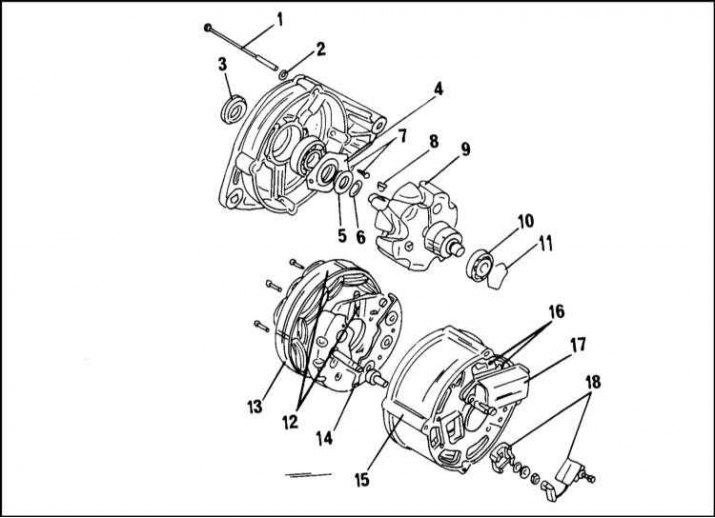
1 - Tie bolt; 2 - washer; 3 - distance ring; 4 - bearing mounting plate; 5 - ring; 6 - distance ring; 7 - bolt and spring washer; 8 - key; 9 - rotor; 10 - bearing; 11 - washer; 12 - stator with rectifier diodes; 13 - stator; 14 - rectifier block; 15 - generator housing; 16 - brushes; 17 - voltage regulator; 18 - Anti-jamming capacitor
Disassembly
1. According to the illustration. the following work is performed:
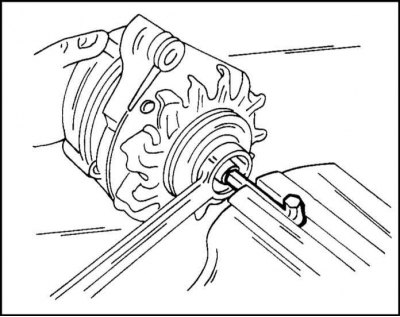
2. Unscrew the nut from the rotor shaft and remove the pulley and fan with the spacer washer from the shaft. You can keep the shaft from turning by placing an old belt over the pulley and clamping it in a vice. You can also insert a socket wrench into the shaft hole and loosen the nut with a spanner, as shown in the illustration. To remove the pulley, a two- or three-jaw puller is used.
3. Remove the key from the shaft.
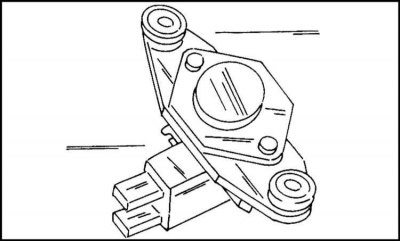
4. Disconnect the voltage regulator with the brush holder. The brush holder is located on the back side and is secured with two screws.
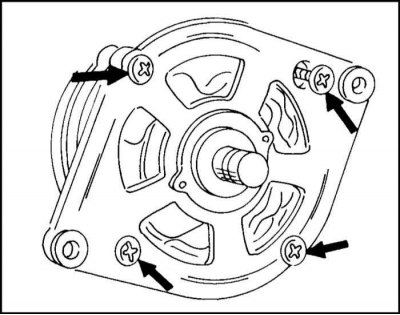
5. Mark the relative positions of the cover on the drive side and the generator housing and unscrew the tie bolts from the housing (arrows in the illustration.). Disconnect the rear bearing cover from the front cover. To do this, you can lightly tap the lid with a plastic hammer.
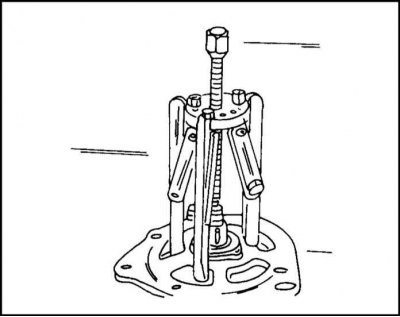
6. Place the drive side cover and rotor under a press and remove the rotor with a three-jaw puller as shown in the illustration. When pressing out, the bolts of the outer bearing mounting washer are torn off. It is necessary to ensure that the jaws of the puller are positioned under the washer, and not just under the cover. If it is necessary to remove the bearing from the cover, unscrew the bolts from the inside and press out the bearing.
7. Remove the bearing from the opposite end of the rotor. If a puller is used for this purpose, position its jaws under the inner bearing ring.
8. Unsolder the rectifier unit from the stator. To do this, use heat sink tweezers to clamp the wires between the stator and the soldering iron tip. The diodes must not overheat.
The rectifier block can only be removed if you have the necessary experience and tools.
Repair of brushes and brush holders
1. Check the quality of contact between the brushes and the slip rings. Check the freedom of movement of the brushes in the brush holder guides. If necessary, clean with Tri liquid.
If the protruding part of the brush is worn down to 5 mm (illustrated), it is necessary to replace the brush by unsoldering it.
Checking the rotor
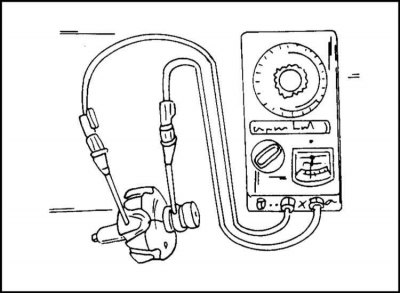
1. If the contact rings are greasy, they must be cleaned with a cloth soaked in Tri liquid. If there are any scratches, sand them with sandpaper.
To check the insulation of the rotor excitation winding, place one probe of the ohmmeter on the rotor core and the other probe on the slip ring. The ohmmeter should show "infinity". Otherwise, the rotor must be replaced (illustration).
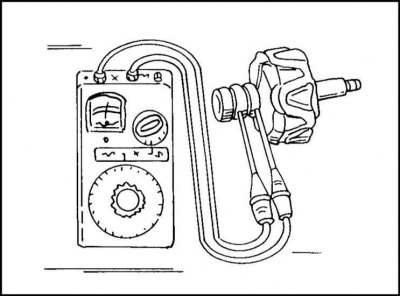
2. To check the rotor excitation winding for an open circuit, apply both ohmmeter tips to the slip rings. The device should show 2.6 - 2.8 Ohm. If the ohmmeter shows "infinity", then this indicates a break in the windings, if it shows "zero" - there is a short circuit (illustration).
Stator check
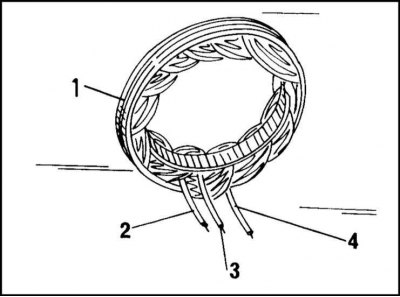
1. If there is a short circuit in the stator winding due to overheating, this can be determined visually. Such a stator must be replaced. Place one ohmmeter probe on the collector ring (1), and the other one in turn on each of the three stator terminals (2), (3), (4), (illustration).
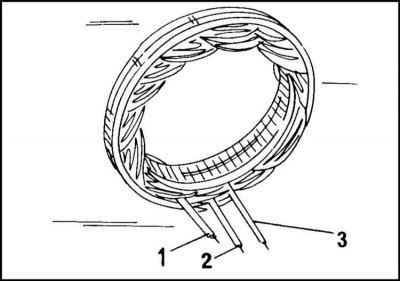
2. The device should show "infinity". To check the stator winding for a break, connect the stator terminals one by one. If the device does not give readings, this indicates a break (illustration). The winding resistance should be 0.10 - 0.11 Ohm.
Checking the rectifier unit
Accurate testing of the magnitude of the 45-pass voltage and the value of the blocking current of the diodes requires a special device and should be carried out in auto repair shops.
Assembly
1. The generator assembly diagram is shown in the illustration. "Bosch Generator Assembly Diagram". Press the bearing onto the rotor shaft. The bearing in the cover on the drive side is secured with an outer washer. After installing the cover on the drive side, a spacer ring (3) is pressed onto the end of the shaft. Before installing the generator on the car engine, it is necessary to test its operation on a stand.
Replacing brushes
1a. As a result of long-term operation, the brushes wear out, reaching the minimum permissible size. The brushes can be replaced without repairing the generator. However, it is not recommended to carry out this work on Delco-Remy generators, as this may cause certain difficulties. Here you need to remove the generator and take it to a car repair shop.
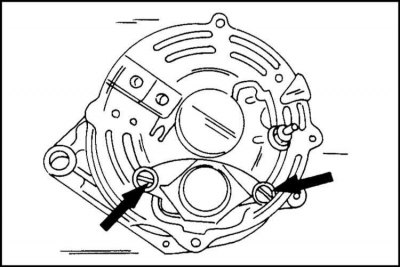
On a Bosch generator, this work can be done after removing the generator. However, this requires some soldering experience. Remove the two screws shown in the illustration from the back of the generator. arrows
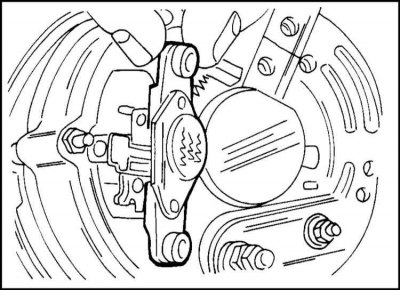
1b. Remove the assembly shown in the illustration. This is the brush holder and voltage regulator assembly.
2. Measure the length of the protruding part of the brushes. If the specified length is less than 5 mm or close to this size, the brushes must be replaced. If the length is sufficient, check the freedom of movement of the brushes in the brush holder guides. They should return back under the action of spring tension. If this does not happen, the brushes are also replaced.
3. To replace the brush, it must be unsoldered. To do this, take the brush cable with tweezers (for heat dissipation) and they give him something to drink.
Insert new brushes with springs into the brush holder guides. Check that the brushes are not jammed. If there is any sticking, clean the brush surfaces with fine sandpaper.
4. Solder the brush cable. Be careful not to let the solder run along the cable, as this will make the cable too stiff.
Wipe the contact rings through the holes in the generator with a rag soaked in gasoline and put the brush holders back in place. Make sure that the brushes fit onto the contact rings. Install the generator on the engine.
Note: Check carefully that the brushes are in place.
Visitor comments