


Contents: Checking the compression pressure in…⬇ Measuring engine oil temperature ⬇ Checking oil pressure ⬇
Checking the compression pressure in the cylinders
The results of the cylinder compression test allow you to determine the overall condition of the upper engine components (pistons, piston rings, valves, cylinder head gaskets, etc.) and qualitatively assess the degree of their wear. What is especially important is that the analysis of the information obtained as a result of the check allows us to narrow the range of possible causes of the compression drop in the cylinders, quite accurately linking the failure to malfunctions of very specific components, be it piston rings, valves, their seats or head gaskets.
The engine must be warmed up to normal operating temperature and the battery fully charged.
1. Start by cleaning the spark plug niches (blow them out with compressed air, a regular bicycle pump is a great source of air in this case). The main objective is to prevent debris from entering the cylinders during measurements.
2. On dOHC 1.0 engines and 1.2 l disconnect both ECU connectors and remove the ignition module.
In this case, the ignition must be turned off.
3. On dOHC 1.4 engines and 1.6 l remove the high voltage wire cover. To do this, remove the oil filler cap and then reinstall it.
4. Disconnect the spark plug connectors. For engines OHC 1.2 and 1.4 l special pliers are used (for example, HAZET 1849). When disconnecting connectors, you should only grasp the connectors themselves, but never the wiring. On engines DOHC 1.4 and 1.6 l the spark plug connectors are disconnected using a special tool located on one of the connectors. Unscrew the spark plugs with a special spark plug wrench.
5. On c14NZ engine disconnect the ignition coil multi-pin connector.
Multi-pin connector of ignition coil on C14NZ engine
Article posted on Internet portal (OpelBook)
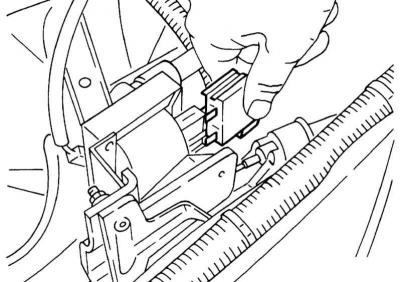
6. On all engines except C14NZ X10XE and X12XE disconnect the DIS ignition module multi-pin connector.
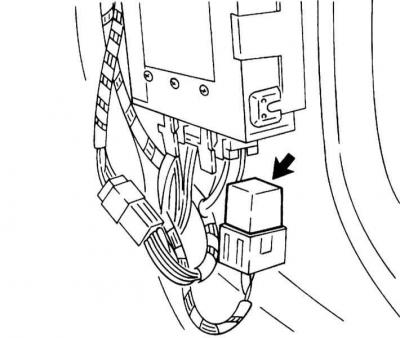
7. On petrol engines 1.2, 1.4 and 1.6 l remove the fuel pump relay (arrow). This eliminates the situation in which unburned injected fuel can enter the catalytic converter during engine start-up. The relay is located in the passenger compartment behind the A-pillar trim, on the bottom right. On diesel engines, disconnect the wiring from the switch on the high-pressure fuel pump.
Removal the fuel pump relay will allow you to de-energize the fuel system of the gasoline engine
8. Crank the engine with the starter to remove any remaining air-fuel mixture and soot.
First, shift the gearbox into neutral and set the parking brake. Do not lean over the engine to avoid injury from ejected soot particles.
9. Install the compression gauge into the spark plug hole of the first cylinder - it is preferable to use a threaded attachment rather than a clamp-type attachment for connecting the compression gauge. Do not forget to open the throttle valve fully during the test.
In diesel engines, the compression ratio is much higher than in gasoline engines, so to check the compression pressure, you will need a special compression meter with a measurement range of at least 40 atm. The compression meter with its adapter is screwed into the glow plug hole.
10. Ask an assistant to press and hold the gas pedal while performing the test.
11. Crank the starter for 4 seconds or as long as necessary to ensure that there are no pressure surges on the compression gauge. On a serviceable engine, the pressure should build up quickly enough. Low pressure on the first stroke, followed by a gradual increase on subsequent strokes, indicates wear of the piston rings. If the pressure does not rise with further cranking of the shaft, this can be regarded as evidence of valve leaks or a leak in the cylinder head gasket (the possibility of cracks in the head is also possible). Deposits on the valve head faces can also cause a decrease in compression pressure. Record the maximum compression gauge reading.
12. Repeat the procedure for the remaining engine cylinders. Compare the results with the standard requirements (see Chapter Engines). The number of revolutions of the crankshaft during the check should be not less than 300 rpm for gasoline engines and not less than 200 rpm for diesel.
13. If the measurement results are excessively low, pour a little engine oil into each cylinder through the spark plug hole (two to three teaspoons) and check again.
14. If adding oil increases the pressure, this indicates wear of the piston rings. If the compression does not increase, the reason for its decrease is valve leaks or a leak in the head gasket. Valve leaks may be associated with burnout of their seats, or deformation/burnout or mechanical damage to the working chamfers.
15. If the compression pressure is equally low in two adjacent cylinders, then with a high degree of probability we can speak about a violation of the integrity of the head gasket within its bridge between these cylinders. The presence of coolant in the engine oil will confirm this assumption.
16. If the pressure in one of the cylinders is approximately 20% lower than in the others and this is accompanied by a violation of the stability of the idle speed, the degree of wear of the cams of the corresponding valve drive on the camshaft should be assessed.
17. An unusual increase in compression pressure is usually the result of excessive carbon formation in the combustion chambers. In this case, the cylinder head must be removed for decarbonization.
18. If the measurement results are excessively low, or if the pressure distribution between the cylinders is not uniform, it would be useful to test the engine for leaks in a car service workshop. Such a test will allow you to accurately determine the source of the leak and assess its severity.
19. After completing the measurements, install all spark plugs/glow plugs and connect the electrical wiring to them.
20. Install all removed components in the reverse order of removal.
Checking the block for leaks
During this test, the speed of the compressed air pumped into the cylinders and the leak locations are determined. This test is an alternative to the compression test. Moreover, from many points of view, it is much more effective, since it is easier to visually identify the source of the leak than to understand the results of the compression measurement.
The equipment needed to check for leaks is not generally available, so this test will have to be entrusted to service center specialists.
Measuring engine oil temperature
To perform various adjustments, it is important to determine the engine oil temperature. The temperature should be measured at a distance of 1 cm above the oil pan.
1. To measure the temperature, insert the measuring probe into the guide of the engine oil level dipstick, rest it against the oil pan, and then lift it by 1 cm.
2. To prevent air from being sucked in through the dipstick guide, seal its opening with a rubber plug.
3. Oil temperature of 80 degrees and above corresponds to the engine operating temperature.
When the engine is overloaded, the oil temperature can reach 150 degrees.
Checking oil pressure
1. Warm up to operating temperature.
2. Turn off the ignition and disconnect the wiring from the engine oil pressure sensor.
3. Unscrew the oil pressure switch. It is located:
- on gasoline engines DOHC 1.0 and 1.2 l - on top of the cylinder head, above the water pump;
- on gasoline engines 1.2, 1.4 and 1.6 l - on the side of the oil pump, above the CKP sensor
- on diesel engines – on the end side of the engine, next to the oil filter.
D/V oil pressure of gasoline engines
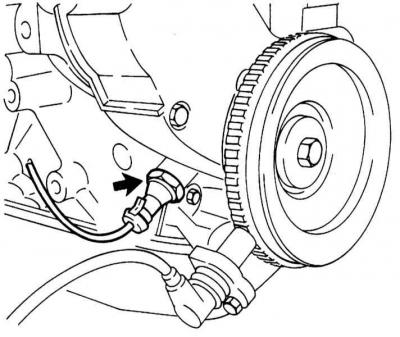
4. Screw the oil pressure gauge into the threaded hole D/V. Opel service stations use the KM-135 hose with the KM-498-V pressure gauge for this.
5. Start the engine and let it idle.
6. Read the pressure gauge readings and compare them with the Specifications in Chapter Engines. If necessary, check the oil circuit for leaks.
Remove the pressure gauge, install a new engine oil pressure gauge with a new copper gasket and tighten it with force 30 Nm. Connect the electrical wiring to the sensor.
Visitor comments