


Petrol engines
The in-line petrol engines are mounted transversely at the front of the car. The transmission assembly is located to the left of the engine and transmits the torque developed by the latter to the front wheels of the car.
The cylinder block is made of aluminum alloy and is equipped with dry-type liners.
Observe the prescribed tightening torques for threaded connections, as aluminum castings are soft materials and over-tightening component fasteners may damage the threaded holes!
The crankshaft rotates in main bearings equipped with plain bearings. Thrust half rings regulating the axial play of the shaft are installed on the central support of the shaft.
The connecting rods are mounted on the working journals of the crankshaft equipped with plain bearings and horizontally split lower heads. The connecting rods are attached to the pistons by means of piston pins press-fitted into their upper heads - the pins have a floating fit in the pistons. The pistons, cast from aluminum, are equipped with three piston rings - two compression rings and one (lower) oil scraper ring.
The camshaft rotates in a bed mounted on top of the cylinder head and is driven from the crankshaft by means of a rubber toothed belt (the same belt is used to drive the water pump). DOHC engines use two camshafts, also driven by a rubber toothed belt. The eccentric cams of the camshaft act on the valve drive levers, the working ends of which rest against the ends of the spring-loaded valve stems inserted into guide bushings and equipped with oil-deflecting caps. The opposite ends of the levers rest against hydraulic compensators, which automatically select valve clearances.
The engine lubrication system is powered by a gear oil pump driven by the crankshaft journal. Oil is drawn in through a mesh-filtered oil intake from the engine oil pan and is filtered by a full-flow replaceable oil filter. Oil moves through oil flows provided in the block casting and is distributed in two main directions: to the crankshaft and camshaft bearings. Oil is supplied to the bearings under pressure through special holes in the shaft bodies. Lubrication of the camshaft cams and valve components, as well as other internal engine components, is carried out by splashing.
General diagram of the functioning of the engine lubrication system
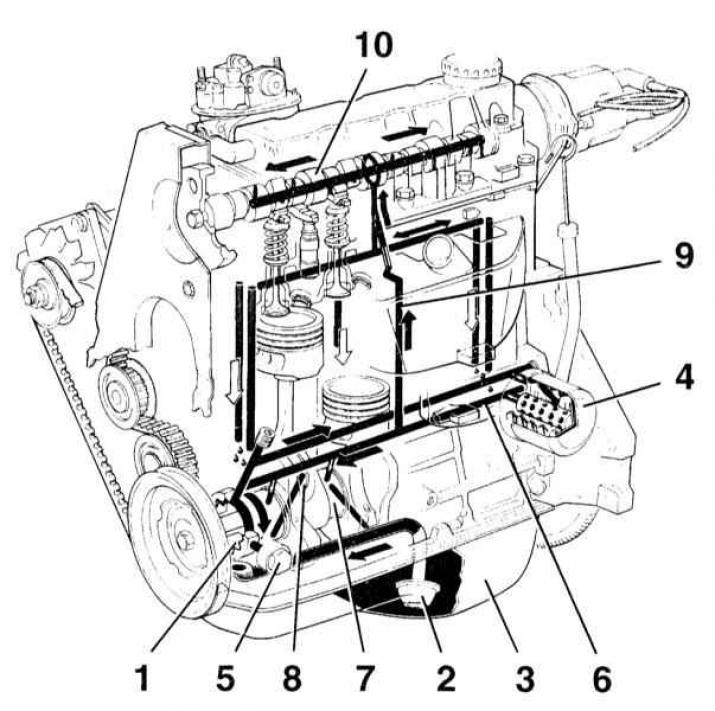
1 - Gear (rotary) oil pump
2 - Oil intake
3 — Oil pan
4 - Full flow oil filter
5 — Pressure reducing valve
6 — Main oil flow
7 — Crankshaft main journal
8 — Crankshaft journal
9 — Oil flow for vertical oil supply
10 — Camshaft journal The crankcase gases are removed from the engine block using a semi-closed ventilation system. The gases are removed through the timing cover and enter the intake manifold via a special hose.
SOHC Diesel Engines
The engines are 4-cylinder in-line, 8-valve, single overhead camshaft (SOHC), mounted transversely at the front of the car. The transmission assembly is attached to the engine on the left and transmits torque to the front wheels.
The cylinder block is manufactured using cast iron casting with cylinders molded directly into its body (dry sleeve block).
The crankshaft rotates in five main bearings equipped with plain bearings. The thrust half rings regulating the axial play of the shaft are seated in the upper half of the central (third) support.
The connecting rods are mounted on the shaft with their lower horizontally split heads, equipped with plain bearings. The cast aluminum pistons are connected to the connecting rods by means of piston pins, freely floating in the upper heads of the connecting rods and secured in the piston bosses with retaining rings. Each piston is equipped with three piston rings - two compression rings and one (lower) oil scraper ring.
The intake and exhaust valves are spring-loaded and move in guide bushings pressed into the cylinder head.
The camshaft is driven from the crankshaft by means of a toothed belt and rotates directly in the cylinder head. The valves are driven from the camshaft by means of drive levers installed directly under the cams. Valve clearances are adjusted automatically by equipping the support posts of the drive levers with hydraulic compensators.
The lubrication system is organized similarly to that described above for gasoline engines, with the only difference being that in order to increase the intensity of piston bottom cooling, an oil sprayer is installed at the base of each cylinder in the block. To maintain normal oil temperature under increased loads, the engine is additionally equipped with an oil cooler.
All engines
List of repair works performed without removing the engine from the car
The following repairs can be performed without removing the engine from the vehicle:
- Compression check;
- Removal and installation the timing cover;
- Removal and installation the timing belt cover;
- Removal and installation of timing drive components (belt/chains, gears/sprockets);
- Removal and installation the camshaft and valve drive levers/tappets);
- Removal and installation the cylinder head;
- Removal and installation of pistons with connecting rods*;
- Removal and installation the oil pan;
- Removal, repair and installation of the oil pump;
- Removal and installation the oil cooler (with appropriate equipment);
- Replacing crankshaft seals;
- Checking the condition and replacing the powertrain suspension supports;
- Removal, condition check and installation of the flywheel/drive disk.
* Although after removing the cylinder head and the pan (without removing the engine) the possibility of dismantling the connecting rod and piston assemblies appears, this opportunity should not be abused due to the difficulties associated with the need to maintain cleanliness and carry out a number of preparatory procedures. In view of the above, a description of this procedure is given in Part General and major engine repairs.
Before starting work, thoroughly clean the engine compartment and the outer surfaces of the power unit using one of a wide range of special solvents. This treatment will prevent dirt from getting inside the engine.
If necessary, depending on the nature of the work to be done, the bonnet can be removed to provide free access to the components to be serviced (see Chapter Body), - to avoid accidental damage to the paintwork, cover the car fenders with special covers or just old blankets.
Visitor comments