


Contents: Removal ⬇ Installation ⬇
Removal
1. Set the parking brake, jack up the front of the vehicle and place it on supports, if equipped, remove the crankcase guard. Remove the air intake ducts and air cleaner housing (see Chapter Power and exhaust systems).
2. Drain the transmission oil (see Chapter Routine maintenance).
3. Remove the battery with the mounting tray (see Chapter Engine electrical equipment).
4. Disconnect the electrical wiring from the reverse light switch sensor (see Checking the proper functioning, removing and installing the reverse light switch sensor) and release it from the intermediate clamps on the gearbox housing.
5. In order to minimize the loss of hydraulic fluid from the clutch, clamp the flexible line connected to the manual transmission. Remove the retaining ring of the nipple connection on top of the clutch dome and disconnect the hose. Carefully squeeze the lock and place the retaining ring in its place in the connector. The sealing ring must be replaced without fail. Immediately seal the open ends of the tube and hose in order to minimize the hydraulic fluid and to prevent dirt from entering the system.
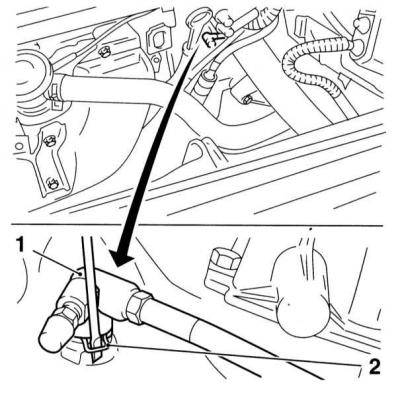
Do not depress the clutch pedal when the hose is disconnected!
6. Remove the exhaust pipe, catalytic converter and middle section of the exhaust system (see Chapter Power and exhaust systems).
7. On models equipped with F13, F17 and F18 manual transmissions, disconnect the shift rod assembly from the top of the transmission case (see Removal and installation the gear shift mechanism). On models with F23 boxes, disconnect the cable ends from the tie rod assembly on top of the crankcase, unscrew the mounting bolt and move the cable support bracket to the side.
8. Remove the drive shafts (see Chapter Clutch and drive shafts).
9. Hang the power unit on a rod placed in the mudguard grooves and remove the front subframe (see Chapter Suspension and steering).
10. Support the transmission with a trolley jack - to distribute the load, place a wooden block between the jack head and the manual transmission housing.
11. Remove the mounting bolts and separate the front powertrain suspension bracket from the clutch dome.
12. Unscrew the six mounting bolts and remove the left support bracket from the gearbox housing and remove the bracket. Gradually release the hoist and lower the rear of the transmission by approximately 5 cm - make sure that the communication lines laid underneath are not pinched (hoses and wiring).
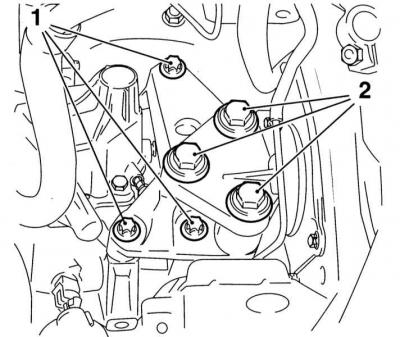
13. On models with a stamped steel oil pan, unscrew the clutch cover and remove it from the base of the crankcase.
14. Remove the upper and lower transmission-to-engine mounting bolts - try to remember the location of the bolts and the support brackets they secure. Make sure once again that all communication lines are disconnected and that nothing interferes with removing the transmission.
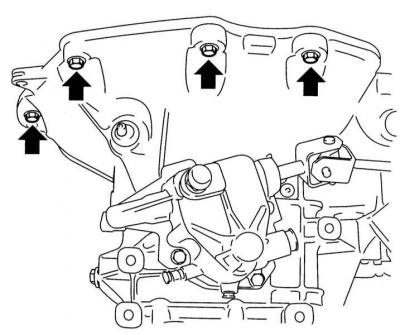
15. After moving the jack with the transmission secured to it, separate the clutch dome from the engine block - make sure that the dome is completely removed from the guide bushings; if the bushings are loose, remove them and put them in a safe place.
Installation
Installation is carried out in reverse order. Please note the following points.
1. Before installation, make sure that the guide bushings are seated in their sockets.
2. Tighten all fasteners to the required torque.
3. Before installing the drive shafts, replace their seals (see Replacing oil seals).
4. Install the front subframe in accordance with the recommendations (see Chapter Suspension and steering).
5. Do not forget to replace the sealing ring of the union nut of the clutch hydraulic drive hose, check the reliability of the hose fixation and bleed the hydraulic drive (see Chapter Clutch and drive shafts).
6. Fill the manual transmission with the required amount of transmission oil of the required type (see Chapter Routine maintenance).
7. Finally, adjust the gear shift mechanism (see Adjusting the gear shift drive).
Visitor comments