


Contents: Removal ⬇ Installation ⬇
Note: This is a fiddly job and in many cases it is easier to remove the transmission together with the engine as described in chapter 2. If you are removing the gearbox separately, we recommend that you read this section carefully before you begin. During assembly, you will need to replace various parts, appropriate equipment to support the engine, and a special tool to engage the gearbox input shaft with the clutch.
Removal
Disconnect the negative battery terminal.
While working in the engine compartment, loosen the shift lever rod and linkage mounting bolt, then pull the shift lever tube toward the engine bulkhead to disconnect it from the linkage.
With the clamp removed, disconnect the clutch cable from the release lever, pushing it back toward the bulkhead if necessary to disengage the cable. Remove the cable retainer from its bracket on the transmission case, then position the cable out of the way.
Disconnect the reverse light switch wire above the left front transmission case bracket.
If necessary, disconnect the wire from the vehicle speed sensor.
Unscrew the clamp sleeve and disconnect the speedometer cable from the top of the transmission.
Remove the three upper engine-to-gearbox mounting bolts, noting the location of the brackets or clamps.
Now the engine needs to be suspended from the left bracket. The ideal option would be to attach it to a strong wooden or metal beam resting on blocks securely fixed in the channels on the sides. A special branded device is used for this.
Raise the front of the vehicle and support it securely with stands under the drive axle so that the transmission can be removed.
On twin cam engines, remove the lower engine splash shield.
Once you are sure the engine is secure, remove the front suspension subframe.
Drain the oil from the gearbox.
Now you need the appropriate tool to remove the inner ends of the axle shafts from the differential. A flat steel rod with a rounded end can be used to remove the right-hand drive shaft. On some models, a square rod will be needed to remove the left-hand drive shaft.
Insert a pry bar between the drive shaft and the differential housing to remove the snap ring. Oil may leak even if the gearbox oil is drained. Do not allow the drive shafts to hang down under the weight, so tie them up.
If necessary, loosen the lock nut and disconnect the flat ground wire from the transmission end cover.
With a container underneath to collect the oil, unscrew the bolts and remove the cover. Remember the location of the bolts (and studs), as two sizes of bolts are used.
Remove the gasket.
Remove the retaining ring from the end of the transmission input shaft using special pliers.
Using a wrench, loosen the bolt from the end of the drive shaft.
Now the shaft can be disengaged from the splined hub of the friction disk of the clutch. Special tools KM-556-1-A and KM-556-4 are used, however, it is also possible to use homemade devices (for more details, see. chapter 6).
You can also screw an M7 bolt into the end of the drive shaft and use it to pull the shaft out until it stops.
Place a jack under the gearbox and place wooden blocks underneath to distribute the weight evenly.
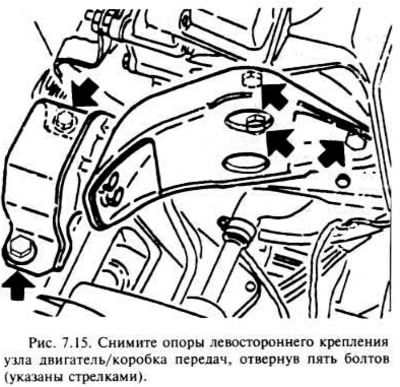
Remove the left-hand engine/gearbox assembly mounting supports by unscrewing the two bolts securing the gaskets to the vehicle body and the three bolts securing the bracket to the gearbox.
Loosen the bolts and remove the cover from the base of the conical clutch housing.
Once you are sure that the gearbox is properly secured, remove the remaining engine and gearbox mounting bolts.
Now the gearbox can be lowered and pulled out from under the front of the car. This is easier to do with outside help.
Installation
Before installation, make sure that the two old bolts for the left-hand engine/gearbox assembly to the car body rotate freely in the threaded holes in the body. If necessary, cut a new thread with an M10x1.25 mm tap.
Begin installing the gearbox under the front of the car, securing it to the jack using wooden blocks, as during removal.
Raise the transmission enough to allow the lower engine/transmission mounting bolts to be installed, then install them but do not tighten them.
Install the left-hand engine/transaxle mounts using two new gasket-to-body bolts. Tighten all bolts to the specified torque.
Tighten the previously installed engine/transmission assembly bolts to the specified torque, then move the jack away from under the transmission.
Now the drive shaft of the gearbox must be pushed through the hub of the friction disk of the clutch until it enters the centering bearing at the end of the crankshaft. In no case should the shaft be driven into place with a hammer, this can lead to damage to the gearbox. If the drive shaft cannot be inserted manually, it is necessary to apply pressure to the end of the shaft. There is a special tool for this purpose, N KM-564, but another device can also be used.
Install the bolt onto the end of the drive shaft, install a new retaining ring.
Install the transmission end cover with a new gasket and tighten the bolts to specification. Check the installation of the ground wire stud to ground.
If necessary, connect the ground wire to the transmission ground and install the lock nut.
Install the flat cover onto the base of the cone-shaped clutch housing and tighten the bolts.
Install new snap rings onto the inner ends of the drive shafts, pushing them into the differential housing as far as possible.
Install the front suspension subframe and then the front wheels.
Retract the lifting equipment and lower the vehicle to the ground.
(Information taken from the website: OPELBOOK.ru)
Install the three upper engine-to-transmission mounting bolts and tighten to specification.
Connect the speedometer flexible shaft and clamping sleeve.
If necessary, connect the wire to the vehicle speed sensor.
Connect the wire to the reverse signal switch.
Install the clutch cable holder on the gearbox housing, connect the cable to the clutch release lever and adjust the cable stroke. Make sure the cable is positioned the same as before removal.
Connect the shift fork rod to the linkage, adjust it before tightening the bolt.
Fill the gearbox with oil.
Connect the negative battery terminal.
Visitor comments