


Warning: Brake fluid used as a working fluid in the clutch drive path is toxic and chemically aggressive and destroys the paintwork when in contact with body panels. Before starting the procedure, cover the fenders and front panel of the car with special covers or just old blankets. Bleed the brake system wearing safety glasses. If brake fluid accidentally gets into your eyes, rinse them immediately with plenty of water and seek medical help!
Caution: Even the slightest amount of mineral oil in the brake fluid will cause the clutch to fail!
1. The hydraulic clutch release drive must be bled each time its components are removed, and also when the fluid level in the reservoir drops so much that air gets into the master cylinder. When bleeding, use only fresh brake fluid of the required grade (DOT-4). Make sure that the union connections of the clutch hydraulic circuit are tight.
Attention: Do not reuse liquid that has been pumped out of the system, or liquid that has been stored for a long time in a loosely closed container!
2. Bleeding of the hydraulic circuit is performed through a special connection using a set of special equipment that is used for bleeding the working brake system.
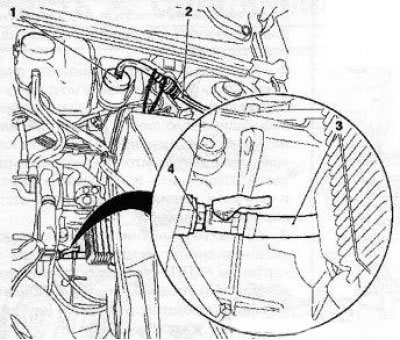
4.2 Connecting the clutch bleeding kit: 1. Adapter; 2. Device MKM-6174-2; 3. Device MKM-6174-1; 4. Bleeding coupling
Attention: Manual bleeding of the drive on models equipped with ABS is not allowed! The general connection diagram of the kit is shown in the accompanying illustration - before using the kit, carefully read the operating instructions. The bleeding equipment must withstand an internal pressure of at least 2 bar.
3. On models equipped with Y30DT/Z20NET/Z19DT(H) engines, first remove the battery with the tray (see Chapter 5). Remove the master cylinder reservoir cap and fill the reservoir with fresh hydraulic fluid, bringing its level to the MAX mark. Connect a special adapter to the reservoir (see illustration 4.2) and attach the MKM-6174-2 device to it - lower the free end of the hose into a suitable drain container. Remove the protective cap of the bleeding connection and attach the MKM6174-2 device to it. Attach the other end of the device to the bleeding device.
4. Turn on the pumping device, turn the coupling (see illustration 4.2) 2-3 turns, this will open the bleeding valve. Continue bleeding until air bubbles stop coming out of the drain hose. Manually tighten the coupling, turn off the bleeding device and remove the adapter from the brake fluid reservoir.
5. If necessary, bleed the hydraulic line between the coupling unit and the clutch slave cylinder by connecting the MKM-6174-2 device to the MKM-6174-1 and lowering the free end of the hose into a drain container with brake fluid. Ask an assistant to fully depress the clutch pedal and hold it in the pressed position. After unscrewing the coupling, open the bleed valve until air/air bubbles come out of the tract. Manually tighten the coupling, and pull out and set the clutch pedal to the normal position. Wait about 5 seconds and repeat the above operation 4 more times.
6. After completing the procedure, tighten the coupling with a force of 5 Nm and remove all installed components. Remove traces of brake fluid leaks. Install the battery in place (if it was filmed). Check the proper functioning of the clutch drive, as well as all drive components for leaks.
Visitor comments