
OpelBook.ru
Cars AvtoVAZ Cars Mitsubishi Cars BMW Cars Mercedes Cars Nissan Cars Toyota Cars Chevrolet
English Русский
Български
Беларускі
Український
Српски
Hrvatski
Română
Polski
Slovenský
Magyar
 |  Sitemap  |  Contacts  |    


Main Astra Corsa Insignia Kadett Omega Vectra Zafira Others Articles
Zafira A (1999-2005, petrol)
  • Main
  • Zafira
  • Zafira A
  • Transmission
  • Clutch
  • Clutch release hydraulic drive — bleeding

Clutch release hydraulic drive — bleeding (Opel Zafira A)

            0

Bleeding should be performed after any repair of the clutch hydraulic drive that resulted in a breach of its tightness, as well as when removing the gearbox. It is impossible for air to enter the system without breaching the tightness of the system or draining the master cylinder reservoir to an unacceptable level. Therefore, if air enters the clutch release hydraulic drive during normal operation, it is necessary to check the hydraulic drive for leaks (see "Clutch - checking technical condition").

To complete the work you will need:
  • clear vinyl tube of suitable diameter;
  • brake fluid drain container;
  • clean brake fluid (see "Reference data");
  • special key for fittings or a 10 mm key.

We perform the work with an assistant.

Sequence of execution


1. Prepare the car for work (see "Preparing the car for maintenance and repair").

Warning! To prevent air from entering the brake hydraulics and disengaging the clutch during bleeding, make sure that the brake fluid level in the master cylinder reservoir does not fall below the MIN mark.


2. Remove the protective cap from the bleed nipple of the clutch hydraulic drive.
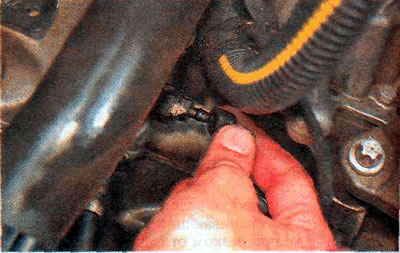
2. Remove the protective cap from the bleed nipple of the clutch hydraulic drive.


3. Connect the rubber tube to the bleed nipple.
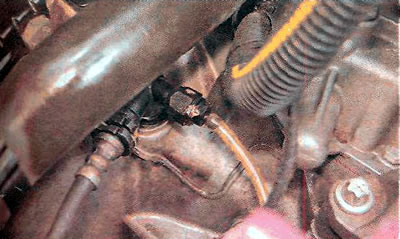


3. Connect the rubber tube to the bleed nipple.


4. Place the other end of the tube in a transparent container partially filled with brake fluid.

5. Ask the assistant to slowly press the clutch pedal several times and hold the pedal in the pressed position after the last press.

6. Using an 11 mm wrench, slightly unscrew the rolling nipple so that the liquid begins to come out of the tube, while the assistant continues to press the pedal.

7. After the brake fluid stops coming out of the tube, tighten the fitting.

Warning! Do not forget to periodically check the brake fluid level in the brake fluid reservoir.


8. Repeat the steps described in points 5-7 until the brake fluid with air bubbles stops escaping from the bleed nipple, after which we finally tighten the nipple.

Note: When replacing the brake fluid, continue bleeding until fresh brake fluid starts to come out of the bleed nipple (lighter). If after five or six repetitions air continues to come out of the tube and the number of air bubbles does not decrease, the system is not airtight! It is necessary to check the tightness of the system (see "Clutch - checking technical condition").


9. Remove the rubber tube from the fitting and put a protective cap on the fitting.


This article is available at russian, bulgarian, belarusian, ukrainian, serbian, croatian, romanian, polish, slovak, hungarian
Checking the article: Chernov Alexander

Share information:

Previous articles
Opel Zafira A: Clutch
Next articles

Clutch — checking technical condition
Clutch — design description
Clutch — reference data
Clutch Master Cylinder — Replacement
Clutch slave cylinder — check and replacement
Clutch — Checking and Replacing


See similar ones from other Opel car manuals:
▶ Bleeding air from the hydraulic circuit of the clutch… Opel Astra H (2004-2009)
▶ Bleeding air from the hydraulic circuit of the clutch… Opel Vectra C (2002-2008)
▶ Bleeding the hydraulic clutch drive (gearboxes — F13 / F17+… Opel Corsa C (2000-2006, petrol)
▶ Bleeding the clutch hydraulic drive Opel Insignia A (2008-2017)
▶ Hydraulic clutch release drive system Opel Omega B (1993-1999)
Link to this page in different formats

Visitor comments


No comments yet


How much will 44 + 11 =


Zafira A (1999-2005, petrol) 
  • General information
  • Governing bodies
  • User manual
  • Maintenance
  • Power unit
  • Engine repair
  • Control system
  • Cooling system
  • Exhaust system
  • Transmission
  • Clutch
  • Mechanical gearbox
  • Automatic gearbox
  • Front wheel drives
  • Chassis
  • Hubs, wheels and tires
  • Front suspension
  • Rear suspension
  • Steering
  • Brake system
  • Body
  • Maintenance and care
  • Exterior
  • Side doors
  • Climate control
  • Electrical equipment
  • Equipment and devices
  • Power devices
  • Lighting and signaling
  • Windshield wipers and washers
  • Electrical circuits
OpelBook.ru © 2017–2026 · Mobile version · · Sitemap: EN BG BY UA RS HR RO PL SK HU · Feedback · Site search
Astra F, petrol · Astra G, petrol · Astra G · Astra H · Astra J, petrol · Corsa B · Corsa C, petrol · Corsa C · Insignia A · Kadett D · Kadett E · Omega A · Omega B · Omega B2 · Vectra A, petrol · Vectra A · Vectra B, petrol · Vectra B · Vectra C · Zafira A, petrol · Frontera A, petrol · Frontera B · Ascona C · Vivaro A ·
We want your visit to be comfortable 🤝! We use cookies 🍪 to make that happen.