
OpelBook.ru
Cars AvtoVAZ Cars Mitsubishi Cars BMW Cars Mercedes Cars Nissan Cars Toyota Cars Chevrolet
English Русский
Български
Беларускі
Український
Српски
Hrvatski
Română
Polski
Slovenský
Magyar
 |  Sitemap  |  Contacts  |    


Main Astra Corsa Insignia Kadett Omega Vectra Zafira Others Articles
Vectra A (1988-1995, petrol) Vectra A (1988-1995) Vectra B (1995-2002, petrol) Vectra B (1995-2002) Vectra C (2002-2008)
  • Main
  • Vectra
  • Vectra C
  • Transmission
  • Clutch
  • Removal and installation the clutch master cylinder

Removal and installation the clutch master cylinder (Opel Vectra C)

            0

1. The clutch master cylinder is mounted to the rear bulkhead of the engine compartment.

2. Remove the battery with the tray (see Chapter 5).

3. Use a clamp to clamp the feed hose connecting the reservoir to the master cylinder.

Note: The hose should be pinched at a distance of about 5 cm from the cut of the end pulled onto the cylinder nipple. Immediately plug the hole in the cylinder to prevent dirt from getting into the tract.


4. Disconnect the connector (see accompanying illustration) wiring, unscrew the 2 mounting bolts and pull the ABS modulator out of the guides.
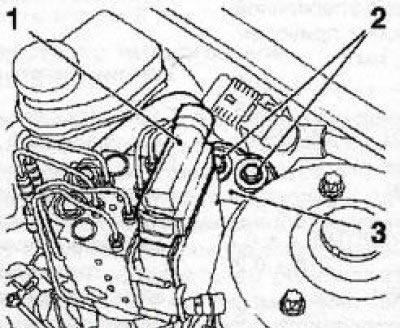
2.4 Removing the ABS modulator (3): 1. Electrical wiring connector; 2. Mounting bolts

2.4 Removing the ABS modulator (3): 1. Electrical wiring connector; 2. Mounting bolts


5. Thoroughly wipe the outside surface of the master cylinder and place a rag underneath it to collect any spilled brake fluid.

6. Remove the retaining ring (see accompanying illustration), release the clutch hydraulic line from the two intermediate holders and pull the hydraulic line together with the damper out of the master cylinder assembly, - to minimize the loss of hydraulic fluid, wrap the connector with a rag. Disconnect the feed line hose from the master cylinder. To prevent dirt from getting into the system, immediately lock the open ends of the lines and connectors.
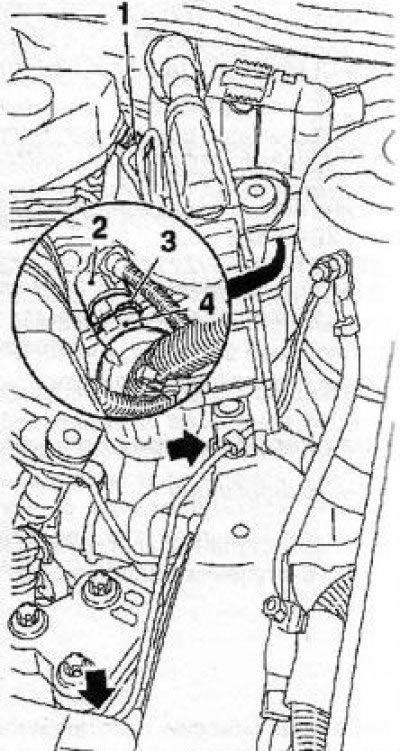


2.6 Removing the hydraulic clutch drive line - the intermediate holders are indicated by arrows: 1.…

2.6 Removing the hydraulic clutch drive line - the intermediate holders are indicated by arrows: 1. Power line; 2. Assembling the master cylinder; 3. Retaining ring; 4. Damper; Nut of the nipple connection of the hydraulic line


Caution: To avoid damage to the paintwork, do not allow brake fluid to come into contact with painted surfaces of body panels!


7. Remove the lower instrument panel trim under the steering column.

8. Remove the sensor switch (see sopr. an illustration) lock the master cylinder rod by installing the KM-6170 device into the recesses on the clutch pedal, insert the KM-6202 device into the hole on the KM-6170 device, squeeze the rod lock tabs and pull the clutch pedal towards you.
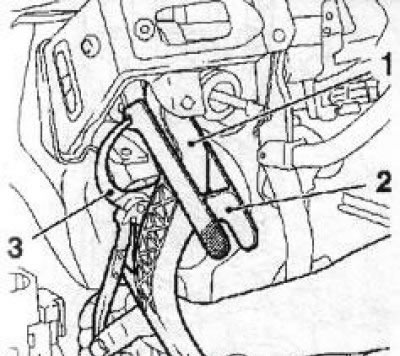
2.8 Installation of special devices KM-6170 (2) and MKM-6202 (3) for removing the clutch master…

2.8 Installation of special devices KM-6170 (2) and MKM-6202 (3) for removing the clutch master cylinder rod lock: 1. Clutch pedal


Note: The retainer can be removed and separated from the piston rod until the master cylinder is removed.


9. On diesel models, squeeze out the insulation (see accompanying illustration) to the side and secure it with a plastic wedge.
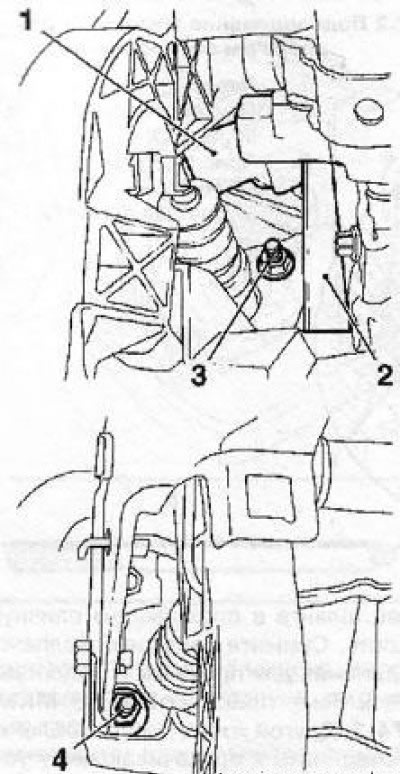
2.9 Nuts (3 and 4) for fastening the clutch master cylinder: 1. Isolation; 2. Plastic wedge

2.9 Nuts (3 and 4) for fastening the clutch master cylinder: 1. Isolation; 2. Plastic wedge


10. Remove the two nuts securing the master cylinder to the engine compartment bulkhead (see illustration 2.9). Go to the engine compartment and remove the master cylinder.

11. Installation is carried out in the reverse order of removal. Finally, "pump" the hydraulic circuit to remove air locks (see Section 4).


This article is available at russian, bulgarian, belarusian, ukrainian, serbian, croatian, romanian, polish, slovak, hungarian
Checking the article: Meshcheryakov Damir

Share information:

Previous articles
Opel Vectra C: Clutch
Next articles

Clutch specifications
Description of the clutch design
Removal and installation the clutch slave cylinder assembly with release bearing
Bleeding air from the hydraulic circuit of the clutch release drive
Removal and installation the clutch pedal
Removal, inspection and installation of clutch components


See similar ones from other Opel car manuals:
▶ Clutch Master Cylinder — Removal and Installation Opel Astra G (1998-2004, petrol)
▶ Removal and installation the clutch master cylinder Opel Corsa C (2000-2006)
▶ Replacing the clutch master cylinder Opel Insignia A (2008-2017)
▶ Clutch Master Cylinder — Replacement Opel Zafira A (1999-2005, petrol)
▶ Clutch master cylinder Opel Frontera B (1998-2004)
Link to this page in different formats

Visitor comments


No comments yet


How much will 33 + 32 =


Vectra C (2002-2008) 
  • General information
  • User manual
  • Vehicle device
  • Maintenance
  • Troubleshooting
  • Power unit
  • Engine repair
  • Cooling system
  • Power and control system
  • Engine electrics
  • Transmission
  • Clutch
  • Car gearbox
  • Drive shafts
  • Chassis
  • Car suspension
  • Steering
  • Brake system
  • Body
  • Exterior
  • Interior
  • Doors, locks and windows
  • Heating and ventilation
  • Electrical equipment
  • Equipment and devices
  • Headlights and lighting
  • Electrical circuits
Vectra B (1995-2002) 
  • General information
  • User manual
  • Weekly checks
  • Maintenance (gasoline)
  • Maintenance (diesel)
  • Troubleshooting
  • Power unit
  • SOHC gasoline engine
  • DOHC petrol engine
  • Diesel engine 1.7 liter
  • Diesel engine 2.0 liters
  • Engine repair
  • Cooling system
  • Fuel system (gasoline)
  • Fuel system (diesel)
  • Charging system
  • Launch system
  • Ignition and preheat
  • Transmission
  • Clutch
  • Mechanical gearbox
  • Automatic gearbox
  • Drive shafts
  • Chassis
  • Brake system
  • Wheel suspension
  • Steering
  • Body
  • Exterior
  • Interior
  • Doors and windows
  • Heating and ventilation
  • Electrical equipment
  • Equipment and devices
  • Electrical circuits
Vectra B (1995-2002, petrol) 
  • General information
  • Maintenance
  • Help with malfunctions
  • Power unit
  • Engine repair
  • Exhaust system
  • Cooling system
  • Fuel system
  • Multec injection system
  • Four point injection
  • Transmission
  • Clutch
  • Gearbox and drive
  • Chassis
  • Wheel suspension
  • Steering
  • Brake system
  • Wheels and tires
  • Body
  • Exterior
  • Interior
  • Electrical equipment
  • Fuses and electronics
  • Power devices
  • Ignition system
  • Lighting and signaling
  • Equipment and devices
  • Heating and ventilation
  • Electrical circuits
Vectra A (1988-1995) 
  • Power unit
  • Engine repair
  • Ignition system
  • Lubrication system
  • Cooling system
  • Injection system
  • Fuel system (carburetor)
  • Fuel system (diesel)
  • Exhaust system
  • Transmission
  • Clutch
  • Car gearbox
  • Chassis
  • Front suspension
  • Rear suspension
  • Steering
  • Brake system
  • Wheels and tires
  • Body
  • Exterior
  • Interior
  • Electrical equipment
  • Electrical circuits
Vectra A (1988-1995, petrol) 
  • General information
  • User manual
  • Maintenance
  • Power unit
  • SOHC engine
  • DOHC engine
  • Cooling and ventilation
  • Fuel system (carburetor)
  • Fuel system (injector)
  • Exhaust converter
  • Transmission
  • Clutch
  • Mechanical gearbox
  • Automatic gearbox
  • Drive shafts
  • Chassis
  • Brake system
  • Car suspension
  • Steering
  • Body
  • Body elements
  • Electrical equipment
  • Power devices
  • Equipment and devices
  • Electrical circuits
OpelBook.ru © 2017–2026 · Mobile version · · Sitemap: EN BG BY UA RS HR RO PL SK HU · Feedback · Site search
Astra F, petrol · Astra G, petrol · Astra G · Astra H · Astra J, petrol · Corsa B · Corsa C, petrol · Corsa C · Insignia A · Kadett D · Kadett E · Omega A · Omega B · Omega B2 · Vectra A, petrol · Vectra A · Vectra B, petrol · Vectra B · Vectra C · Zafira A, petrol · Frontera A, petrol · Frontera B · Ascona C · Vivaro A ·
We want your visit to be comfortable 🤝! We use cookies 🍪 to make that happen.