


In an emergency, the clutch disc can be temporarily centered with another suitable rod (with a steel finger, a round wooden stick, etc.).
Remove the gearbox.
First, loosen the 6 pressure plate mounting bolts only one turn to loosen the pressure plate.
If the flywheel rotates at the same time when loosening the bolts, insert a screwdriver into the flywheel teeth as a locking device.
Completely unscrew the bolts, remove the pressure and driven disks.
Wipe the flywheel with a rag soaked in gasoline.
Assess the wear of the driven disk:
There is still enough material on the lining or the brass rivets protrude dangerously far (most often, first from the pressure plate side)? Opel does not provide an exact amount of wear, so you have to rely on intuition.
There should be no one-sided wear of the linings, as well as no cracks.
Material copied from the portal OPELBOOK
Next, check the strength of the fastening of the coil springs and rivets of the lining.
Assess the wear of the pressure plate:
Are the wear marks on the tips of the disc spring deeper than 0.3 mm?
Are the tips of the disc spring exactly parallel to the rest of the pressure plate or do they have a recess on one side?
Are all the rivets still strong?
Are the leaf springs under the sealing ring OK?
Are there any cracks or nicks on the adjacent ring?
In addition, the ring should not be bent towards the center by more than 0.3 mm (apply a metal ruler). Otherwise, replace the pressure plate.
Check the small needle bearing at the rear in the middle of the crankshaft and the clutch release bearing of the central release module for ease of movement.
Clutch installation
Removing the clutch is a labor-intensive job. Therefore, each of the wear-sensitive parts, such as the driven disk, pressure plate and central release module, must be replaced at the slightest doubt about their functionality. Otherwise, there is a risk that the same work will have to be done again. Even better: install the entire clutch assembly as it is offered by parts stores.
Leaking engine or transmission oil can also quickly disable a new clutch. Therefore, pay attention to traces of oil in the clutch area and, if necessary, immediately replace the crankshaft or gearbox input shaft sealing rings.
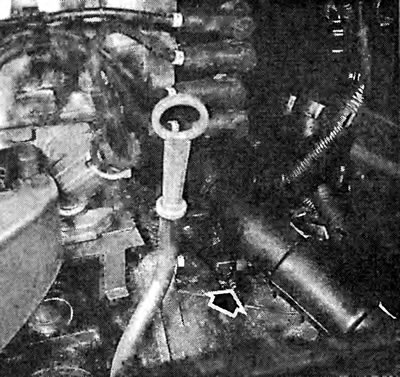
Bleeding the clutch hydraulics: Remove the dust cap from the bleed valve (arrow). Attach a suitable transparent hose to the valve and lower the free end of the hose into a container partially filled with brake fluid. Open the bleed valve and bleed the clutch hydraulics as described in the text on the opposite page.
Lubricate the gearbox input shaft in the tooth area with Molykote Longterm 2 grease.
Completely remove the anti-corrosion wax from the new pressure plate.
Place the driven disk on the flywheel so that the inscription is visible "Getriebeseite" — "gearbox side".
Place the pressure plate on the flywheel and loosely tighten the bolts.
Tighten the mounting bolts by hand and center the driven disk. It must be exactly centered on the flywheel so that the transmission shaft can be inserted later. Use a centering rod or auxiliary tool for this purpose.
Tighten the bolts one by one, at least in two stages. Tighten the M7 bolts to 15 Nm, M8 to 28 Nm.
Tip: New clutch linings do not immediately adhere to the entire friction surface due to the roughness of their surface. Therefore, they must be run in so that their opposing friction surfaces can rub in. This should be done by gently and softly engaging the clutch or even by grinding.
Visitor comments