
OpelBook.ru
Cars AvtoVAZ Cars Mitsubishi Cars BMW Cars Mercedes Cars Nissan Cars Toyota Cars Chevrolet
English Русский
Български
Беларускі
Український
Српски
Hrvatski
Română
Polski
Slovenský
Magyar
 |  Sitemap  |  Contacts  |    


Main Astra Corsa Insignia Kadett Omega Vectra Zafira Others Articles
Vectra A (1988-1995, petrol) Vectra A (1988-1995) Vectra B (1995-2002, petrol) Vectra B (1995-2002) Vectra C (2002-2008)
  • Main
  • Vectra
  • Vectra B
  • Power unit
  • Fuel system
  • Preheating of intake air

Preheating of intake air (Opel Vectra B)

            0

The air sucked into the combustible mixture must not be too cold or too hot. Therefore, in 8-valve 1.6 l engines with central injection, under certain conditions, the air enters the intake channels preheated:

At low outside temperatures, the combustible mixture burns better (emissions of harmful substances are lower), if the air required for combustion is heated.

Preheated air prevents central injection icing, which can occur at temperatures from +3°C to +8°C and high air humidity. When the engine is running, some of the fuel evaporates; the resulting cold of evaporation at the appropriate air humidity can lead to the formation of a layer of ice and prevent the preparation of a perfect fuel-air mixture.

At higher outside temperatures, cooler intake air is better. Air expands when heated. Since the engine can only suck in a certain amount of air, it gets less when it is hot. This leads to a richer fuel-air mixture and increased fuel consumption.

Automatic control of intake air preheating


Preheating of the air is carried out depending on the load and temperature: cold air enters the air filter housing at the front through the intake pipe. Heated air from the exhaust manifold can enter through the second channel. In the air filter housing there is a control valve that regulates the flow of heated air. The so-called thermal valve determines from which channel the air is sucked. When the throttle valve is closed or only slightly open, there is high negative pressure in the intake manifold underneath it. This negative pressure acts on the membrane of the control valve, as a result of which it opens the flow of warm air and simultaneously reduces the flow of cold air. When gas is supplied, the negative pressure in the intake manifold decreases, and now the air valve closes the flow of warm air.


As soon as the intake air reaches a certain temperature, the thermal valve in the vacuum line closes the passage, the damper closes the supply of warm air, now only cold air can be sucked in.
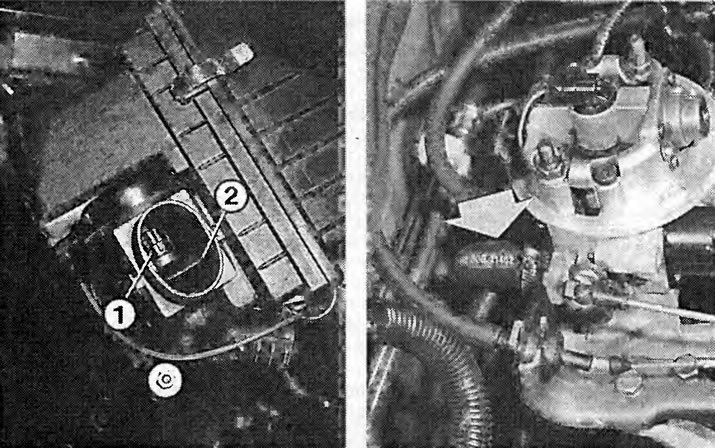
Left: The thermal valve (1) and the damper (2) regulating the air flow are structural elements of…

Left: The thermal valve (1) and the damper (2) regulating the air flow are structural elements of the preheating system.

Right: The intake manifold in the 8-valve 1.6L engine is heated by coolant. The arrow shows the coolant hose to the intake manifold.


(Article posted on an online resource: opelbook)


This article is available at russian, bulgarian, belarusian, ukrainian, serbian, croatian, romanian, polish, slovak, hungarian
Checking the article: Shapovalov Yaroslav

Share information:

Previous articles
Opel Vectra B: Fuel system
Next articles

Replacing the air filter
Blowing out the air filter insert
Removal the air filter insert
Replacing the fuel filter
Removal the fuel pump
Electric fuel pump
Help with air filter problems
Intake manifold heating
Throttle body heating


See similar ones from other Opel car manuals:
▶ Preheating of intake air Opel Kadett D (1979-1984)
▶ Intake manifold — removal and installation Opel Astra F (1991-1998, petrol)
▶ Removal and installation air intake tract components Opel Corsa B (1993-2000)
▶ Removal and installation the intake manifold — 1.6 and 1.8… Opel Insignia A (2008-2017)
▶ Intake Manifold Heater Element (Carburetor Models) —… Opel Omega A (1986-1993)
Link to this page in different formats

Visitor comments


No comments yet


How much will 24 + 49 =


Vectra C (2002-2008) 
  • General information
  • User manual
  • Vehicle device
  • Maintenance
  • Troubleshooting
  • Power unit
  • Engine repair
  • Cooling system
  • Power and control system
  • Engine electrics
  • Transmission
  • Clutch
  • Car gearbox
  • Drive shafts
  • Chassis
  • Car suspension
  • Steering
  • Brake system
  • Body
  • Exterior
  • Interior
  • Doors, locks and windows
  • Heating and ventilation
  • Electrical equipment
  • Equipment and devices
  • Headlights and lighting
  • Electrical circuits
Vectra B (1995-2002) 
  • General information
  • User manual
  • Weekly checks
  • Maintenance (gasoline)
  • Maintenance (diesel)
  • Troubleshooting
  • Power unit
  • SOHC gasoline engine
  • DOHC petrol engine
  • Diesel engine 1.7 liter
  • Diesel engine 2.0 liters
  • Engine repair
  • Cooling system
  • Fuel system (gasoline)
  • Fuel system (diesel)
  • Charging system
  • Launch system
  • Ignition and preheat
  • Transmission
  • Clutch
  • Mechanical gearbox
  • Automatic gearbox
  • Drive shafts
  • Chassis
  • Brake system
  • Wheel suspension
  • Steering
  • Body
  • Exterior
  • Interior
  • Doors and windows
  • Heating and ventilation
  • Electrical equipment
  • Equipment and devices
  • Electrical circuits
Vectra B (1995-2002, petrol) 
  • General information
  • Maintenance
  • Help with malfunctions
  • Power unit
  • Engine repair
  • Exhaust system
  • Cooling system
  • Fuel system
  • Multec injection system
  • Four point injection
  • Transmission
  • Clutch
  • Gearbox and drive
  • Chassis
  • Wheel suspension
  • Steering
  • Brake system
  • Wheels and tires
  • Body
  • Exterior
  • Interior
  • Electrical equipment
  • Fuses and electronics
  • Power devices
  • Ignition system
  • Lighting and signaling
  • Equipment and devices
  • Heating and ventilation
  • Electrical circuits
Vectra A (1988-1995) 
  • Power unit
  • Engine repair
  • Ignition system
  • Lubrication system
  • Cooling system
  • Injection system
  • Fuel system (carburetor)
  • Fuel system (diesel)
  • Exhaust system
  • Transmission
  • Clutch
  • Car gearbox
  • Chassis
  • Front suspension
  • Rear suspension
  • Steering
  • Brake system
  • Wheels and tires
  • Body
  • Exterior
  • Interior
  • Electrical equipment
  • Electrical circuits
Vectra A (1988-1995, petrol) 
  • General information
  • User manual
  • Maintenance
  • Power unit
  • SOHC engine
  • DOHC engine
  • Cooling and ventilation
  • Fuel system (carburetor)
  • Fuel system (injector)
  • Exhaust converter
  • Transmission
  • Clutch
  • Mechanical gearbox
  • Automatic gearbox
  • Drive shafts
  • Chassis
  • Brake system
  • Car suspension
  • Steering
  • Body
  • Body elements
  • Electrical equipment
  • Power devices
  • Equipment and devices
  • Electrical circuits
OpelBook.ru © 2017–2026 · Mobile version · · Sitemap: EN BG BY UA RS HR RO PL SK HU · Feedback · Site search
Astra F, petrol · Astra G, petrol · Astra G · Astra H · Astra J, petrol · Corsa B · Corsa C, petrol · Corsa C · Insignia A · Kadett D · Kadett E · Omega A · Omega B · Omega B2 · Vectra A, petrol · Vectra A · Vectra B, petrol · Vectra B · Vectra C · Zafira A, petrol · Frontera A, petrol · Frontera B · Ascona C · Vivaro A ·
We want your visit to be comfortable 🤝! We use cookies 🍪 to make that happen.