
OpelBook.ru
Cars AvtoVAZ Cars Mitsubishi Cars BMW Cars Mercedes Cars Nissan Cars Toyota Cars Chevrolet
English Русский
Български
Беларускі
Український
Српски
Hrvatski
Română
Polski
Slovenský
Magyar
 |  Sitemap  |  Contacts  |    


Main Astra Corsa Insignia Kadett Omega Vectra Zafira Others Articles
Vectra A (1988-1995, petrol) Vectra A (1988-1995) Vectra B (1995-2002, petrol) Vectra B (1995-2002) Vectra C (2002-2008)
  • Main
  • Vectra
  • Vectra B
  • Power unit
  • Fuel system
  • Fuel lines

Fuel lines (Opel Vectra B)

            0

The fuel system of our fuel injection engines must withstand operating pressures of up to 3 bar. The hoses are therefore made of particularly pressure-resistant material. In addition, they are secured at the connection points with clamping clamps, robust screw connections or quick-release fasteners (so-called Quick Fittings).

Removal fuel lines and fuel hoses


Cleanliness is the first commandment when working in the fuel system. It is necessary to pre-clean - especially in the gasoline injection system - at least the area in which the work is being carried out, so that dirt cannot get into the open pipes.

To loosen the clamping clamps, you need to flatten the metal loop around the perimeter with pliers. Due to this, the clamping clamp expands.

Another option: widen the metal loop with a narrow screwdriver.

Remove the fuel hose by twisting it. If this is not possible, place an open-end wrench on the end of the hose and use it to pry the hose off.

When installing, you must use screw clamps instead of clamps.

Screw clamps (hose clamps) can be reused. When tightening, do not apply too much force, otherwise the toothed engagement will be destroyed and the screw clamp will become unusable.

Do not over tighten pipe connections with hollow bolts. Check and replace sealing rings if necessary.

Quick release latches: they can be loosened even without special tools.
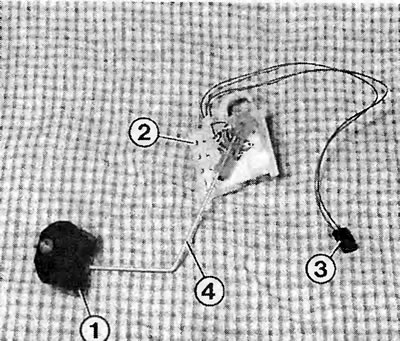
The photograph shows the removed fuel level sensor in the fuel tank. The numbers indicate:

The photograph shows the removed fuel level sensor in the fuel tank. The numbers indicate:
1 - float;
2 - variable resistance;
3 - connecting connector;
4 - connecting rod.
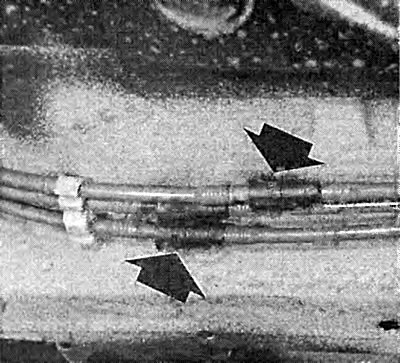

Both arrows point to the so-called Quick Fittings (quick acting closures), which connect the fuel…

Both arrows point to the so-called Quick Fittings (quick acting closures), which connect the fuel lines on the underside of the vehicle. Read on in the section "Removing Fuel Lines and Fuel Hoses" in this chapter to learn how to disconnect these seals without special tools.


Press the fastening tabs into both recesses in the quick release using two screwdrivers.


At the same time, pull the quick release bolt.

When installing, press both ends of the pipes together until you can hear them lock into place.

In our vehicles with fuel injection engines, please note that the fuel system remains under pressure for a long time after the engine is switched off.

When unscrewing the fuel line, have a rag ready to prevent fuel from splashing into your eyes, or release the fuel pressure using a test connector on vehicles with such a device, on the fuel distribution pipe (place a container under the draining fuel).


This article is available at russian, bulgarian, belarusian, ukrainian, serbian, croatian, romanian, polish, slovak, hungarian
Checking the article: Shapovalov Yaroslav

Share information:

Previous articles
Opel Vectra B: Fuel system
Next articles

Fuel quantity indicator sensor
What is the purpose of fuel tank ventilation?
Fuel tank — general information
This way you will save in economy mode
Fuel consumption
Regular gasoline or super gasoline?
Checking the fuel system for leaks
Electric fuel pump
Removal the fuel pump
Replacing the fuel filter
Removal the air filter insert
Blowing out the air filter insert


See similar ones from other Opel car manuals:
▶ Checking the condition and replacing fuel lines and their… Opel Astra H (2004-2009)
▶ Checking the condition and replacing fuel lines and their… Opel Corsa B (1993-2000)
▶ High pressure fuel lines and injectors — removal and… Opel Omega B2 (1999-2003)
▶ Diagnostics and cleaning of fuel injectors Opel Insignia A (2008-2017)
▶ Fuel system of a carburetor engine Opel Kadett E (1984-1995)
Link to this page in different formats

Visitor comments


No comments yet


How much will 22 + 22 =


Vectra C (2002-2008) 
  • General information
  • User manual
  • Vehicle device
  • Maintenance
  • Troubleshooting
  • Power unit
  • Engine repair
  • Cooling system
  • Power and control system
  • Engine electrics
  • Transmission
  • Clutch
  • Car gearbox
  • Drive shafts
  • Chassis
  • Car suspension
  • Steering
  • Brake system
  • Body
  • Exterior
  • Interior
  • Doors, locks and windows
  • Heating and ventilation
  • Electrical equipment
  • Equipment and devices
  • Headlights and lighting
  • Electrical circuits
Vectra B (1995-2002) 
  • General information
  • User manual
  • Weekly checks
  • Maintenance (gasoline)
  • Maintenance (diesel)
  • Troubleshooting
  • Power unit
  • SOHC gasoline engine
  • DOHC petrol engine
  • Diesel engine 1.7 liter
  • Diesel engine 2.0 liters
  • Engine repair
  • Cooling system
  • Fuel system (gasoline)
  • Fuel system (diesel)
  • Charging system
  • Launch system
  • Ignition and preheat
  • Transmission
  • Clutch
  • Mechanical gearbox
  • Automatic gearbox
  • Drive shafts
  • Chassis
  • Brake system
  • Wheel suspension
  • Steering
  • Body
  • Exterior
  • Interior
  • Doors and windows
  • Heating and ventilation
  • Electrical equipment
  • Equipment and devices
  • Electrical circuits
Vectra B (1995-2002, petrol) 
  • General information
  • Maintenance
  • Help with malfunctions
  • Power unit
  • Engine repair
  • Exhaust system
  • Cooling system
  • Fuel system
  • Multec injection system
  • Four point injection
  • Transmission
  • Clutch
  • Gearbox and drive
  • Chassis
  • Wheel suspension
  • Steering
  • Brake system
  • Wheels and tires
  • Body
  • Exterior
  • Interior
  • Electrical equipment
  • Fuses and electronics
  • Power devices
  • Ignition system
  • Lighting and signaling
  • Equipment and devices
  • Heating and ventilation
  • Electrical circuits
Vectra A (1988-1995) 
  • Power unit
  • Engine repair
  • Ignition system
  • Lubrication system
  • Cooling system
  • Injection system
  • Fuel system (carburetor)
  • Fuel system (diesel)
  • Exhaust system
  • Transmission
  • Clutch
  • Car gearbox
  • Chassis
  • Front suspension
  • Rear suspension
  • Steering
  • Brake system
  • Wheels and tires
  • Body
  • Exterior
  • Interior
  • Electrical equipment
  • Electrical circuits
Vectra A (1988-1995, petrol) 
  • General information
  • User manual
  • Maintenance
  • Power unit
  • SOHC engine
  • DOHC engine
  • Cooling and ventilation
  • Fuel system (carburetor)
  • Fuel system (injector)
  • Exhaust converter
  • Transmission
  • Clutch
  • Mechanical gearbox
  • Automatic gearbox
  • Drive shafts
  • Chassis
  • Brake system
  • Car suspension
  • Steering
  • Body
  • Body elements
  • Electrical equipment
  • Power devices
  • Equipment and devices
  • Electrical circuits
OpelBook.ru © 2017–2026 · Mobile version · · Sitemap: EN BG BY UA RS HR RO PL SK HU · Feedback · Site search
Astra F, petrol · Astra G, petrol · Astra G · Astra H · Astra J, petrol · Corsa B · Corsa C, petrol · Corsa C · Insignia A · Kadett D · Kadett E · Omega A · Omega B · Omega B2 · Vectra A, petrol · Vectra A · Vectra B, petrol · Vectra B · Vectra C · Zafira A, petrol · Frontera A, petrol · Frontera B · Ascona C · Vivaro A ·
We want your visit to be comfortable 🤝! We use cookies 🍪 to make that happen.