
OpelBook.ru
Cars AvtoVAZ Cars Mitsubishi Cars BMW Cars Mercedes Cars Nissan Cars Toyota Cars Chevrolet
English Русский
Български
Беларускі
Український
Српски
Hrvatski
Română
Polski
Slovenský
Magyar
 |  Sitemap  |  Contacts  |    


Main Astra Corsa Insignia Kadett Omega Vectra Zafira Others Articles
Vectra A (1988-1995, petrol) Vectra A (1988-1995) Vectra B (1995-2002, petrol) Vectra B (1995-2002) Vectra C (2002-2008)
  • Main
  • Vectra
  • Vectra B
  • Power unit
  • Engine repair
  • Engine scrolling

Engine scrolling (Opel Vectra B)

            0

In some cases the engine needs to be either put into the correct position or turned. There are various options for this.

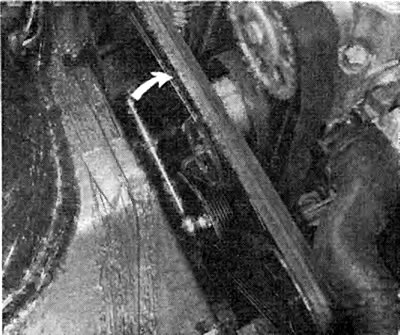
To turn the crankshaft manually, you need to turn it in the direction of the arrow by the central…

To turn the crankshaft manually, you need to turn it in the direction of the arrow by the central bolt of the crankshaft belt pulley. As a tool, you need a star-shaped socket wrench.
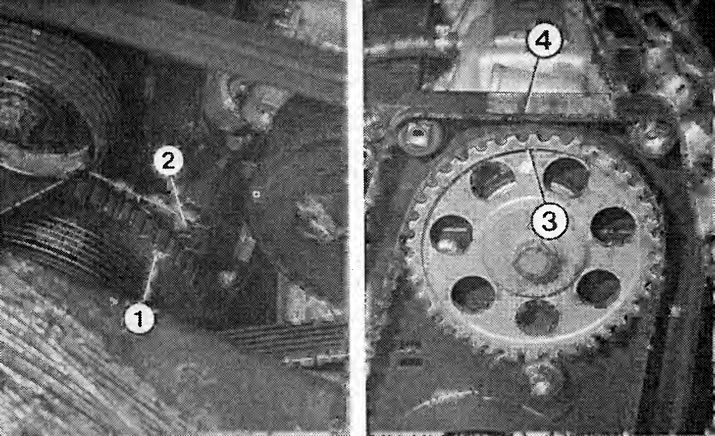

Left: TDC is considered to be found if the mark on the crankshaft belt pulley (1) is opposite the…

Left: TDC is considered to be found if the mark on the crankshaft belt pulley (1) is opposite the arrow on the rear cover (2) of the toothed belt.

Right: Additionally, with the timing belt cover removed, the mark on the camshaft pulley (3) must match the mark on the rear timing belt cover (4). Of course, in 16V engines with a displacement of 1.8/2.0 l, this applies to both camshaft pulleys.


  • If there is a sufficiently level surface, move the car forward accordingly, putting it in 5th gear.
  • Or lift the front of the Opel on one side, as if changing a tire, put it in 5th gear and turn the free-hanging wheel, which will set the engine in motion.
  • Or unscrew the spark plugs (the engine is easier to turn).
  • Rotate the engine clockwise with a bent socket or star-shaped socket wrench installed on the crankshaft belt pulley.
  • Never turn the engine by the camshaft timing belt pulley mounting bolt with the timing belt cover removed! Otherwise, the timing belt may jump, causing engine damage.

Setting the 1st cylinder to the ignition timing position


In a four-stroke engine, the piston reaches the top dead center (TDC) twice during the four working strokes: once when the inlet mixture ignites, and the second time after the exhaust gases are ejected, with the intake of the fuel-air mixture beginning immediately after that. During various adjustments, a position is usually required in which the ignition spark jumps into the 1st cylinder (located on the right side of the road).


Source is on the website opelbook.ru
  • Remove the front timing belt cover.
  • Turn the crankshaft until the mark on the front side of the camshaft belt pulley is at the same height as the mark on the rear timing belt cover.
  • Of course, in 16V engines with a displacement of 1.8/2.0 l this applies to both camshaft pulleys.
  • In a 16V engine with a displacement of 1.6 liters, the marks on the camshaft pulleys should be opposite each other and coincide with the upper edge of the cylinder head.
  • For all engines: The mark on the crankshaft pulley must be opposite the arrow.
  • If the crankshaft belt pulley is removed, the mark on the toothed belt drive pulley is turned vertically downwards towards the corresponding cutout.


This article is available at russian, bulgarian, belarusian, ukrainian, serbian, croatian, romanian, polish, slovak, hungarian
Checking the article: Shapovalov Yaroslav

Share information:

Previous articles
Opel Vectra B: Engine repair
Next articles

Help with pressure problems
Measuring compression pressure
Limiting the number of revolutions
Nominal and maximum engine speed
Engine life
Running in a new engine
Working with a toothed belt
Checking the condition of the timing belt
Replacing the timing belt
Checking the timing belt tension
Cylinder head work
Hydraulic tappets


See similar ones from other Opel car manuals:
▶ Engine bay — 1.4L C 14 NZ engine Opel Astra F (1991-1998, petrol)
▶ Starting the engine from an auxiliary power source Opel Corsa B (1993-2000)
▶ Engine compartment fuse box Opel Insignia A (2008-2017)
▶ Engine hood Opel Kadett E (1984-1995)
▶ Starting the engine Opel Omega A (1986-1993)
Link to this page in different formats

Visitor comments


No comments yet


How much will 29 + 39 =


Vectra C (2002-2008) 
  • General information
  • User manual
  • Vehicle device
  • Maintenance
  • Troubleshooting
  • Power unit
  • Engine repair
  • Cooling system
  • Power and control system
  • Engine electrics
  • Transmission
  • Clutch
  • Car gearbox
  • Drive shafts
  • Chassis
  • Car suspension
  • Steering
  • Brake system
  • Body
  • Exterior
  • Interior
  • Doors, locks and windows
  • Heating and ventilation
  • Electrical equipment
  • Equipment and devices
  • Headlights and lighting
  • Electrical circuits
Vectra B (1995-2002) 
  • General information
  • User manual
  • Weekly checks
  • Maintenance (gasoline)
  • Maintenance (diesel)
  • Troubleshooting
  • Power unit
  • SOHC gasoline engine
  • DOHC petrol engine
  • Diesel engine 1.7 liter
  • Diesel engine 2.0 liters
  • Engine repair
  • Cooling system
  • Fuel system (gasoline)
  • Fuel system (diesel)
  • Charging system
  • Launch system
  • Ignition and preheat
  • Transmission
  • Clutch
  • Mechanical gearbox
  • Automatic gearbox
  • Drive shafts
  • Chassis
  • Brake system
  • Wheel suspension
  • Steering
  • Body
  • Exterior
  • Interior
  • Doors and windows
  • Heating and ventilation
  • Electrical equipment
  • Equipment and devices
  • Electrical circuits
Vectra B (1995-2002, petrol) 
  • General information
  • Maintenance
  • Help with malfunctions
  • Power unit
  • Engine repair
  • Exhaust system
  • Cooling system
  • Fuel system
  • Multec injection system
  • Four point injection
  • Transmission
  • Clutch
  • Gearbox and drive
  • Chassis
  • Wheel suspension
  • Steering
  • Brake system
  • Wheels and tires
  • Body
  • Exterior
  • Interior
  • Electrical equipment
  • Fuses and electronics
  • Power devices
  • Ignition system
  • Lighting and signaling
  • Equipment and devices
  • Heating and ventilation
  • Electrical circuits
Vectra A (1988-1995) 
  • Power unit
  • Engine repair
  • Ignition system
  • Lubrication system
  • Cooling system
  • Injection system
  • Fuel system (carburetor)
  • Fuel system (diesel)
  • Exhaust system
  • Transmission
  • Clutch
  • Car gearbox
  • Chassis
  • Front suspension
  • Rear suspension
  • Steering
  • Brake system
  • Wheels and tires
  • Body
  • Exterior
  • Interior
  • Electrical equipment
  • Electrical circuits
Vectra A (1988-1995, petrol) 
  • General information
  • User manual
  • Maintenance
  • Power unit
  • SOHC engine
  • DOHC engine
  • Cooling and ventilation
  • Fuel system (carburetor)
  • Fuel system (injector)
  • Exhaust converter
  • Transmission
  • Clutch
  • Mechanical gearbox
  • Automatic gearbox
  • Drive shafts
  • Chassis
  • Brake system
  • Car suspension
  • Steering
  • Body
  • Body elements
  • Electrical equipment
  • Power devices
  • Equipment and devices
  • Electrical circuits
OpelBook.ru © 2017–2026 · Mobile version · · Sitemap: EN BG BY UA RS HR RO PL SK HU · Feedback · Site search
Astra F, petrol · Astra G, petrol · Astra G · Astra H · Astra J, petrol · Corsa B · Corsa C, petrol · Corsa C · Insignia A · Kadett D · Kadett E · Omega A · Omega B · Omega B2 · Vectra A, petrol · Vectra A · Vectra B, petrol · Vectra B · Vectra C · Zafira A, petrol · Frontera A, petrol · Frontera B · Ascona C · Vivaro A ·
We want your visit to be comfortable 🤝! We use cookies 🍪 to make that happen.