OpelBook.ru
Cars AvtoVAZ Cars Mitsubishi Cars BMW Cars Mercedes Cars Nissan Cars Toyota Cars Chevrolet
English Русский
Български
Беларускі
Український
Српски
Hrvatski
Română
Polski
Slovenský
Magyar
 |  Sitemap  |  Contacts  |    


Main Astra Corsa Insignia Kadett Omega Vectra Zafira Others Articles
Vectra A (1988-1995, petrol) Vectra A (1988-1995) Vectra B (1995-2002, petrol) Vectra B (1995-2002) Vectra C (2002-2008)
  • Main
  • Vectra
  • Vectra B
  • Power unit
  • Engine repair
  • Replacing the timing belt

Replacing the timing belt (Opel Vectra B)

            0

Maintenance work


  • Remove the timing belt only when the engine is cold.
  • Remove the front timing belt cover.
  • Set the engine to the TDC position of the 1st cylinder ignition. In 16-valve engines, additionally fix the camshaft pulleys in this position with locking bolts (KM-852 for 16V 1.6 l engine or KM-953 for 16V 1.8 and 2.0 l engines).
  • 8-valve 1.6L engine: Turn the timing belt tension roller upwards with a flat-end wrench, counteracting the spring force, so that the holes in the movable part of the tension roller and in its support plate coincide
  • Secure the tension roller in this position with a suitable pin or drill.
  • 16V: Loosen the tension roller mounting bolt and turn the adjusting eccentric clockwise until the arrow on the tension roller touches the left stop.
  • For all: Remove the loose timing belt from the belt pulleys.
  • In 16V engines, check the mounting position of the water pump, see section "Checking the timing belt tension".
  • Place the new belt so that the traction side (between the camshaft pulley and the crankshaft pulley) was taut. If the position of the crankshaft and camshaft pulleys has not changed, then the valve timing has not yet been knocked out of alignment.
  • However, for safety reasons, this should be checked before final installation.
  • Check the timing belt tension.

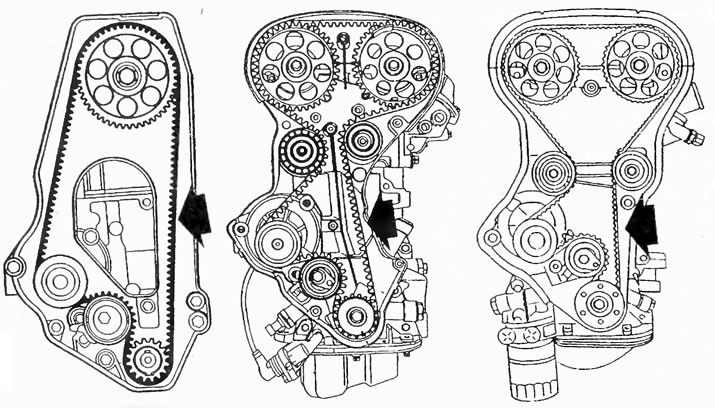
The figures show the location of the timing belt, on the left - in the 8-valve engine - 1.6 l, in…

The figures show the location of the timing belt, on the left - in the 8-valve engine - 1.6 l, in the center - in the 16-valve engine 1.6 l and on the right - in the engine 1.8/2.0 l. The correct tension of the timing belt in all engines is provided by an automatic tension roller between the water pump and the crankshaft. The arrow in each case shows the traction side of the timing belt.
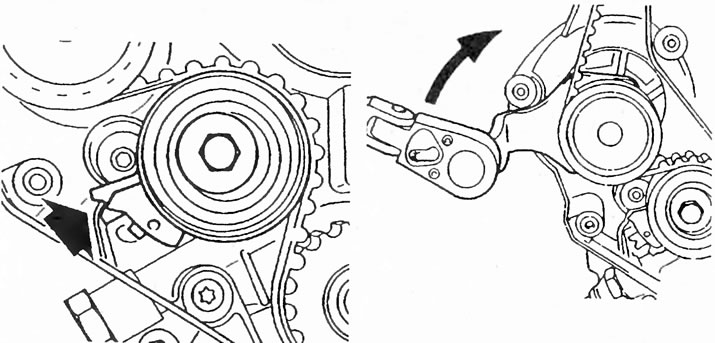

The pictures show an 8-valve 1.6 l engine.

The pictures show an 8-valve 1.6 l engine.

Left:When the timing belt tension is correct, the arrow on the movable part of the tension roller is opposite the mark on the support plate.

Right: To adjust the tension of the toothed belt, slightly loosen the water pump mounting bolts and accordingly turn the eccentrically located pump clockwise with the KM-421-A tool.


This article is available at russian, bulgarian, belarusian, ukrainian, serbian, croatian, romanian, polish, slovak, hungarian
Checking the article: Shapovalov Yaroslav

Share information:

Previous articles
Opel Vectra B: Engine repair
Next articles

Checking the condition of the timing belt
Working with a toothed belt
Engine scrolling
Help with pressure problems
Measuring compression pressure
Limiting the number of revolutions
Checking the timing belt tension
Cylinder head work
Hydraulic tappets
Help with cylinder head gasket problems
Bearing damage
Engine damage


See similar ones from other Opel car manuals:
▶ Replacing the timing belt Opel Astra J (2009-2015, petrol)
▶ Replacing or adjusting the timing belt Opel Insignia A (2008-2017)
▶ Timing Belt — Checking Condition, Adjusting Tension and… Opel Zafira A (1999-2005, petrol)
▶ Replacing the engine timing belt Opel Frontera A (1991-1998, petrol)
▶ Checking the condition and replacing the auxiliary drive… Opel Corsa B (1993-2000)
Link to this page in different formats

Visitor comments


No comments yet


How much will 14 + 18 =


Vectra C (2002-2008) 
  • General information
  • User manual
  • Vehicle device
  • Maintenance
  • Troubleshooting
  • Power unit
  • Engine repair
  • Cooling system
  • Power and control system
  • Engine electrics
  • Transmission
  • Clutch
  • Car gearbox
  • Drive shafts
  • Chassis
  • Car suspension
  • Steering
  • Brake system
  • Body
  • Exterior
  • Interior
  • Doors, locks and windows
  • Heating and ventilation
  • Electrical equipment
  • Equipment and devices
  • Headlights and lighting
  • Electrical circuits
Vectra B (1995-2002) 
  • General information
  • User manual
  • Weekly checks
  • Maintenance (gasoline)
  • Maintenance (diesel)
  • Troubleshooting
  • Power unit
  • SOHC gasoline engine
  • DOHC petrol engine
  • Diesel engine 1.7 liter
  • Diesel engine 2.0 liters
  • Engine repair
  • Cooling system
  • Fuel system (gasoline)
  • Fuel system (diesel)
  • Charging system
  • Launch system
  • Ignition and preheat
  • Transmission
  • Clutch
  • Mechanical gearbox
  • Automatic gearbox
  • Drive shafts
  • Chassis
  • Brake system
  • Wheel suspension
  • Steering
  • Body
  • Exterior
  • Interior
  • Doors and windows
  • Heating and ventilation
  • Electrical equipment
  • Equipment and devices
  • Electrical circuits
Vectra B (1995-2002, petrol) 
  • General information
  • Maintenance
  • Help with malfunctions
  • Power unit
  • Engine repair
  • Exhaust system
  • Cooling system
  • Fuel system
  • Multec injection system
  • Four point injection
  • Transmission
  • Clutch
  • Gearbox and drive
  • Chassis
  • Wheel suspension
  • Steering
  • Brake system
  • Wheels and tires
  • Body
  • Exterior
  • Interior
  • Electrical equipment
  • Fuses and electronics
  • Power devices
  • Ignition system
  • Lighting and signaling
  • Equipment and devices
  • Heating and ventilation
  • Electrical circuits
Vectra A (1988-1995) 
  • Power unit
  • Engine repair
  • Ignition system
  • Lubrication system
  • Cooling system
  • Injection system
  • Fuel system (carburetor)
  • Fuel system (diesel)
  • Exhaust system
  • Transmission
  • Clutch
  • Car gearbox
  • Chassis
  • Front suspension
  • Rear suspension
  • Steering
  • Brake system
  • Wheels and tires
  • Body
  • Exterior
  • Interior
  • Electrical equipment
  • Electrical circuits
Vectra A (1988-1995, petrol) 
  • General information
  • User manual
  • Maintenance
  • Power unit
  • SOHC engine
  • DOHC engine
  • Cooling and ventilation
  • Fuel system (carburetor)
  • Fuel system (injector)
  • Exhaust converter
  • Transmission
  • Clutch
  • Mechanical gearbox
  • Automatic gearbox
  • Drive shafts
  • Chassis
  • Brake system
  • Car suspension
  • Steering
  • Body
  • Body elements
  • Electrical equipment
  • Power devices
  • Equipment and devices
  • Electrical circuits
OpelBook.ru © 2017–2026 · Mobile version · · Sitemap: EN BG BY UA RS HR RO PL SK HU · Feedback · Site search
Astra F, petrol · Astra G, petrol · Astra G · Astra H · Astra J, petrol · Corsa B · Corsa C, petrol · Corsa C · Insignia A · Kadett D · Kadett E · Omega A · Omega B · Omega B2 · Vectra A, petrol · Vectra A · Vectra B, petrol · Vectra B · Vectra C · Zafira A, petrol · Frontera A, petrol · Frontera B · Ascona C · Vivaro A ·
We want your visit to be comfortable 🤝! We use cookies 🍪 to make that happen.