


Contents: Radiator Fan Thermal Switch ⬇ Radiator Fan Malfunctions ⬇ Troubleshooting the Radiator Fan ⬇ Removal the radiator fan ⬇
Vectra has an electric radiator fan that only turns on when needed, saving engine power and, as a result, petrol.
That's why on the radiator on the right (if you look in the direction of travel) a temperature-sensitive switch is installed. When it "feels" that the liquid flowing past it is still too hot, it turns on the fan. In the same way, it turns off the electric fan if the temperature at the bottom of the radiator has dropped to a certain value.
Tip: Due to the electrical connection via terminal 30 (in 1.8 and 2.0 l engines) the fan may suddenly start even when the engine is off. Be careful when working in the engine compartment!
Radiator Fan Thermal Switch
In 1.6L engines, a thermal switch switches the radiator fan on at approximately 100°C and switches it off again at approximately 95°C. When the switch-on temperature is reached, a contact in the switch closes the electrical circuit of the radiator fan and it switches on. Current flows to the fan via the 15A terminal from the ignition switch only when the ignition is on.
In 1.8/2.0L engines, the electric radiator fan has a two-stage switching. At the appropriate switching temperature, the first contact in the thermal switch closes the electric circuit of the radiator fan. In this circuit there is an additional resistance, which reduces the voltage and makes the fan run only at half speed. If the coolant temperature continues to rise, the thermal switch closes the second electric circuit. The current bypasses the resistance, the electric motor receives a non-reduced voltage, and its impeller rotates at full speed. Due to the high power consumption, the current flows through two fan relays, which are located in the relay box next to the battery.
Radiator Fan Malfunctions
A failed radiator fan can cause the coolant temperature to rise too much, but only when idling for a long time, such as in a traffic jam on a holiday evening in the city or on the motorway. But a failed fan does not mean the end of the trip:
- After the engine has cooled down a bit, you can drive smoothly to the nearest workshop at medium speed. Don't lose sight of the temperature indicator.
- On the contrary, idling and slow driving are dangerous for the engine. Almost no cooling air flows through the radiator fins. If driving conditions require driving at low speed, the cause of the malfunction should be identified immediately and, if necessary, the thermal switch should be short-circuited.
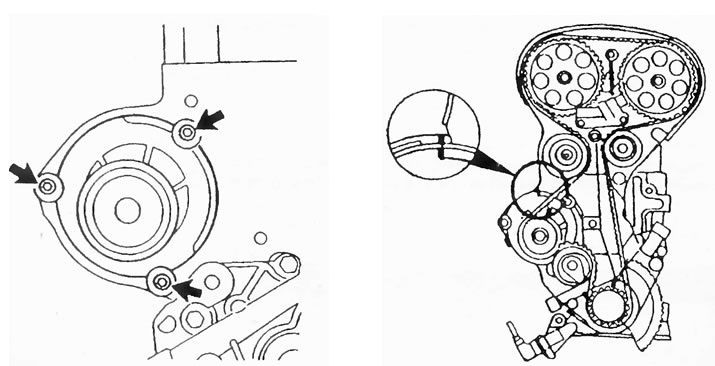
Left: The water pump is secured with three bolts to the end face of the engine.
Right: In cars with a 16V engine, when screwing on the water pump, take into account its mounting position: both marks on the pump must match.
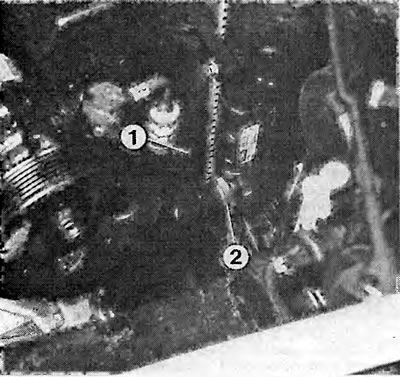
The thermal switch (2) of the radiator fan is screwed into the Vectra on the right side of the radiator (1). The thermal switch switches the radiator fan on or off depending on the coolant temperature.
Troubleshooting the Radiator Fan
Check the relevant fuses first.
If they are OK, disconnect the thermal switch wire plug.
Short both contacts of the wire connector with a piece of wire.
In a two-stage thermal switch, close all three connector tabs.
If the fan now starts working when the ignition is on, then (here experimentally) the thermal switch removed from the electrical circuit is faulty.
To continue driving, securely clamp the jumper into the connector and insulate it with tape or adhesive tape to prevent short circuits.
If the thermal switch jumper did not help, then with 1.8 and 2.0 L engines check the fan relay (see chapter "Tools and instruments"): when both connecting wires of the thermal switch are bridged, you should be able to hear the switching contacts in the relay closing when the ignition is on.
If this is not the case, then you need to make a temporary jumper for the relay. To do this, connect the plug tabs of terminals 30 and 87 of the relay with a piece of wire (with a paper clip) and insert the relay.
The radiator fan should now spin even with the ignition off. If so, the relay is faulty.
A jumper wire can be installed as an emergency temporary aid on the road. It should be removed after the trip.
If there is still no success, then check the fan motor now.
Disconnect the fan motor wire connector and route it from the black wire terminal instead (1.6L engine) or red/yellow wire (1.8 and 2.0 l engine) auxiliary wire to the positive terminal of the battery. The plug connector of the brown or brown/white wire is connected directly to the negative terminal.
If the propeller still does not spin, the fan motor is faulty - replace it.
But if the fan rotates, then with 1.8 and 2.0 l engines you need to check the relay (see chapter "Instruments and devices"). Otherwise, check all connections of the wires of the thermal switch and electric fan.
With a radiator fan powered directly by the battery, you can also continue your ride without any worries. Route the auxiliary wire so as to avoid short circuits.
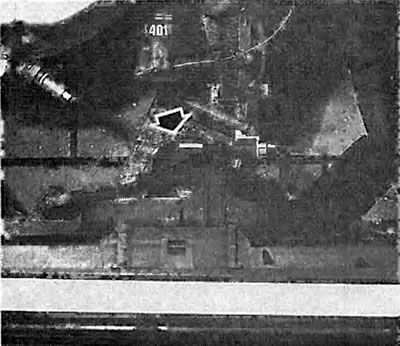
The electric radiator fan (arrow) is connected only when necessary. Please note that when the engine is warm, the fan can be switched on at any time. This is for the case when, for example, with the ignition on, measuring work is carried out in the engine compartment.
Removal the radiator fan
Disconnect the ground cable from the battery.
Disconnect the fan wire connector and remove the wire harness from the clamps on the air intake funnel.
Unscrew the air intake funnel with the radiator fan at the top of the radiator, remove it from the mount on the left and right, and then remove it upwards from the engine compartment.
If necessary, remove the fan blade wheel by using a screwdriver to pry the mounting clips off the motor shaft.
Loosen the three nuts and remove the fan from the air intake funnel.
Visitor comments