


The viscous coupling consists of a housing filled with special oil, in which there are disks, between which there is no rigid mechanical connection. Every other disk is connected to the rear axle drive shaft. When the disks slip, i.e. when the front and rear wheels rotate at different speeds, the viscosity of the oil in the viscous coupling increases. Due to this, the disks begin to rotate as a single unit, and the wheel rotation speeds are equalized. A small difference in rotation speeds is compensated, and an increase in their difference leads to an increase in elastic forces in the viscous coupling so much that up to 100% of the torque from the engine can be transmitted to the rear wheels. The rear wheel drive is engaged so softly and smoothly that the driver does not even notice it.
On a normal dry road, the wheels rotate at approximately the same speed. In this case, most of the torque is transmitted to the front wheels. However, if, due to high torque during acceleration or on a bad road, the front wheels rotate faster than the rear wheels, the viscous coupling increases the torque to the rear wheels. When the front wheels slip, almost all of the torque is transmitted to the rear axle.
When braking, the rear wheels would be difficult to brake due to the connection between the front and rear axles. Therefore, the all-wheel drive Opel Vectra/Calibra vehicles are equipped with a hydraulic disengaging clutch, which automatically disconnects the viscous coupling when braking. The disengaging clutch is controlled electronically and is involved in the general hydraulic circuit.
When braking with the engine (when the accelerator pedal is not pressed) all-wheel drive is maintained, so braking is transmitted to all wheels.
Material provided by this website www.opelbook.ru
When the engine is turned off, the rear wheels are disconnected. Therefore, towing all-wheel drive vehicles with the front part raised is carried out in the same way as with front-wheel drive vehicles. If for some reason it is necessary to disconnect the rear-wheel drive, fuse F19 should be removed.
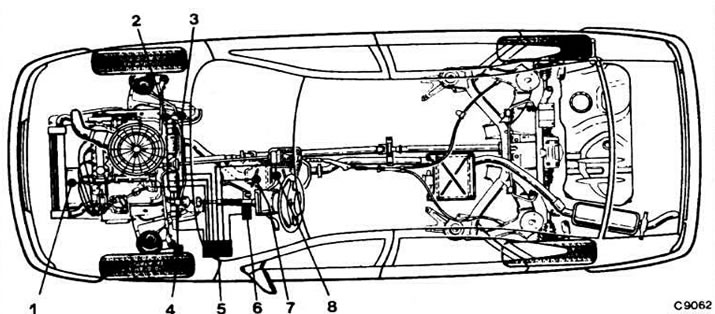
1 - engine crankshaft speed sensor
2 - control valve
3 - pressure switch
4 - diagnostic connector (ALDL)
5 - computer
6 - cleanliness sensor
7 - brake light switch
8 - All-wheel drive indicator light
The operation of the all-wheel drive is ensured by a computer with its own memory for error codes. Simultaneously with the recording of the error code in the memory, the all-wheel drive symbol flashes or lights up on the instrument panel. Repair of the all-wheel drive system should be carried out only in specialized workshops.
Visitor comments