
OpelBook.ru
Cars AvtoVAZ Cars Mitsubishi Cars BMW Cars Mercedes Cars Nissan Cars Toyota Cars Chevrolet
English Русский
Български
Беларускі
Український
Српски
Hrvatski
Română
Polski
Slovenský
Magyar
 |  Sitemap  |  Contacts  |    


Main Astra Corsa Insignia Kadett Omega Vectra Zafira Others Articles
Astra F (1991-1998, petrol) Astra G (1998-2004, petrol) Astra G (1998-2004) Astra H (2004-2009) Astra J (2009-2015, petrol)
  • Main
  • Astra
  • Astra J
  • Transmission
  • Drive shafts
  • Features of the front wheel drive design

Features of the front wheel drive design (Opel Astra J)

            0

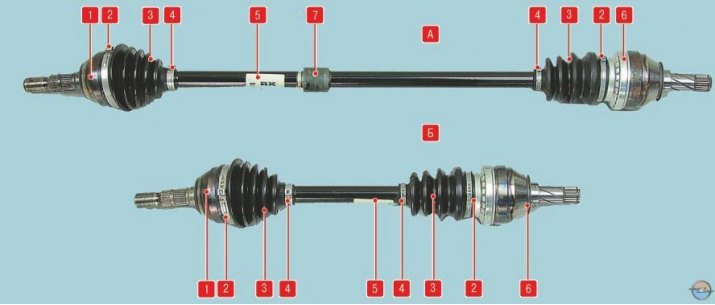
The front wheel drives consist of internal 6 (Fig. 1) and external 1 constant velocity joints (CV joints) connected by shafts 5. The external joint enables only angular movements of the connected shafts. The internal joint, in addition to angular movements, ensures axial displacements of the shafts when turning the front wheels and operating the suspension.

Fig. 1. Front wheel drives: A - right front wheel drive; B - left front wheel drive: 1 - outer…

Fig. 1. Front wheel drives: A - right front wheel drive; B - left front wheel drive: 1 - outer constant velocity joints; 2 – large clamps for fastening the hinge covers; 3 – hinge covers; 4 – small clamps for fastening hinge covers; 5 – drive shafts; 6 – internal constant velocity joints; 7 – torsional vibration damper


The Birfield type outer joint consists of a housing, a separator, a cage and six balls. Grooves for placing the balls are made in the joint housing and in the cage. The grooves in the longitudinal plane are made along the radius, which ensures the required angle of rotation of the outer joint. The splined tip of the outer joint housing is installed in the hub of the front wheel and attached to it with a nut.

The outer joint collar is installed on the splines of shaft 5 and secured to the shaft with a retaining ring.


The internal Lebro-type joint of a car with a manual transmission differs from the external one in that the raceway of the cage housing is made straight, not radial, which allows the joint parts to move in the longitudinal direction. The splined tip of the internal joint housing is secured in the differential axle gear with a spring retaining ring.

The Tripod type internal joint of a car with an automatic transmission consists of a housing and three rollers on needle bearings, put on the journals of a three-pin hub. The joint housing has grooves for the rollers. The three-pin hub is fixed on the shaft with a locking ring, the rollers allow the hub to move in the grooves of the joint housing in the axial direction, due to which the drive can be lengthened or shortened to compensate for the mutual movements of the suspension and the power unit. The splined ends of the inner joint housings are fixed in the differential axle gears in the same way as in Lebro type joints.

To reduce torsional vibrations and oscillations, a rubber damper 7 is pressed onto the right drive shaft.

Text was copied from the portal [OpelBook.ru]

In the Birfield and Lebro type joints, balls of the same sorting group are installed. All the parts of the joint are selectively matched to each other, so it is impossible to repair the joint by replacing individual parts; only the assembled joint and a small repair kit, including a retaining ring, a cover and clamps for fastening the cover, and in some cases, grease, are supplied as spare parts.


The internal Tripod type hinge is supplied as a spare part in the form of two repair kits: a large one, which includes all the hinge parts, and a small one, which contains a retaining ring, a cover, clamps for fastening the cover and, in some cases, grease.

To lubricate the joints, a special lubricant with molybdenum disulfide is used (domestic analogue - SHRUS-4). The cavities of all joints are protected from road dirt and water by rubber corrugated covers 3, fixed to the joint housings and to the drive shafts by large 2 and small 4 clamps, respectively.

The outer and inner constant velocity joints of both drives are identical. However, since the drive shafts differ in length, the right and left wheel drives are not interchangeable.

Note. Drive joints are very durable, their estimated service life is almost equal to the service life of the car. However, during operation they are changed or repaired quite often due to damage to the protective covers. Such work is quite expensive and labor-intensive. In order to save a lot, regularly check the condition of the protective covers of the joints and immediately replace them at the slightest damage. If water or dust gets into the joint through a damaged cover, it will fail after several hundred kilometers. A sealed joint wears out extremely slowly.


This article is available at russian, bulgarian, belarusian, ukrainian, serbian, croatian, romanian, polish, slovak, hungarian
Checking the article: Trifonova Emilia

Share information:

Previous articles
Opel Astra J: Drive shafts
Next articles

Possible faults of front wheel drives
Removal and installation front wheel drives
Replacing constant velocity joints of front wheel drives


See similar ones from other Opel car manuals:
▶ Front wheel drive Opel Kadett E (1984-1995)
▶ Bleeding the hydraulic system (front-wheel drive vehicles) Opel Vectra A (1988-1995)
▶ Front Wheel Drive Seals — Replacement Opel Zafira A (1999-2005, petrol)
▶ Checking the condition of the protective covers of the… Opel Frontera A (1991-1998, petrol)
▶ Design of the clutch and its drive components Opel Corsa B (1993-2000)
Link to this page in different formats

Visitor comments


No comments yet


How much will 32 + 38 =


Astra J (2009-2015, petrol) 
  • General information
  • Vehicle device
  • User manual
  • Faults en route
  • Maintenance
  • Power unit
  • Engine repair
  • Cooling and lubrication system
  • Engine power system
  • Exhaust system
  • Transmission
  • Clutch
  • Car gearbox
  • Drive shafts
  • Chassis
  • Front suspension
  • Rear suspension
  • Steering
  • Brake system
  • Wheels and tires
  • Body
  • Exterior
  • Interior
  • Doors and windows
  • Body Care
  • Heating and air conditioning
  • Security systems
  • Electrical equipment
  • Equipment and devices
  • Lighting and signaling
  • Power devices
  • Electrical circuits
Astra H (2004-2009) 
  • General information
  • Introduction to the guide
  • Troubleshooting
  • User manual
  • Maintenance
  • Power unit
  • Engine repair
  • Cooling and heating
  • Power and exhaust system
  • Ignition system
  • Launch and charge system
  • Transmission
  • Mechanical gearbox
  • Automatic gearbox
  • Drive shafts
  • Chassis
  • Brake system
  • Car suspension
  • Steering
  • Body
  • Interior
  • Exterior
  • Electrical equipment
  • Equipment and devices
  • Electrical circuits
Astra G (1998-2004) 
  • General information
  • Introduction to manual
  • User manual
  • Maintenance
  • Power unit
  • SOHC gasoline engines
  • DOHC gasoline engines
  • Diesel engines 1.7 and 2.0
  • Engine repair
  • Cooling system
  • Supply system
  • Injection system (gasoline)
  • Injection system (diesel)
  • Exhaust system
  • Charge and launch system
  • Ignition system (gasoline)
  • Preheat system (diesel)
  • Transmission
  • Manual gearbox
  • Automatic gearbox
  • Clutch
  • Drive shafts
  • Chassis
  • Brake system
  • Wheel suspension
  • Steering
  • Body
  • Exterior
  • Interior
  • Doors and windows
  • Ventilation and heating
  • Electrical equipment
  • Equipment and devices
  • Electrical circuits
Astra G (1998-2004, petrol) 
  • General information
  • User manual
  • Car care
  • Maintenance
  • Power unit
  • Single shaft engines
  • Twin shaft engines
  • Engine repair
  • Cooling and heating
  • Fuel and exhaust systems
  • Starting and charging system
  • Ignition system
  • Transmission
  • Clutch
  • Mechanical gearbox
  • Automatic gearbox
  • Drive shafts
  • Chassis
  • Brake system
  • Car suspension
  • Steering
  • Body
  • Interior
  • Exterior
  • Electrical equipment
  • Equipment and devices
  • Wiring diagrams Opel Astra
  • Wiring diagrams Opel Zafira
Astra F (1991-1998, petrol) 
  • General information
  • Maintenance
  • Power unit
  • Engine in car
  • Engine removed
  • Cooling system
  • Heating and ventilation
  • Fuel supply (carburetor)
  • Fuel supply (injector)
  • Emission control
  • Ignition system
  • Transmission
  • Clutch
  • Mechanical gearbox
  • Automatic gearbox
  • Drive shafts
  • Chassis
  • Brake system
  • Car suspension
  • Steering
  • Body
  • Exterior
  • Interior
  • Electrical equipment
  • Equipment and devices
  • Electrical circuits
OpelBook.ru © 2017–2026 · Mobile version · · Sitemap: EN BG BY UA RS HR RO PL SK HU · Feedback · Site search
Astra F, petrol · Astra G, petrol · Astra G · Astra H · Astra J, petrol · Corsa B · Corsa C, petrol · Corsa C · Insignia A · Kadett D · Kadett E · Omega A · Omega B · Omega B2 · Vectra A, petrol · Vectra A · Vectra B, petrol · Vectra B · Vectra C · Zafira A, petrol · Frontera A, petrol · Frontera B · Ascona C · Vivaro A ·
We want your visit to be comfortable 🤝! We use cookies 🍪 to make that happen.