


Contents: Engine and exhaust system ⬇ Engine oil change ⬇ Draining engine oil ⬇ Drain plug tightening torques ⬇ Replacing the oil filter ⬇ Refilling engine oil ⬇ Visual search for oil leaks ⬇ Engine oil level - check ⬇
This chapter covers all maintenance work on various vehicle systems, components and assemblies that must be performed as part of the maintenance plan.
The necessary wearing parts and the proposed type of special tool are also indicated here.
It is recommended to check and, if necessary, increase the tire pressure, check and, if necessary, replenish the volume of engine oil and cooling system fluids, windshield wipers and windshield washers at least every 4-6 weeks.
Attention! When purchasing spare parts, it is recommended to have the vehicle's technical passport with you, because often, to identify a vehicle, you need to know its body number, model range or year of manufacture. To be absolutely sure that the part you purchase is absolutely identical to the previous one, it is recommended, if possible, to take the old part with you to compare it with the one you are purchasing.
Engine and exhaust system
In accordance with the maintenance plan, the following work must be performed:
- Replace engine oil and oil filter.
- Check the engine oil level and top it up if necessary. Inspect the engine and make sure there are no oil leaks.
- Diesel vehicles: Remove condensate from the fuel filter or replace the replaceable filter element.
- Cars with gasoline engines: Replace the fuel filter.
- Cars with gasoline engine: Replace the timing belt.
- Check the exhaust gas composition and get a printout of fault codes (in the workshop).
- V-ribbed accessory drive belt. Check condition.
- Replace the timing belt and check the tension roller.
- Cooling, heating and ventilation systems. Check the fluid level and antifreeze concentration and make sure they are tight.
- Vehicles with 2.5L diesel engine: Replace coolant.
- Exhaust system. Check condition.
- Fuel system. Check the tightness, laying of fuel lines, strength of their connections.
- Replace the air filter element. Vehicles with gasoline engines. Replace the spark plugs.
Engine oil change
To change the oil you will need the following tools and equipment:
- inspection pit or hydraulic garage lift,
- special tool for unscrewing the oil filter (pliers, chain wrench or HAZET 2172 device),
- a socket head for unscrewing the oil drain bolt, as well as a container for collecting the drained oil with a capacity of at least 7 liters.
Necessary parts for replacing worn ones:
- an aluminum or copper O-ring for the drain plug thread if the oil is to be drained rather than collected. The O-ring is sometimes supplied with the oil filter,
- replacement oil filter element,
- 4.5 to 6.5 liters of engine oil (depending on the engine type). Refueling volumes when changing oil with filter replacement.
Engine, Volume
- Petrol 2.0/2.2 l - 4.5 l
- Petrol 2.5/3.0 l - 5.75 l
- Diesel 2.0/2.2 l - 5.5 l
- Diesel 2.5 l - 6.5 l
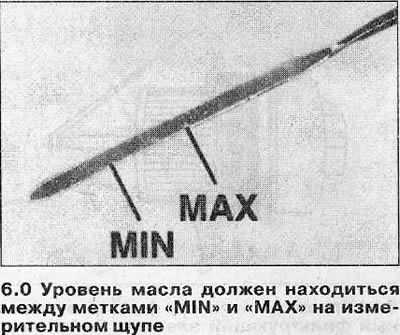
The filling volume when adding oil from the "MIN" mark to the "MAX" mark on the dipstick is 1.0 l, for a diesel engine with a volume of 2.5-1.5 l.
The oil level should always be between these marks (see illustration 6.0).
When changing the oil, it is also necessary to replace the oil filter.
Under increased operating loads, such as city driving, frequent trips in mountainous areas, operating a vehicle with a trailer or in very dusty conditions, the engine oil should be changed more quickly.
In cars with a gasoline engine, engine oil can be removed using a special probe rather than drained (for example, at some gas stations) through the guide tube for the oil dipstick.
Draining engine oil
1. Warm up the engine. To do this, drive a short distance until the coolant temperature gauge starts showing the operating temperature of the coolant. Then drive about five kilometers more to ensure normal oil temperature.
2. Disconnect the negative (-) battery terminal.
Caution! When you disconnect the battery, previously entered data, including the security code, is deleted from the memory systems of some devices, such as a radio.
3. Vehicles with V6 petrol engine from 9/1998 and diesel engine: Unscrew the oil filter cap using a suitable socket head. This opens the valve for draining the oil into the oil pan.
4. Place the vehicle horizontally on jack stands.
5. Remove the engine splash guard (protection), if present.
6. Vehicles with Y25DT diesel engine. Remove the cover from the mudguard that covers the hole on it for draining the engine oil.
7. Place a container underneath to collect the drained oil.
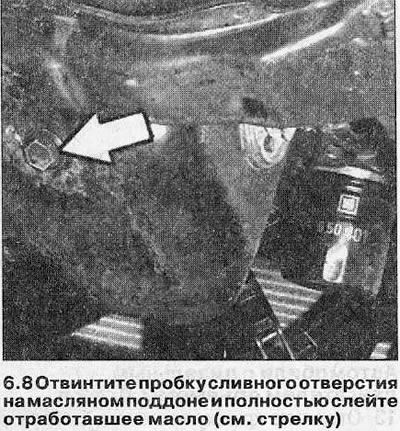
8. Unscrew the drain plug on the oil pan and drain the used oil completely (see arrow in illustration).
Caution! If large amounts of metal shavings and metal abrasion products are found in the engine oil, this indicates the presence of scoring, for example, in the crankshaft bearings or connecting rod bearings. To avoid further damage, after repairing the engine, it is necessary to thoroughly clean the oil channels and oil circulation hoses.
As an additional measure, if installed, the oil cooler must be replaced.
9. After draining the engine oil, screw the plug into the drain hole.
Drain plug tightening torques
Petrol engines
- Plug with copper sealing washer - 55 Nm
- Plug with metal sealing washer - 10 Nm
- Plug with rubber sealing washer - 10 Nm
- Diesel engines 2.0/2.2 l - 10 Nm
Diesel engine 2.5 l (X25DT)
- Bolt M12 - 25 Nm
- Bolt M16 - 45 Nm
- Diesel engine 2.5 l (Y25DT) - 10 Nm
10. Place a container under the oil filter.
Replacing the oil filter
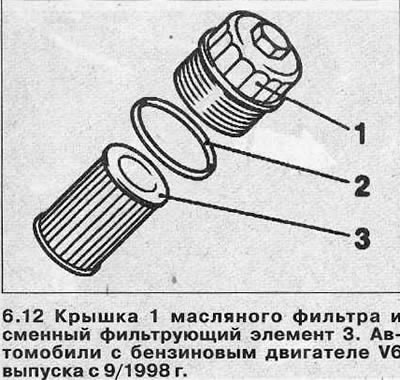
Cars with V6 petrol engine produced since 9/1998.
11. Unscrew the oil filter cover and remove it together with the replaceable filter element, if it has not been removed before.
12. Install cover 1 with a new replaceable filter element 3, a new sealing ring 2 and tighten it with a force of 25 Nm (see illustration).
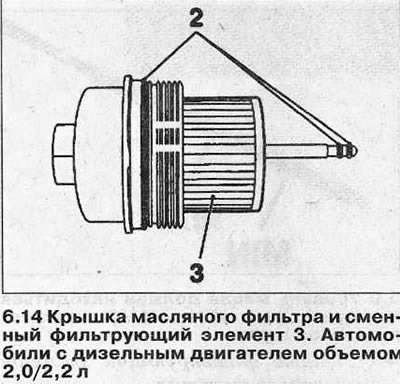
Cars with 2.0/2.2L diesel engine
13. Unscrew the oil filter cover and remove it together with the replaceable filter element, if it has not been removed before.
14. Install the cover with a new replaceable filter element 3, new sealing rings 2 and tighten it with a force of 20 Nm. If necessary, tighten the cover to 25 Nm (see illustration).
Cars with 2.5L diesel engine
Caution! Depending on the configuration, some adjacent parts may need to be removed to remove the oil filter.
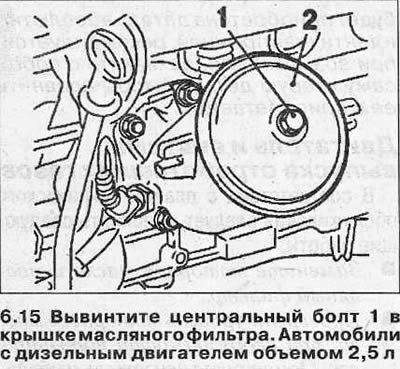
15. Unscrew the central bolt 1 in the oil filter cover and remove the oil filter cover 2 together with the central bolt (see illustration).
16. Remove the replaceable filter element from the filter housing and collect the leaked oil with a rag.
17. Insert the new replacement filter element into the oil filter housing.
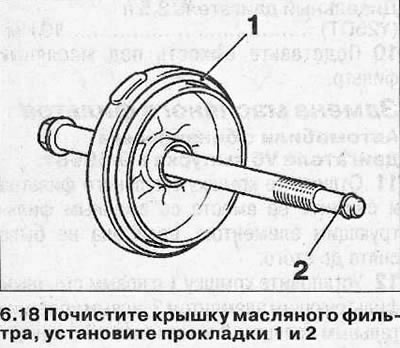
18. Clean the oil filter cover, install gaskets 1 and 2 on the cover and on the central bolt (see illustration).
19. Install the central bolt into the filter housing and put the cover on by pressing it. The bolt should go into the threaded hole on the bottom of the filter.
20. Tighten the central bolt of the oil filter by hand and then with a force of 25 Nm. If the cover is metal, then its tightening is 30 Nm.
Refilling engine oil
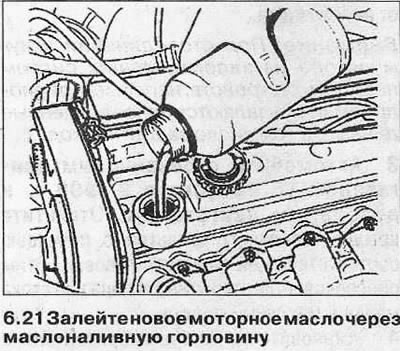
21. Fill with new engine oil through the oil filler neck in the cylinder head cover (see illustration). Attention! When adding engine oil, it is recommended to fill in approximately 1/2 liter less than the filling volume. After that, start the engine and warm it up. Then turn off the engine and after a few minutes check the oil level and add oil if necessary. Excess oil must be removed because it can cause damage to the engine and catalytic converter seals.
22. Replace the oil filler cap and lower the vehicle onto its wheels.
23. Perform a test drive and after its completion check the tightness of the drain plug and oil filter. If necessary, tighten them, being careful.
24. Check the oil level approximately 2 minutes after stopping the engine and, if necessary, top up the oil level to the normal level.
25. Replace the engine splash guard. Caution! For better control over the engine condition and operation, it is recommended to fill the engine with one type and one brand of oil. In this regard, it is recommended to install a plate indicating the brand and viscosity of the oil filled after each oil change.
Attention! The random use of oils of different types has an adverse effect on the condition of the engine. If possible, do not mix motor oils of the same type but different brands. If necessary, you can safely mix oil of the same brand and type but different viscosity.
Visual search for oil leaks
If oil consumption is increased, all possible leakage areas should be checked. To do this:
26. Unscrew the oil filler cap and check the condition of its gasket.
27. Check the condition of the crankcase ventilation hose, for example, from the crankcase to the cylinder head and from the head to the air filter or intake manifold.
28. Check the cylinder head cover gasket.
29. Check the cylinder head gasket.
30. Check the oil filter gasket.
31. Check the gasket on the threaded plug of the engine oil drain hole.
32. Check the condition of the oil level sensor sealing ring
33. Check the oil pan gasket.
34. Check the front and rear camshaft and crankshaft oil seals.
35. Check the tightness of the timing gear housing.
Since leaks usually spread oil over a large surface area of the engine, it can be difficult to determine the location of the leak at first glance. The following search method is recommended:
36. Wash the engine. To do this, spray the engine with an aerosol cleaner and, after letting it work, rinse with water. Before doing this, cover the generator and fuse box with a plastic bag.
Attention! Engine washing should only be performed at car washes equipped with an oil separator.
37. Sprinkle the outside of the connecting joints and their gaskets with lime or talc.
38. Check the oil level again and top up if necessary.
39. Take a test drive. Since the oil liquefies when the engine is hot and therefore leaks more quickly, it is best to take this drive on a highway, covering a distance of about 30 km.
40. Inspect the engine after the test drive, using a flashlight. Identify leaks and correct any faults.
Engine oil level - check
After approximately every 1000 km of mileage, it is necessary to check the engine oil level and top it up if necessary.
The permitted oil consumption per 1000 km of run is no more than 1 l. Exceeding this volume indicates wear of the oil-deflecting caps and/or piston rings.
41. Place the vehicle on a horizontal surface.
42. Turn off the engine and wait about 3 minutes for the oil to drain into the pan.
43. Remove the oil level indicator (dipstick) and wipe it dry with a clean rag.
44. Insert the dipstick all the way into place and pull it out again. The oil level should be in the area between the marks (see illustration).
45. Add engine oil only when its level is close to the MIN mark.
The difference between the MAX and MIN marks is approximately 1 liter. For cars with a diesel engine with a volume of 2.5-1.5 liters.
46. Fill the oil through the oil filler neck in the cylinder head cover. Use only recommended types and brands of oils without additives.
Visitor comments