


Tools required:
- hydrometer, which is commercially available and also offered for use at filling stations. When using the HAZET4810-B hydrometer, you can also measure the density of the electrolyte in the battery.
1. Warm up the engine until you can touch the upper radiator hose without burning yourself.
Caution! When the engine is hot, place a thick cloth on the radiator filler cap before removing it to avoid being burned by hot coolant or steam. Remove the cap only when the coolant temperature is below +90°C.
2. Unscrew and remove the cap from the expansion tank, taking precautions.
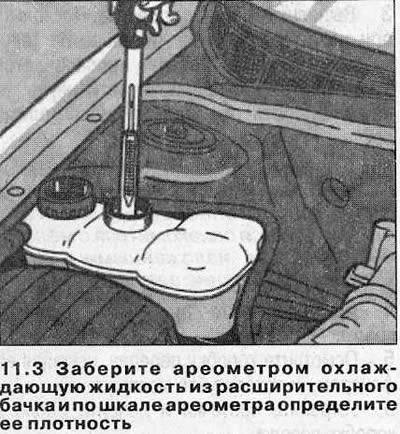
3. Use a hydrometer to take the coolant from the expansion tank and use the hydrometer scale to determine its concentration (see illustration). Protection against freezing in our latitudes must be provided down to -35°C.
Attention! The radiator and heater are made of aluminum. For this reason, only the liquid recommended by OPEL should be poured into the cooling system.
Caution! Do not mix coolants of different colors.
Increasing the antifreeze content in the coolant
Example: When measuring the coolant concentration on a car with a 4-cylinder engine, it was found that the coolant added provides freeze protection only at an ambient temperature of -10°C. To provide freeze protection at a temperature of -35°C, 3 liters of coolant should be drained from the system and 3 liters of clean antifreeze should be added to the system.

Attention! The table shows the values at a coolant temperature of +20°C.
4. Close the expansion tank cap and check the coolant concentration again after a test drive.
Visual inspection of the cooling system for leaks
5. Check the cooling system hoses for porosity by squeezing and bending them. Replace any hoses that are hardened or swollen.
The hoses should not sit too shallow on the connecting fittings.
6. Check the strength of the hose clamps. If necessary, replace the old clamps with new ones.
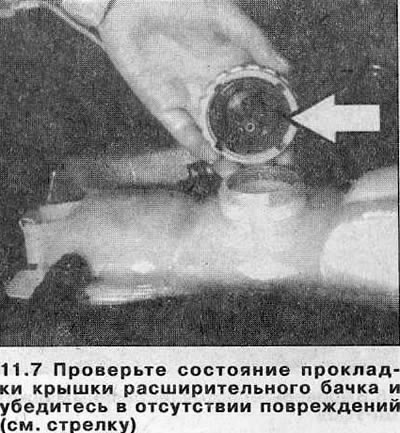
7. Check the condition of the expansion tank cap gasket and ensure that there is no damage (see arrow in illustration).
Attention! Coolant loss may be caused by an incorrectly screwed cap on the expansion tank.
If the coolant level is constantly dropping and you cannot find the leak, check the cooling system by warming up the engine.
8. Let the hot engine idle until the radiator fan comes on and check for fluid leaks from the water pump.
Significant losses of coolant and (or) the presence of oil in it, as well as white clouds of exhaust gases with a warm engine indicate a defect in the cylinder head gasket.
Attention! It is sometimes difficult to find the leak location. In this case, you should contact a workshop, which has a special device for this purpose, with the help of which the cooling system is tested under pressure. In this case, you can also check the pressure reducing valve on the expansion tank cap.
Material provided by this website: opelbook.ru
Caution! Drops of liquid on the ventilation hole of the water pump, as well as traces of its evaporation in the engine compartment should not cause concern, unless there is a significant drop in the coolant level in the expansion tank.
Visitor comments