


Contents: Idle mixture quantity correction…⬇ Hot Engine Idle Air Valve ⬇ Main dosing system 1st chamber ⬇ Main dosing system of the 2nd chamber ⬇ 2nd chamber mixture composition…⬇ Econostat ⬇ Accelerator pump ⬇
The idle system takes in fuel through the idle fuel jet 1 (see picture) and forms an emulsion with the air entering through opening 2. The emulsion passes through distribution channel 3 and enters the opening regulated by screw 4 of the mixture quality (composition), and to opening 5 of the bypass channel.
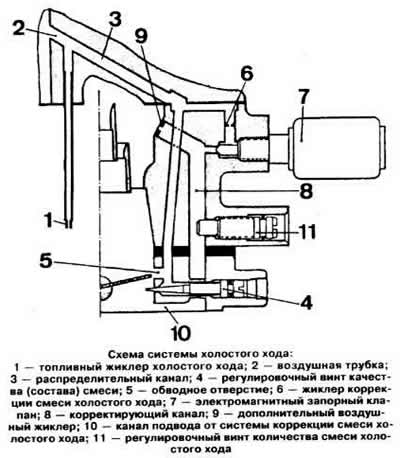
Idle mixture quantity correction system
The idle mixture correction system maintains the carbon monoxide (CO) content in the exhaust gases unchanged, regardless of the amount of additional fuel-air emulsion supplied.
The idle mixture passes through the idle mixture correction jet 6 (see picture) and electromagnetic shut-off valve 7 and enters the correction channel 8, where it receives an additional amount of air through the nozzle 9. The emulsion obtained in this way is dosed by the mixture quantity adjustment screw 11 and enters the corrected mixture supply channel 10.
Adjusting screw 11 allows you to regulate the amount of idle mixture, i.e. determine the engine crankshaft speed at idle.
Hot Engine Idle Air Valve
The hot engine idle air valve is installed in the channel connecting the upper part of the float chamber with the 1st chamber. The valve opens and closes under the action of a bimetallic spring. When the engine heats up strongly, the valve opens and an additional amount of air enters the intake manifold.
This allows compensation for the over-enrichment of the combustible mixture at idle speed, caused by the pressure of the vapors formed during the evaporation of hot fuel in the float chamber.
At normal engine operating temperature, the valve is always closed. Therefore, before adjusting the engine idle speed, it is necessary to make sure that the hot engine idle air valve is closed.
Main dosing system 1st chamber
When the throttle valve of the 1st chamber is slightly open, the vacuum in the intake manifold is large enough and, overcoming the resistance of spring 3 (see picture), moves piston 1 down together with adjusting needle 2.
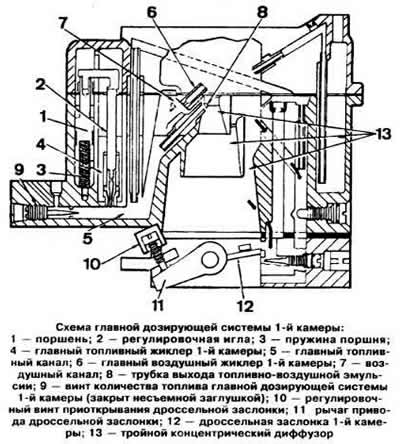
The amount of fuel coming from the main fuel jet opening is metered by the adjusting needle 2. From the jet outlet, the fuel enters the main fuel channel 5 and mixes with the air coming out of the main air jet 6 of the 1st chamber and the flow channel 7. Through the tube 8, the fuel-air emulsion enters the carburetor diffuser.
When the throttle valve of the 1st chamber is fully open, the vacuum in the intake manifold drops and spring 3 pulls piston 1 upward, removing adjusting needle 2 from the main fuel jet 4 of the 1st chamber. As a result, the amount of fuel supplied through the jet increases.
An additional amount of fuel enters the main fuel channel of the 1st chamber through an opening, the dimensions of which are determined by the position of screw 9, which is adjusted at the manufacturing plant. The screw is closed with a metal plug and there is no access to it.
Main dosing system of the 2nd chamber
The throttle valves of the 1st and 2nd chambers are mechanically linked to each other. The throttle valve of the 2nd chamber begins to open when the throttle valve of the 1st chamber is already open by ⅔ of the stroke (when releasing the bimetallic spring of the automatic starting device), i.e. during sharp acceleration and high engine speed operating modes.
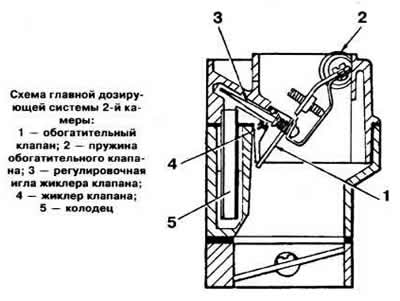
When the throttle valve of the 2nd chamber begins to open, the vacuum in the intake manifold tends to open the enrichment valve 1 (see picture), which remains in the closed position under the action of spring 2. At a certain vacuum, the enrichment valve begins to open, moving the adjusting needle 3 of the valve jet 4. Fuel coming from well 5 is sucked through the jet. The position of the adjusting screw of the metering needle of the jet is set at the manufacturer and should not be changed during operation.
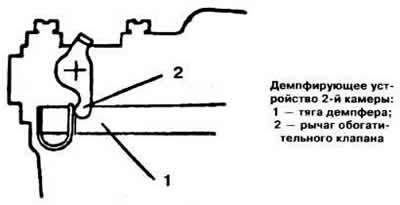
At the moment of opening of the enrichment valve, the damping device comes into action, consisting of a pneumatic drive, a rod and a lever and operating independently of the starting device.
While the throttle valve of the 2nd chamber is closed, the diaphragm of the pneumatic drive is under the action of vacuum and through rod 1 (see picture) holds the enrichment valve in the closed position. When the throttle valve of the 2nd chamber opens, the pressure in the pneumatic drive drops and the diaphragm spring smoothly moves the rod 1, releasing the lever 2 of the enrichment valve, which opens.
2nd chamber mixture composition compensation system
The carburetor has a compensation system that ensures the transition in its operation before the main metering system of the 2nd chamber is turned on. This prevents excessive depletion of the combustible mixture when the throttle valve of the 2nd chamber is opened. The mixture composition compensation system operates as long as the throttle valve of the 2nd chamber remains open.
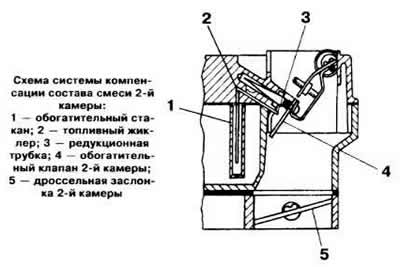
Fuel from the float chamber is drawn through a calibrated hole into the enrichment cup 1 (see picture), from where, after the throttle valve of the 2nd chamber begins to open, it passes through the jet 2 built into the carburetor body and the reduction tube 3 and enters the space in front of the enrichment valve of the 2nd chamber.
Econostat
At full engine load at speeds close to maximum, the economizer is switched on. It provides an additional amount of fuel to the diffuser of the 1st chamber.
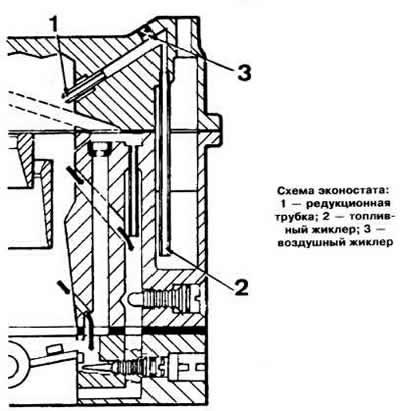
Under the action of the vacuum supplied to the reduction tube 1 (see picture), fuel is taken from the float chamber through jet 2, at the outlet of which it is mixed with air entering through air jet 3. In addition, jet 3 is designed to regulate the amount of fuel-air emulsion when the economizer is operating.
Accelerator pump
The accelerator pump regulates the amount of combustible mixture when the throttle valve of the first chamber is suddenly opened.
Lever 1 (see picture) the accelerator pump drive is connected by a rod to the throttle valve of the 1st chamber. When the valve is opened, lever 1 presses on piston 2 of the pump, which leads to uniform injection of fuel through ball valve 3 under the action of spring 4.
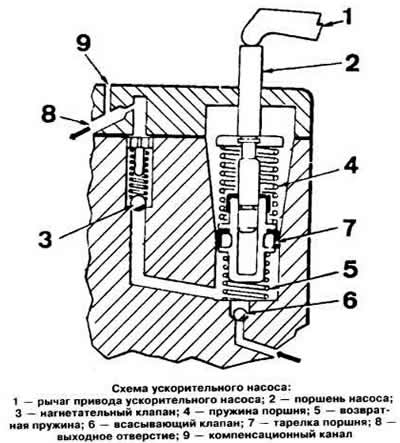
Then the return spring 5 moves the piston to its original position and the fuel again enters the pump cavity from the float chamber through the suction valve 6.
Visitor comments