


Main dosing system
Fuel for the formation of a combustible mixture is supplied through the main fuel jet 8 (see diagram), installed at an angle to the flow in the lower part of the float chamber, air is supplied through a diffuser. The required amount of air in the combustible mixture is provided by a calibrated hole in the air jet 6 of the main metering system. The emulsion tube 7 is located at the outlet of the float chamber after the main fuel jet.
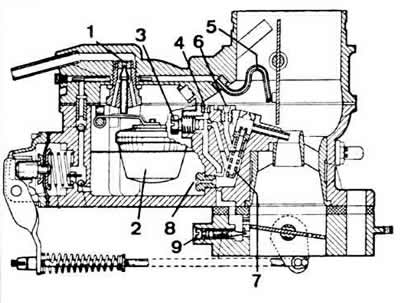
Solex 35 PDSI Carburetor Diagram
1 - needle valve;
2 - float;
3 - idle fuel jet;
4 - idle air jet;
5 - injection tube;
6 - main air jet;
7 - emulsion tube;
8 - main fuel jet;
9 — adjusting screw for idle mixture quality (composition).
Idle system
The fuel required for the engine to operate in idle mode is supplied by idle jet 3. Emulsifying air is supplied through idle air jet 4. The idle system has adjusting screws for the quantity and quality (composition) of the mixture 9.
The accelerator pump serves to supply additional fuel during acceleration of the vehicle and works as follows. At idle, the throttle valve is closed. The diaphragm is held in place by a spring, which allows the float chamber to be filled. The diaphragm is connected to the throttle actuator by means of a rod connected to the throttle valve axis. Turning the throttle valve axis when it opens causes the diaphragm to move simultaneously, and fuel from the float chamber is injected into the diffuser through a calibrated sprayer.
Fuel mixture enricher
The enricher of the combustible mixture operates when the throttle valve is fully open. It consists of a calibrated vertical tube with a weight located in the float chamber and an enricher tube located in a large diffuser. The end of the tube is located in the zone of low vacuum of the diffuser. At low and medium engine load and crankshaft speed, the vacuum in the diffuser is insufficient to lift the 0.28 g weight and collect fuel from the vertical tube. The weight is made in the form of a needle valve (see pos.25 on the exploded view of the carburetor).
As the crankshaft speed increases, the vacuum in the diffuser becomes sufficient to lift the weight and draw fuel through the tube, causing additional fuel to be supplied to the diffuser. The enrichment of the fuel mixture gradually increases until the crankshaft speed reaches its maximum.
Starting device
The starting device ensures the start and idling of a cold engine. The air damper is controlled manually from the car interior. Depending on the position, the damper can completely block the air supply to the main metering system of the carburetor. A lever with a pin is attached to the end of the air damper axis, connected by a calibrated spring to the cam of the air damper drive.
The cam, located on the carburetor cover, is connected at one end to the air damper drive cable, and at the other end, through a rod, to the fast idle lever, which is mounted on the throttle shaft.
With the help of a lock, made in the form of a spring-loaded ball and acting on the air damper lever, the air damper can be set in three fixed positions; the first two positions correspond to the complete closing of the air damper and differ only in the degree of tension of the calibrated spring, and the third position corresponds to the complete opening of the air damper.
To start a cold engine at low temperatures, pull the choke handle all the way out. This will close the choke completely and open the throttle valve slightly.
After the engine has been running with the air damper closed for some time, the duration of which depends on the outside temperature, begin to gradually press the handle until you feel the resistance of the ball valve retainer in the intermediate position. In this case, the tension of the spring holding the air damper in the closed position weakens, which makes it easier to open under the influence of vacuum, while the throttle valve remains slightly open. This ensures the optimum composition of the fuel-air mixture necessary for starting a cold engine and increasing the crankshaft speed during warming up.
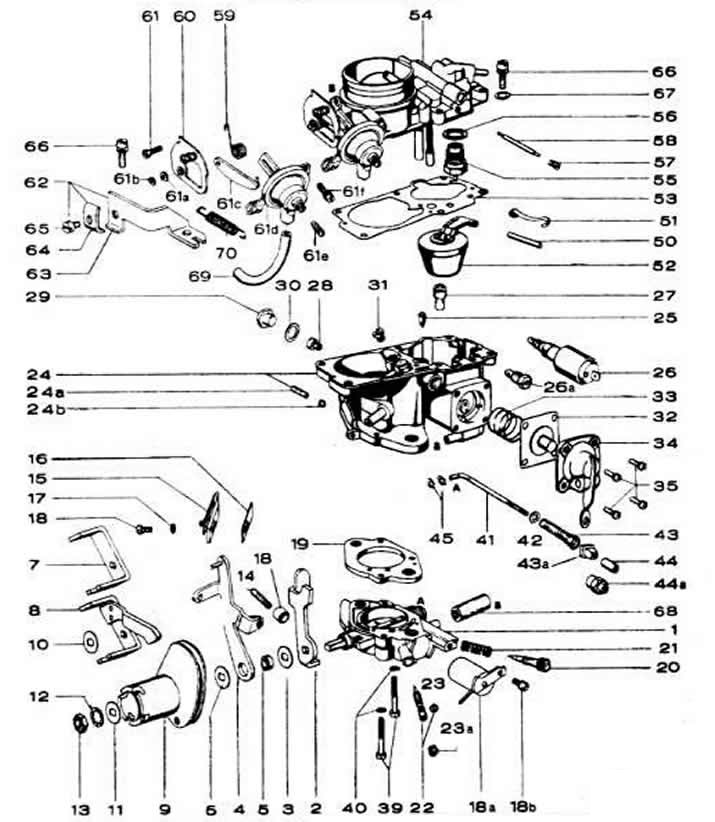
Main parts of the Solex 35 PDSI carburetor:
1 - throttle body;
9 — throttle control drum;
14 - stop screw;
19 — throttle body gasket;
20 — idle mixture quantity adjusting screw;
22 — adjusting screw for idle mixture quality (composition);
23 - gasket;
23a — plug for adjusting screw of mixture quality (composition);
24 — carburetor body;
25 — fuel mixture enrichment needle valve;
26 - electromagnetic shut-off valve;
26a - idle fuel jet;
27 — seat of the fuel mixture enrichment needle valve;
28 - main fuel jet;
29 - cork;
31 - main air jet;
32 — accelerator pump diaphragm;
41 — accelerator pump drive rod;
50 — float axis;
52 - float;
53 - carburetor cover gasket;
54 — carburetor cover;
55 - needle valve;
56 - sealing ring;
61 d — pneumatic drive of the air damper.
Visitor comments