


Contents: Automatic starting device ⬇ Idle system ⬇ Transition system of the 1st chamber ⬇ Accelerator pump ⬇ Operation of the main dosing system…⬇ Power mode economizer ⬇ Transition system of the 2nd chamber ⬇ Main dosing system of the 2nd…⬇
Automatic starting device
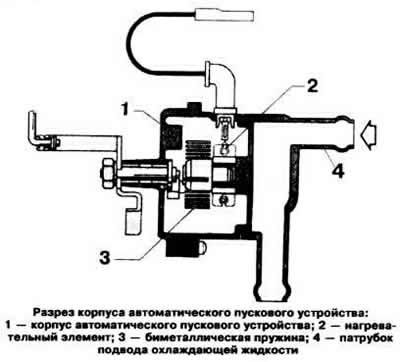
When starting a cold engine, the automatic starting device is activated by pressing the accelerator pedal. Initially, the air damper is completely closed. After the ignition is turned on, the heating circuit of the bimetallic spring located in the body of the automatic device is closed, and the spring begins to heat up.
When the engine is started, a significant vacuum is created under the air damper. The axis of the air damper is offset, so after starting the engine, the air damper opens under the action of the vacuum to a certain value depending on the counteracting force of the bimetallic spring.
Immediately after starting the engine, to prevent over-enrichment of the combustible mixture due to a drop in pressure in the float chamber, the air damper is opened by a certain amount by the pneumatic actuator rod. In this case, the engine enters the accelerated idle mode, and the accelerated idle adjusting screw is installed on the upper part of the profiled throttle control cam.
As the engine warms up, the crankshaft speed decreases when the throttle valve of the 1st chamber moves. When the accelerator pedal is pressed briefly, the fast idle speed adjusting screw, which has a mechanical connection with the throttle valve, releases the profiled cam, which moves under the action of a bimetallic spring. After releasing the accelerator pedal, the fast idle speed adjusting screw is installed on the intermediate part of the profiled cam, as a result of which the throttle valve is closed and the engine crankshaft speed decreases.
(Article posted on an online resource: opelbook.ru)
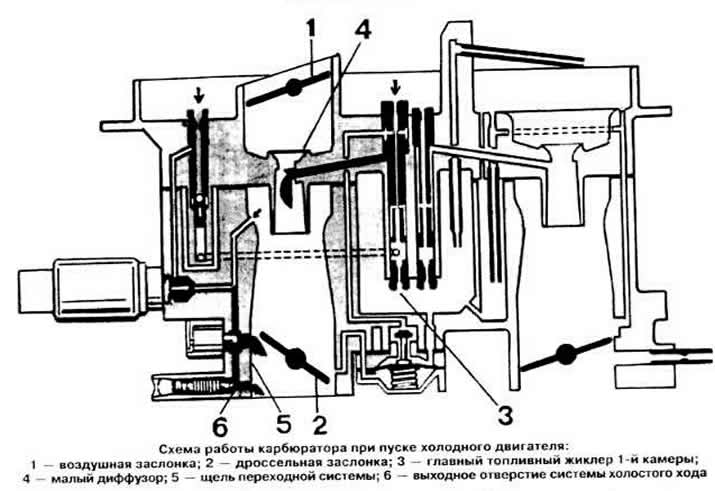
As the temperature of the heating element of the bimetallic spring and the coolant on the bimetallic spring increases, the tension of the bimetallic spring weakens and the air damper gradually opens. When the coolant warms up to a temperature above 65°C, the power supply circuit of the electric mixture heating unit and the automatic starting device is opened by a thermal switch located in the intake manifold. In this case, the air damper is fully open, the fast idle adjusting screw no longer rests on the profiled throttle control cam, and the throttle valve of the 1st chamber occupies a position corresponding to the normal idle mode.
Idle system
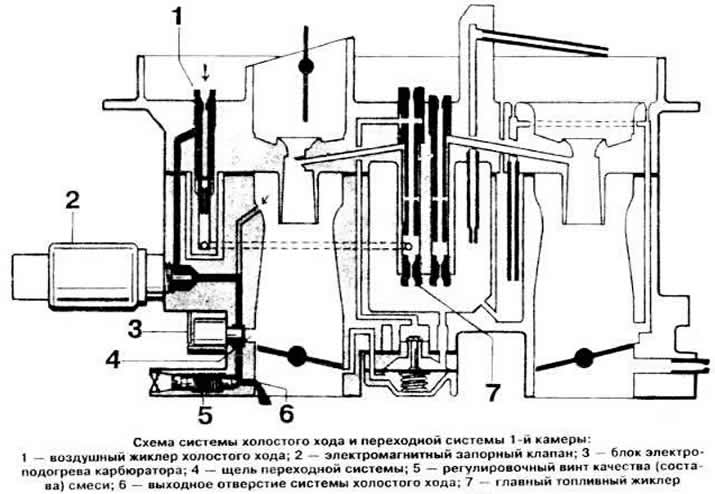
When the engine is running at idle, the throttle valve of the 1st chamber is held in a slightly open position. Fuel from the float chamber enters through the main fuel jet of the 1st chamber into the well of the emulsion tubes and is fed to the idle fuel jet. At the exit from the jet, the fuel is mixed with air passing through the idle air jet. The pre-prepared fuel-air mixture passes through a channel with an electromagnetic shut-off valve and is additionally mixed with air coming from the channel of the transition system. The finally prepared emulsion exits under the throttle valve through an opening adjusted by the mixture quality (composition) screw. The electric carburetor heating unit prevents it from icing in adverse weather conditions.
Transition system of the 1st chamber
When the accelerator pedal is pressed, the edge of the throttle valve forms a crescent-shaped gap in the area of the transition system slit, located above the outlet of the idle system. Under the action of vacuum, an additional amount of fuel-air emulsion enters the first chamber through the transition system slit, which ensures normal operation of the carburetor when switching from idle to load modes.
Accelerator pump
As soon as the throttle valve of the 1st chamber moves away from the idle position, the spring moves the diaphragm of the accelerator pump back, which leads to filling the pump cavity with fuel. When the throttle valve opens, the profiled cam acts on the pump drive lever, which compresses the diaphragm of the pump. The inlet valve closes and the diaphragm, through the ball valve and the sprayer, pumps fuel into the main mixing chamber, enriching the combustible mixture.
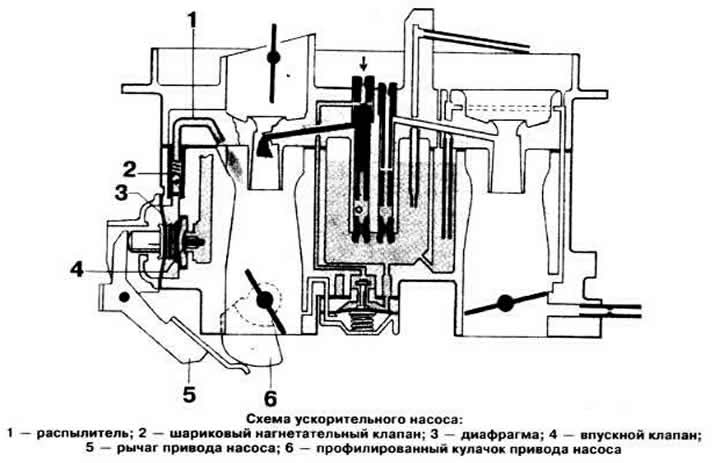
The performance of the accelerator pump is regulated by changing the position of the profiled cam of the pump drive.
Operation of the main dosing system of the 1st chamber at partial load
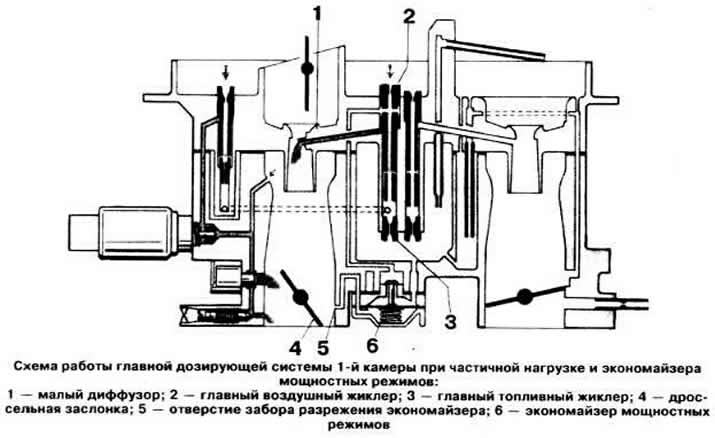
With further opening of the throttle valve of the 1st chamber, the main metering system of the 1st chamber is switched on under the action of vacuum. From the float chamber, under the action of vacuum, the fuel through the main fuel jet 1 and the chamber enters the well of the emulsion tube, where it mixes with the air coming out of the opening of the main air jet. The resulting emulsion is sprayed by the air flow passing through the small and large diffusers. At the same time, an additional amount of the working mixture enters the mixture formation zone through the gap of the transition system of the 1st chamber and the outlet opening of the idle system.
Power mode economizer
The main metering system of the 1st chamber includes a power mode economizer, which is triggered at a certain vacuum behind the throttle valve of the 1st chamber. Fuel is taken from the float chamber through the diaphragm valve. As long as the diaphragm is held by the vacuum in the intake manifold, the valve is closed. When the throttle valve opens to a certain degree, the vacuum drops and the diaphragm of the valve opens under the action of the spring. An additional amount of fuel enters the emulsion tube of the main metering system of the 1st chamber through the channels. At the same time, the supply of additional emulsion through the gap of the transition system and the outlet opening of the idle system gradually stops.
Transition system of the 2nd chamber
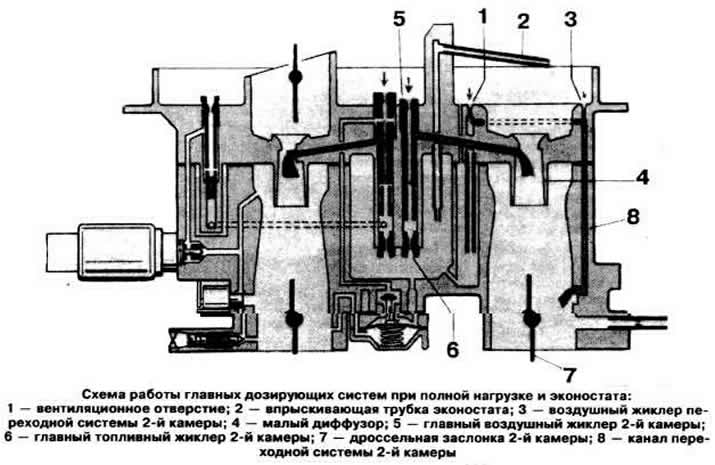
The throttle valve of the 2nd chamber remains blocked until the throttle valve of the 1st chamber opens to a certain angle. In this case, under the action of vacuum, the pneumatic actuator rod of the throttle valve of the 2nd chamber moves, ensuring its opening. The transition system operates until the main metering system of the 2nd chamber is switched on.
Main dosing system of the 2nd chamber and economizer
As the vacuum in the small diffuser zone drops, the amount of fuel-air emulsion formed in the main metering system of the 2nd chamber increases. At full load at speeds close to maximum, with the throttle valves fully open, the economizer is switched on. Fuel from the float chamber enters the fuel pipe through the economizer nozzle and is sucked into the secondary mixing chamber through the injection pipe, enriching the working mixture.
Visitor comments