


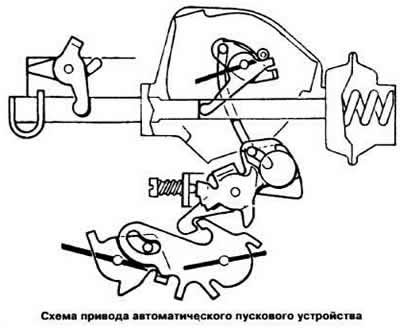
The automatic starting device has electric heating in the form of two heating elements, one of which serves for preliminary heating, and the other is switched on only after the cover of the starting device has heated up to a certain temperature. The size of the opening of the air damper during starting and warming up of the engine is determined by the pneumatic drive.
On a cold engine, when you press the accelerator pedal, the air damper closes, and its axis is held by a bimetallic spring of the starting device.
The throttle valve of the 1st chamber is slightly open, since the screw by means of which its opening is regulated rests on the upper profile of the idle sector (at the same time, a special rod prevents the throttle valve of the 2nd chamber from opening).
The vacuum from the intake manifold when the engine starts reaches the space under the air damper. Under the action of the vacuum, fuel is taken through an additional small diffuser of the triple diffuser of the carburetor. At the same time, the air damper opens slightly, opening the access of air necessary for the formation of a combustible mixture.
During engine operation at fast idle speed, to prevent over-enrichment of the combustible mixture, the automatic starting device is connected to the air damper pneumatic drive, which is triggered by a large vacuum in the space under the air damper. The pneumatic drive rod gradually partially opens the air damper.
After the ignition is turned on, the bimetallic spring heats up and expands, gradually opening the air damper. When the engine warms up, the air damper opens to the maximum, completely opening the air supply to the carburetor.
The vacuum drops and the diaphragm of the air damper pneumatic drive is released, and under the action of its spring, the pneumatic drive rod returns to its original position.
Visitor comments