
OpelBook.ru
Cars AvtoVAZ Cars Mitsubishi Cars BMW Cars Mercedes Cars Nissan Cars Toyota Cars Chevrolet
English Русский
Български
Беларускі
Український
Српски
Hrvatski
Română
Polski
Slovenský
Magyar
 |  Sitemap  |  Contacts  |    


Main Astra Corsa Insignia Kadett Omega Vectra Zafira Others Articles
Vectra A (1988-1995, petrol) Vectra A (1988-1995) Vectra B (1995-2002, petrol) Vectra B (1995-2002) Vectra C (2002-2008)
  • Main
  • Vectra
  • Vectra B
  • Chassis
  • Wheels and tires
  • Wheel replacement

Wheel replacement (Opel Vectra B)

            0

Changing a wheel on the road is not that easy. The bolts on the wheel may be rusty, or they may have been hammered in with an impact driver in the workshop (instead of tightening to the prescribed torque of 110 Nm). In this case, the tools in the car will not help, but only a powerful wrench for wheel bolts or a wheel cross with a piece of pipe put on it to strengthen the lever.

Still, dare to change the wheel sometime, even if it hasn't been in an accident. At the same time, check whether the jack still works and whether you can unscrew the wheel bolts with a wheel wrench.

In case of a tire accident, stop as quickly as possible. But brake very carefully, otherwise the car will start tossing, despite the ABS. When changing a wheel, behave in such a way as not to interfere with other road users and not to endanger yourself. Immediately secure your car with hazard warning lights and an emergency triangle.

Apply the handbrake and engage 1st gear or reverse.

Also, turn on your hazard warning lights and place a warning triangle.

Secure the wheels on the other side of the car from rolling, for example by propping them up with stones or pieces of wood.

If the rims are steel, insert your fingers into the holes in the cast wheel cap and remove the cap or use a removable clamp (on-board instrument).

For rims made of light metals, carefully pry off the protective caps with a screwdriver.

Use the key to open the wheel bolt lock, if there is one.

Loosen the wheel bolts one turn only.

Install the jack, tilted outward, in the designated place at the lower edge of the body (see the chapter "Workplace").


If the ground is soft, place a board under the jack.

Raise the car

Unscrew the bolts completely.

Remove the wheel and install the spare.

Tighten the bolts evenly and crosswise, rotating the wheel back and forth to ensure it is perfectly centered on the hub.

Lower the vehicle, tighten the bolts (110 Nm).

Install the decorative cap and protective caps. When installing the cap, pay attention to the location of the hole for the tire valve

After driving a short distance, check the bolts for tightness.

Tire repair


Repairing steel-cord radial tires is problematic. If the defect is detected after a significant period of time, the tire carcass may have been damaged by prolonged driving with too low air pressure. If moisture has penetrated through the puncture, rust may corrode the stabilizing steel cord. It is dangerous when the damage cannot be detected from the outside. If the repaired tire is subjected to heavy loads (high speed, full load), it may fail suddenly. Inserting the camera is only a poor last resort, as the protruding steel wire in the damaged area may rub the camera.

Tip: If you are repairing a steel-belted radial tire at a workshop, have it repaired by a tire repair service. If necessary, mark the tire as a spare tire, no longer suitable for high speeds, and put it in the spare tire well. If in doubt, buy a new tire.
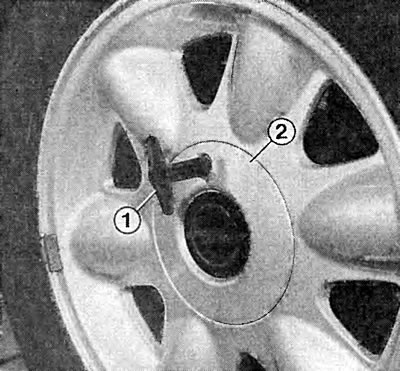

To replace a factory-fitted alloy wheel, you will need the special key (1) shown here to be able to…

To replace a factory-fitted alloy wheel, you will need the special key (1) shown here to be able to unscrew the hubcap (2).


This article is available at russian, bulgarian, belarusian, ukrainian, serbian, croatian, romanian, polish, slovak, hungarian
Checking the article: Shapovalov Yaroslav

Share information:

Previous articles
Opel Vectra B: Wheels and tires
Next articles

Help with tire problems
Checking the condition of the tires
Checking tire pressure
Rims — description and care
Tyre designation
What tires should I install?
Wheel mounting position
Checking the tightness of wheel bolts
Unbalanced wheels
Anti-skid chains


See similar ones from other Opel car manuals:
▶ Rear Brake Wheel Cylinder — Removal, Repair and Installation Opel Astra F (1991-1998, petrol)
▶ Removal, repair and installation of front wheel disc brake… Opel Corsa B (1993-2000)
▶ Wheel replacement Opel Insignia A (2008-2017)
▶ Front wheel drive Opel Kadett E (1984-1995)
▶ Seat and steering wheel adjustments Opel Omega A (1986-1993)
Link to this page in different formats

Visitor comments


No comments yet


How much will 23 + 31 =


Vectra C (2002-2008) 
  • General information
  • User manual
  • Vehicle device
  • Maintenance
  • Troubleshooting
  • Power unit
  • Engine repair
  • Cooling system
  • Power and control system
  • Engine electrics
  • Transmission
  • Clutch
  • Car gearbox
  • Drive shafts
  • Chassis
  • Car suspension
  • Steering
  • Brake system
  • Body
  • Exterior
  • Interior
  • Doors, locks and windows
  • Heating and ventilation
  • Electrical equipment
  • Equipment and devices
  • Headlights and lighting
  • Electrical circuits
Vectra B (1995-2002) 
  • General information
  • User manual
  • Weekly checks
  • Maintenance (gasoline)
  • Maintenance (diesel)
  • Troubleshooting
  • Power unit
  • SOHC gasoline engine
  • DOHC petrol engine
  • Diesel engine 1.7 liter
  • Diesel engine 2.0 liters
  • Engine repair
  • Cooling system
  • Fuel system (gasoline)
  • Fuel system (diesel)
  • Charging system
  • Launch system
  • Ignition and preheat
  • Transmission
  • Clutch
  • Mechanical gearbox
  • Automatic gearbox
  • Drive shafts
  • Chassis
  • Brake system
  • Wheel suspension
  • Steering
  • Body
  • Exterior
  • Interior
  • Doors and windows
  • Heating and ventilation
  • Electrical equipment
  • Equipment and devices
  • Electrical circuits
Vectra B (1995-2002, petrol) 
  • General information
  • Maintenance
  • Help with malfunctions
  • Power unit
  • Engine repair
  • Exhaust system
  • Cooling system
  • Fuel system
  • Multec injection system
  • Four point injection
  • Transmission
  • Clutch
  • Gearbox and drive
  • Chassis
  • Wheel suspension
  • Steering
  • Brake system
  • Wheels and tires
  • Body
  • Exterior
  • Interior
  • Electrical equipment
  • Fuses and electronics
  • Power devices
  • Ignition system
  • Lighting and signaling
  • Equipment and devices
  • Heating and ventilation
  • Electrical circuits
Vectra A (1988-1995) 
  • Power unit
  • Engine repair
  • Ignition system
  • Lubrication system
  • Cooling system
  • Injection system
  • Fuel system (carburetor)
  • Fuel system (diesel)
  • Exhaust system
  • Transmission
  • Clutch
  • Car gearbox
  • Chassis
  • Front suspension
  • Rear suspension
  • Steering
  • Brake system
  • Wheels and tires
  • Body
  • Exterior
  • Interior
  • Electrical equipment
  • Electrical circuits
Vectra A (1988-1995, petrol) 
  • General information
  • User manual
  • Maintenance
  • Power unit
  • SOHC engine
  • DOHC engine
  • Cooling and ventilation
  • Fuel system (carburetor)
  • Fuel system (injector)
  • Exhaust converter
  • Transmission
  • Clutch
  • Mechanical gearbox
  • Automatic gearbox
  • Drive shafts
  • Chassis
  • Brake system
  • Car suspension
  • Steering
  • Body
  • Body elements
  • Electrical equipment
  • Power devices
  • Equipment and devices
  • Electrical circuits
OpelBook.ru © 2017–2026 · Mobile version · · Sitemap: EN BG BY UA RS HR RO PL SK HU · Feedback · Site search
Astra F, petrol · Astra G, petrol · Astra G · Astra H · Astra J, petrol · Corsa B · Corsa C, petrol · Corsa C · Insignia A · Kadett D · Kadett E · Omega A · Omega B · Omega B2 · Vectra A, petrol · Vectra A · Vectra B, petrol · Vectra B · Vectra C · Zafira A, petrol · Frontera A, petrol · Frontera B · Ascona C · Vivaro A ·
We want your visit to be comfortable 🤝! We use cookies 🍪 to make that happen.