


Place the vehicle on a level, solid and non-slip surface. The front wheels should be pointing straight ahead.
Apply the parking brake, select first gear, reverse gear, or move the gear selector to position P.
Take out the spare tire.
It is strictly forbidden to change several wheels at the same time.
Use the jack only to change a flat tire, not to change from summer to winter tires or vice versa,
If the car is on soft ground, a strong board should be placed under the jack (no more than one centimeter thick).
There must be no people or animals in the posted vehicle.
Do not position yourself under a vehicle that is raised on a jack.
Do not start the engine on a raised vehicle.
Before installing the wheel, clean the wheel nuts and threads.
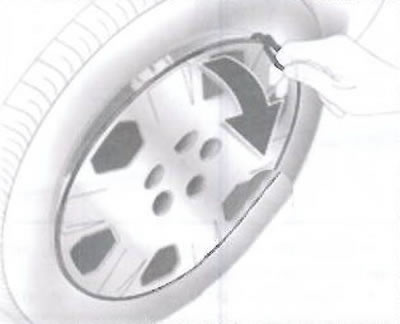
Use a screwdriver to pry up the lug nut caps and remove them. Remove the wheel cap using the hook.
Alloy wheels: Pry the lug nut caps with a screwdriver and remove them. Place a soft cloth between the screwdriver and the alloy wheel to protect the wheels.
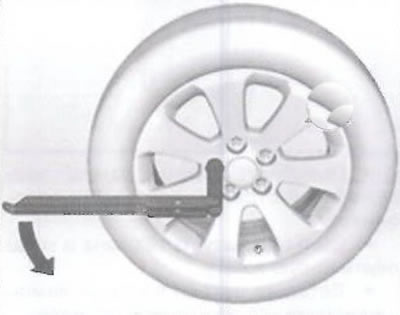
Lay out the wheel lug wrench and position it, making sure it is secure, then loosen each wheel nut by half a turn.
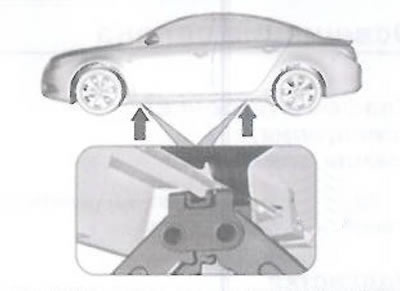
Make sure that the jack is installed at the vehicle jacking points.
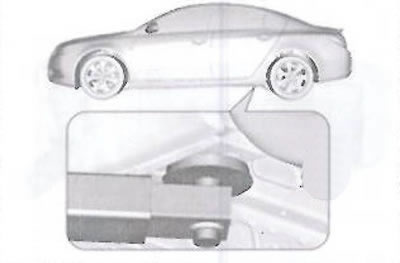
Loading a car onto a lifting platform
Place the rear arm of the lifting platform under the bottom of the vehicle.
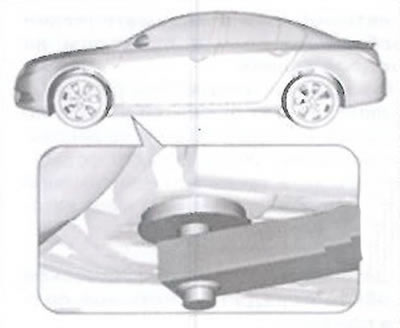
Place the front arm of the lifting platform under the bottom of the vehicle.
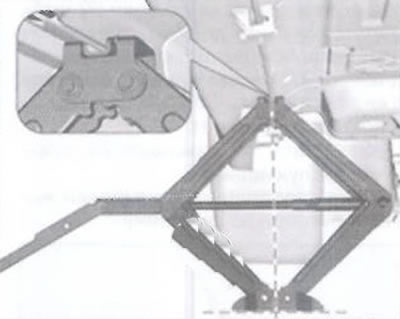
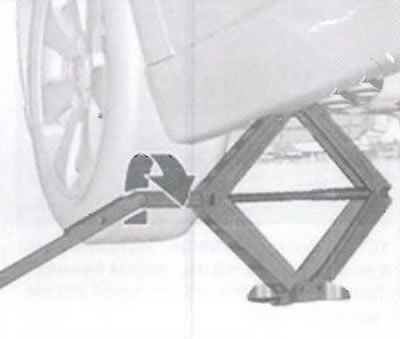
Set the jack to the required height. Place it directly under the jacking point so that it does not slip.
Remove the wheel nuts.
Replace the wheel.
Tighten the wheel nuts.
Lower the car.
Fit the wheel lug wrench, make sure it is secure and tighten the nuts crosswise. The bolts should be tightened to 150 Nm.
Before installing the wheel cover, align the valve hole provided in the wheel cover with the tire valve.
Install the wheel nut caps.
Remove the damaged wheel and tool kit.
Check the tire pressure of the installed wheel and the tightening torque of the wheel nuts as soon as possible.
Replace or repair the faulty tire.
Visitor comments