
OpelBook.ru
Cars AvtoVAZ Cars Mitsubishi Cars BMW Cars Mercedes Cars Nissan Cars Toyota Cars Chevrolet
English Русский
Български
Беларускі
Український
Српски
Hrvatski
Română
Polski
Slovenský
Magyar
 |  Sitemap  |  Contacts  |    


Main Astra Corsa Insignia Kadett Omega Vectra Zafira Others Articles
Insignia A (2008-2017)
  • Main
  • Insignia
  • Insignia A
  • General information
  • Repair on the road
  • Towing a car

Towing a car (Opel Insignia A)

            0

Contents: Cars with manual transmission and…⬇ On vehicles with automatic…⬇ On vehicles with automatic…⬇
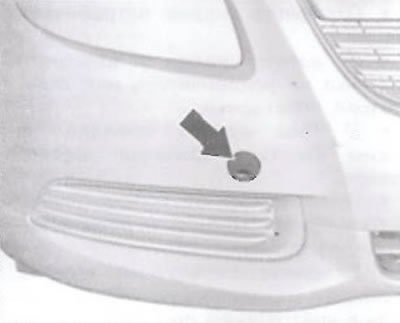
Towing a car


Remove the cover shown in the illustration.
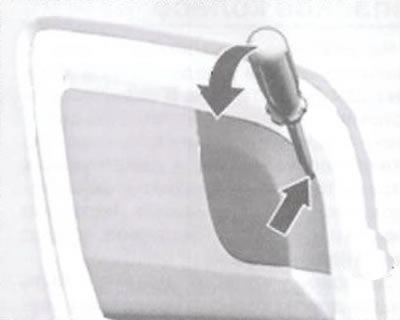
Remove the cover shown in the illustration.


Note: Insignia OPC: Insert a screwdriver into the slot at the top arc of the cap. Release the cap by gently sliding the screwdriver downwards. To avoid damage, it is recommended to place a rag between the screwdriver and the frame.


The towing eye is stored in the tool kit.

[Material provided by this website: opelbook.ru]
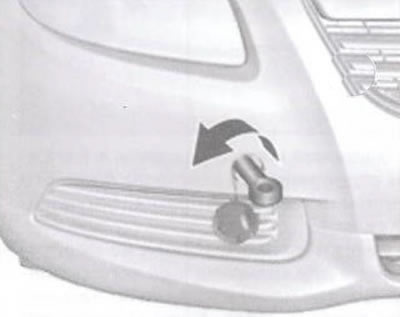
The towing eye is stored in the tool kit.


Screw the towing eye in until it stops, leaving it in a horizontal position. Attach a towing rope or, better yet, a towing bar to the eye. The towing eye is only allowed to be used for towing on the road, but not for pulling out a stuck vehicle. Turn on the ignition to unlock the steering wheel and enable the brake light, horn and windshield wipers to be turned on.


The gearbox must be in neutral.

Caution: Move off slowly. Avoid jerking. Too much traction can damage the vehicle.


When the engine is not running, braking and steering require significantly more effort. To prevent exhaust gases from the towing vehicle from entering the passenger compartment, close the windows and turn on the air recirculation system.

Cars with manual transmission and all-wheel drive system


If all four wheels of the towed vehicle are in contact with the road, the speed and distance of towing are technically unlimited. If only one axle is lifted, the maximum speed must be 50 km/h. There are no restrictions regarding the distance.

On vehicles with automatic transmission and front-wheel drive


The vehicle should be towed in the direction of its forward movement at a speed of no more than 80 km/h for a distance of no more than 100 km. In all other cases, as well as in the case of a faulty gearbox, the front axle of the vehicle must be raised.

On vehicles with automatic transmission and all-wheel drive system


The vehicle must be towed forward. If the vehicle is towed with the weight of its wheels on the road, the speed must not exceed 50 km/h and the distance must not exceed 50 km. If the front axle is lifted, the maximum speed must be 50 km/h. There are no restrictions on the distance.

Contact a service station for assistance.

After towing is complete, remove the towing eye.
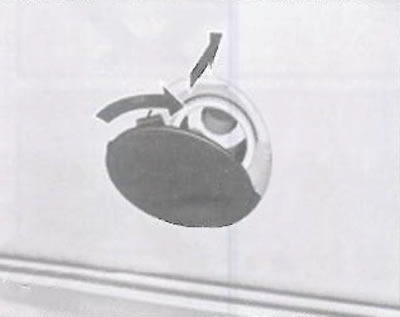
After towing is complete, remove the towing eye.


Install the cap by inserting the bottom part first, then turn the cap slightly clockwise and close it.

Note: Insignia OPC: Insert the bottom edge of the cap into the slot. Press the cap down and insert it into the bumper.


This article is available at russian, bulgarian, belarusian, ukrainian, serbian, croatian, romanian, polish, slovak, hungarian
Checking the article: Zinoviev Kirill

Share information:

Previous articles
Opel Insignia A: Repair on the road
Next articles

Starting the engine from an external power source
Tires with the specified direction of rotation
Spare wheel
Side direction indicators and instrument panel lighting
Wheel replacement
Tire repair kit
Towing another vehicle


See similar ones from other Opel car manuals:
▶ Towing a car Opel Astra G (1998-2004, petrol)
▶ Jacking and towing Opel Corsa B (1993-2000)
▶ Lifting and towing a car Opel Kadett E (1984-1995)
▶ Towing a car Opel Omega B2 (1999-2003)
▶ Towing a car Opel Vectra A (1988-1995)
Link to this page in different formats

Visitor comments


No comments yet


How much will 10 + 10 =


Insignia A (2008-2017) 
  • General information
  • Repair on the road
  • Daily checks
  • Operation and maintenance
  • Safety and tool
  • Power unit
  • Petrol engines 1.6 l
  • Petrol engines 2.0 l
  • Diesel engines 2.0 l
  • Diesel engines 2.8 l
  • Cooling system
  • Lubrication system
  • Supply system
  • Engine management
  • Intake and exhaust system
  • Engine electrical equipment
  • Transmission
  • Clutch
  • Mechanical gearbox
  • Automatic gearbox
  • Transfer case
  • Drive shafts
  • Chassis
  • Wheel suspension
  • Brake system
  • Steering
  • Body
  • Exterior
  • Interior
  • Passive safety
  • Heater and air conditioner
  • Electrical equipment
  • Electrical circuits
OpelBook.ru © 2017–2026 · Mobile version · · Sitemap: EN BG BY UA RS HR RO PL SK HU · Feedback · Site search
Astra F, petrol · Astra G, petrol · Astra G · Astra H · Astra J, petrol · Corsa B · Corsa C, petrol · Corsa C · Insignia A · Kadett D · Kadett E · Omega A · Omega B · Omega B2 · Vectra A, petrol · Vectra A · Vectra B, petrol · Vectra B · Vectra C · Zafira A, petrol · Frontera A, petrol · Frontera B · Ascona C · Vivaro A ·
We want your visit to be comfortable 🤝! We use cookies 🍪 to make that happen.