


Attention. Do not exceed 80 km/h. Do not use the repaired wheel for a long time, the controllability and running characteristics of the car may deteriorate.
If the tire is damaged:
- Apply the parking brake, select first gear, reverse gear, or move the gear selector to position P.
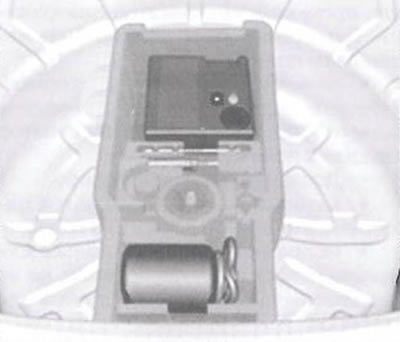
The tire repair kit is located in the compartment under the floor cover in the trunk or in the storage box under the seat.
Remove the tire repair kit from the drawer.
Remove the compressor.
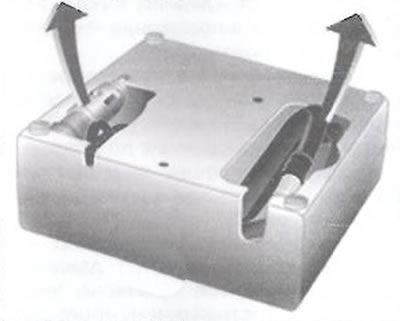
Remove the connecting electrical cord and air hose from their storage compartments under the compressor.
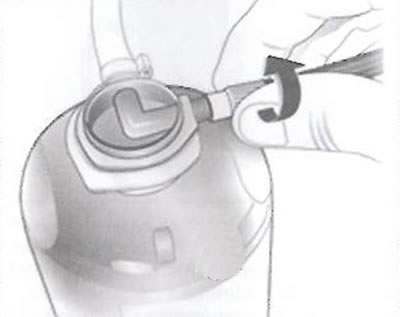
Screw the air hose from the compressor onto the nipple of the sealant can.
Attach the sealant can to the compressor holder.
Place the compressor next to the tire so that the sealant bottle is vertical.
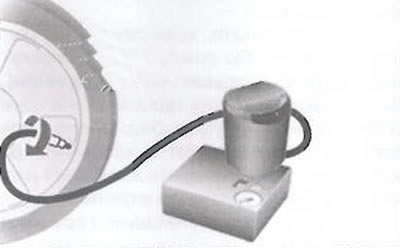
Unscrew the valve cap of the damaged tire.
Screw the free end of the hose onto the tire valve.
The compressor switch must be set to the "O" position.
Insert the compressor power plug into an accessory power outlet or cigarette lighter.
To avoid discharging the battery, it is recommended to start the engine.
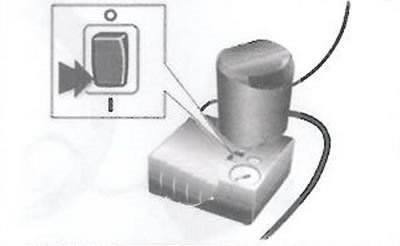
Set the compressor switch to the "I" position. The tire will be filled with sealant.
If the sealant in the reservoir runs out, the compressor pressure gauge will briefly (about 30 seconds) shows pressure up to 6 bar.
Then the pressure starts to drop, which means that all the sealant has been pumped into the tire.
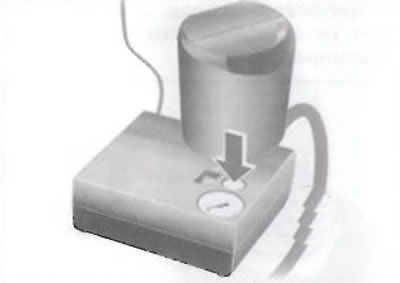
After this, the tire needs to be inflated with air. The working pressure in the tire will be established in about 10 minutes. Once the desired pressure is reached, turn off the compressor.
The source is on the online website Opelbook.ru
If the specified pressure is not established after 10 minutes, remove the tire repair kit. Move the car so that the wheels make a full turn. Reinstall the tire repair kit and continue to inflate the tire for another 10 minutes. If the required pressure is still not established, the tire is very badly damaged. Contact a service station for assistance.
Release excess pressure from the tire using the button on the pressure gauge.
Turn on the compressor for no more than 10 minutes.
Remove the tire repair kit. To remove the sealant bottle, push the clamp on the bracket. Screw the tire inflation hose onto the free nipple of the sealant bottle. This will keep the sealant in the bottle. Store the tire repair kit in the luggage compartment.
Remove any protruding sealant with a rag.
Remove the sticker from the sealant can that indicates the maximum permissible driving speed and stick it in the field of view of the gel driver.
Continue driving immediately to allow the sealant to spread evenly across the tire. After driving for approximately 10 km (but not longer than 10 minutes) you should stop and check the air pressure in your tires. To do this, screw the air hose of the compressor directly onto the tire valve and the compressor.
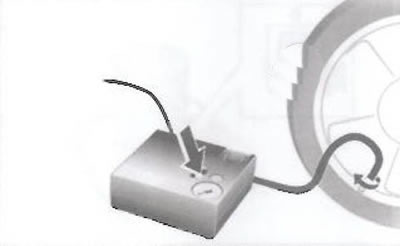
Note: If the pressure is more than 1.3 bar, bring the pressure to the required value. Repeat the procedure until the pressure stops falling. If the pressure drops below 1.3 bar, the car cannot be used. In this case, contact a service station for assistance.
Store the tire repair kit in the trunk.
Note.
- Such repairs significantly reduce driving performance, so this tire should be replaced as soon as possible. If there are unusual sounds or if the compressor gets very hot, it should be turned off for at least 30 minutes. The built-in safety valve opens at a pressure of 7 bar.
- Check the expiration date of the kit. After the expiration date, the manufacturer cannot guarantee effective puncture repair. Carefully read the storage information on the sealant can. Replace the used can. Dispose of the can in accordance with legal requirements.
The compressor and sealant can be used at temperatures down to -30°C. The included adapters can be used to inflate balls, air mattresses, inflatable boats, etc. They are stored at the bottom of the compressor. To remove the adapter, screw the compressor air hose onto it and pull.
Visitor comments