


Contents: Jacking up ⬇ Towing a damaged vehicle ⬇
Jacking up
The jack included in the standard vehicle package is intended for wheel changing procedures only! When performing any other repair or maintenance work, the vehicle must be lifted using a hydraulic (or cart) jack and must be installed on special supports placed under the load-bearing points of the bottom. If there is no need to remove the wheels, the car can be driven into an inspection pit or overpass.
Do not start the engine of a raised vehicle - it is dangerous!
To avoid serious damage to the units, do not place the jack under the crankcase, gearbox or rear axle!
To jack up a car, you should set the parking brake and, for safety, place a wheel chock under the rear wheel located diagonally to the corner being jacked up.
When jacking up the rear corner of a vehicle, the transmission should be in gear instead of the parking brake.
If working on a slope, place the stop on the lower side of the wheel.
Before jacking up the car, remove the decorative cap and use a wheel brace to loosen the mounting bolts of the wheel to be replaced. Have the spare wheel ready.
Try to install the jack on a hard surface, if necessary try to get some hard pad with a sufficiently developed surface (for example, a piece of board).
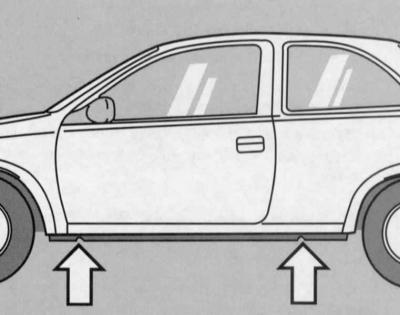
The jack should be inserted into specially designed reinforced points in the front or rear part of the thresholds.
Jack mounting points
Material copied from the portal: opelbook.ru
On models with side sill trim elements, before installing the jack under the vehicle, it is necessary to remove the trim element - pull on its lower edge, turn it upwards and remove it.
Make sure that the jack head is securely engaged with the sill stiffener protrusion.
Special groove on the jack head
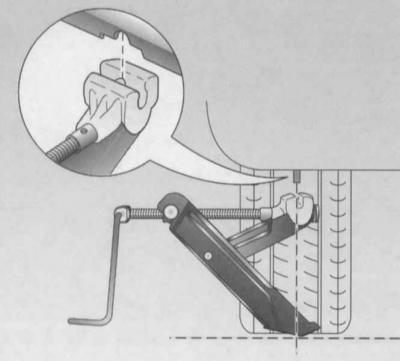
Turn the jack handle to raise the car enough to lift the wheel to be replaced off the ground - make sure that the jack pad is constantly resting on the ground with its entire surface and is positioned directly under the head. Remove the mounting bolts, remove the wheel and install the spare in its place. Screw on the wheel bolts, then lower the car to the ground, remove the jack and tighten the wheel mounting bolts diagonally with the required force. Replace the cap. Fold and put away the tool. Do not forget to remove and put away the wheel chocks.
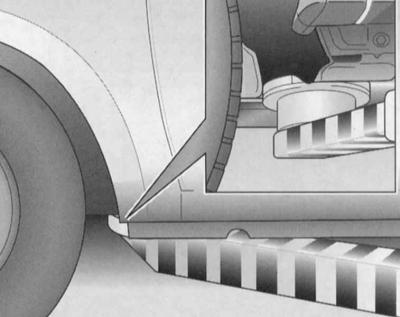
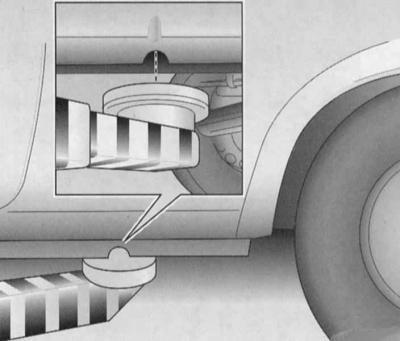
When fixing the car in a raised position, the heads of the supports/lift legs should be moved slightly outward (along the vehicle axis) jacking points of thresholds.
Lift paw placement points
Towing a damaged vehicle
If there is no transmission oil/ATF in the manual transmission or automatic transmission, the vehicle must be towed only with the drive wheels off the ground!
Strictly speaking, the car should be towed with the front wheels off the ground (it's best to use a tow truck platform). If you have to tow the vehicle without lifting the front wheels, turn the ignition key to the OFF position to avoid damaging the steering wheel lock.
Vehicles equipped with AT can be towed in forward gear on all four wheels at a speed not exceeding 80 km/h and for a distance not exceeding 100 km. Before starting towing, check the transmission fluid level (see Chapter Vehicle settings and routine maintenance). Perform the following preparatory procedures:
- Release the parking brake;
- Start the engine;
- Move the selector lever to position D, then to neutral (N);
- Turn off the engine;
- Turn the ignition key to the OFF position (do not leave it in the LOCK position under any circumstances).
Never tow a vehicle equipped with an AT in reverse without lifting the front wheels off the ground!
If you need to tow a vehicle equipped with a manual transmission without lifting the wheels off the ground, be sure to shift the control lever to neutral and release the parking brake.
When towing a damaged vehicle, use only a towing strap designed for this purpose, which can be purchased inexpensively at almost any auto accessory store. The strap should only attach to supporting body parts - never to the bumper. The vehicles covered in this manual are equipped with rear and front towing eyes.
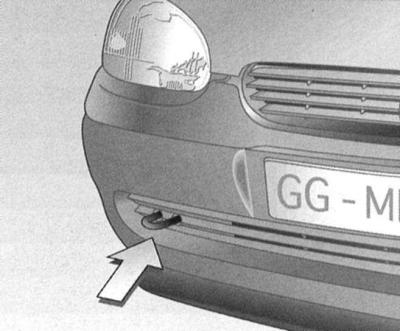
Towing eye at the front of the car
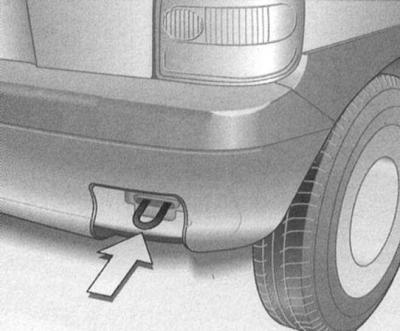
Towing eye at the rear of the car - Hatchback models
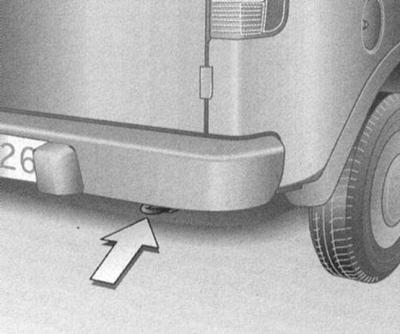
Towing eye at the rear of the vehicle - Combo models
To install a removable front eye, you must first remove the plug installed on the bumper or fold back the cover (depending on the body type). Remove the removable eye from the cover stored in the spare tire niche and screw its threaded part into the socket until it stops.
Remember to turn the ignition key of the towed vehicle to the ON position, otherwise the steering column lock will inevitably be activated. In addition, when the ignition is on, the turn signals and brake lights are also activated.
Remember that when the engine is off, the car's braking efficiency is significantly reduced due to the fact that the brake booster stops functioning. In this case, you should press the foot brake pedal with a little more force than usual. On models equipped with a power steering, when maneuvering, you will have to apply more force to the steering wheel.
When starting off and changing gears, the driver of the towing vehicle must pay special attention to the smooth release of the clutch. The driver of the towed vehicle must try to keep the towing strap taut at all times to avoid jerking and running over the strap by the wheels - ideally, an elastic strap should be used, or better yet, a rigid rod.
Before starting to move, drivers of both vehicles (towing and towed) the route should be agreed upon among themselves.
Movement should be carried out only at moderate speeds, along the shortest route and in compliance with traffic regulations. Avoid sudden braking, acceleration and maneuvering. Remember that when towing a car along the side of the road or a narrow dirt road, there is always a risk of skidding off the roadway.
Both vehicles must have external lighting devices turned on in accordance with traffic regulations.
Visitor comments