
OpelBook.ru
Cars AvtoVAZ Cars Mitsubishi Cars BMW Cars Mercedes Cars Nissan Cars Toyota Cars Chevrolet
English Русский
Български
Беларускі
Український
Српски
Hrvatski
Română
Polski
Slovenský
Magyar
 |  Sitemap  |  Contacts  |    


Main Astra Corsa Insignia Kadett Omega Vectra Zafira Others Articles
Vectra A (1988-1995, petrol) Vectra A (1988-1995) Vectra B (1995-2002, petrol) Vectra B (1995-2002) Vectra C (2002-2008)
  • Main
  • Vectra
  • Vectra B
  • Chassis
  • Wheels and tires
  • Unbalanced wheels

Unbalanced wheels (Opel Vectra B)

            0

Contents: Wheel balancing ⬇ Winter tires ⬇ Disposal of old tires ⬇
Wheel imbalance is felt by vibration in the steering wheel and shaking in the front of the car. This is especially noticeable at certain speeds. The reason lies in the uneven distribution of the wheel weight.

Static imbalance is already evident when the wheel is allowed to swing freely on a raised vehicle: the center of gravity spontaneously turns downwards. A wheel that has only static imbalance bounces when moving.

Dynamic imbalance is only apparent when the wheel is rotating. This is the case when the overweight point is not in the middle plane of the wheel, but is shifted slightly outward or inward. Then the wheel not only bounces, but also swings.

Wheel balancing


Wheels must be statically and dynamically balanced. There are two methods for this: O The wheel of the car is removed and screwed onto a balancing machine. There it is rotated for testing. This provides information about the imbalance, which is leveled by adding lead weights.

Precise balancing is required to eliminate residual imbalance. This involves equalizing the imbalance of the wheel hub and brake disc. The wheels mounted on the machine are driven at the required speed by a motor (front) or an electric motor with a friction wheel (rear) and show residual imbalance. It is equalized again using lead weights.
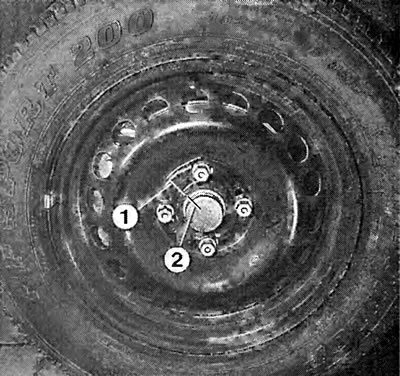
If a wheel that is in good condition and balanced on the vehicle is to be remounted, for example…

If a wheel that is in good condition and balanced on the vehicle is to be remounted, for example after a brake test, it must be bolted to the hub in the same place. To do this, mark the mounting position on the rim (1) and hub (2) as shown here.
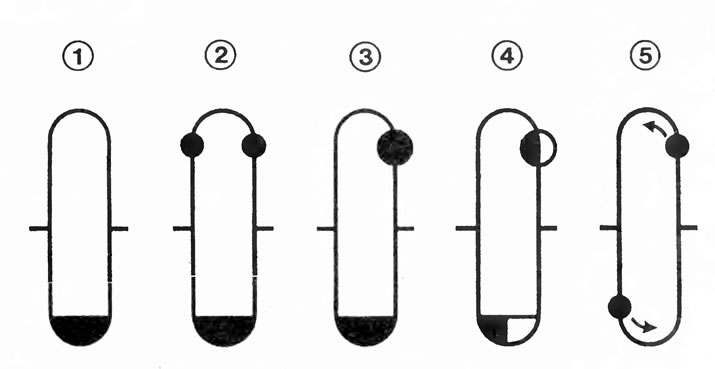

Static and dynamic imbalance in different situations:

Static and dynamic imbalance in different situations:
1 - purely static imbalance;
2 - static imbalance is equalized if 100g weights are placed on both sides of the rim;
3 - only one side of the rim has a 200g weight, which creates a dynamic imbalance;
4 - the imbalance is leveled, but there is no crosswise balance - the wheel swings;
5 - when the wheel rotates, the dynamic imbalance always pulls towards the center line and as a result, the wheel swings.


Tip: Precise balancing is especially recommended on the front wheels of the Vectra. Even the slightest imbalance is felt in the steering wheel. Balancing the rear wheels of the car is generally not necessary.


Winter tires


Summer tires are prone to slipping on snow and ice. Depending on the application and the summer tires you have, it may not always be possible to avoid purchasing special winter tires.

(Source is on the website: www.OpelBook.ru)

No matter what tires you drive on, always remember: at temperatures near freezing, smooth ice forms a film of water when driving on it, which dangerously reduces the grip of even the best winter tires.

With the Vectra you have the choice between traditional M+S tyres, which can be used at speeds up to 160 km/h, and more expensive high-speed tyres with a speed rating of up to 190 km/h. Anyone who drives on Q-class winter tyres should have a reminder somewhere on the dashboard stating the maximum speed limit of 160 km/h (available from a tire dealer or workshop).

As for sizes, we recommend the narrowest possible model for winter tires. This is also related to the price: narrower tires are cheaper than wide ones. The money saved is immediately used to buy suitable rims, since regular remounting in spring and autumn will cost more over time.

M+S tyres with a profile depth of less than 4 mm are no longer suitable for winter use. If winter tyres are prescribed somewhere in the mountains, M+S tyres are only considered as such if their profile depth is at least 4 mm.
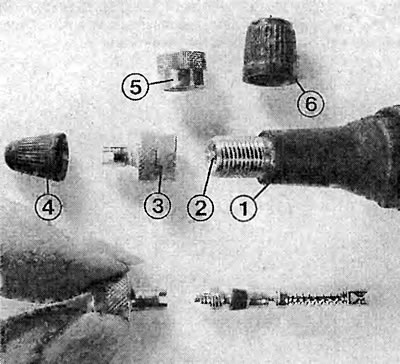
Tire valves (1) must always be covered with protective caps (3, 5 or 6). otherwise dirt gets in and…

Tire valves (1) must always be covered with protective caps (3, 5 or 6). otherwise dirt gets in and the valve needle (2) gets jammed, which no longer closes hermetically. The valve caps (3) are practical, which can also be used to unscrew the valve insert, as shown in the photo. However, due to the sharp edges, they should be protected by rubber caps (4).
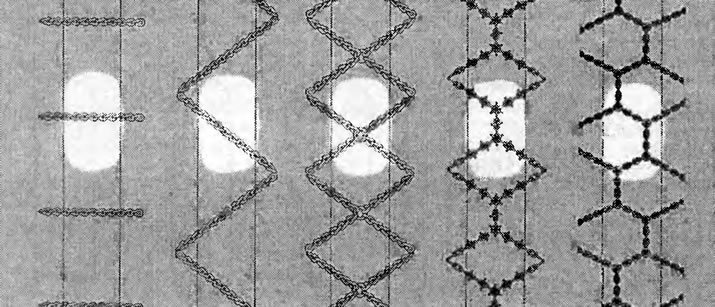

The white notches show where the tire touches the ground. The more the chain touches the road here,…

The white notches show where the tire touches the ground. The more the chain touches the road here, the better. From left to right you see: ladder chain, zigzag chain, cross chain, cross-and-length chain, edge chain.


Disposal of old tires


Old tires cannot be simply thrown into the trash. They are not taken away during garbage disposal either, because depending on the method, old tires are either cut up and recycled further, or burned in special installations. How do you get rid of old tires?

There are different options: depending on the local authority, the collection point may be a city construction site or a landfill. In either case, the tire dealer will take the old tires. But in all cases, you will have to pay a small fee to get rid of the tires.


This article is available at russian, bulgarian, belarusian, ukrainian, serbian, croatian, romanian, polish, slovak, hungarian
Checking the article: Shapovalov Yaroslav

Share information:

Previous articles
Opel Vectra B: Wheels and tires
Next articles

Checking the tightness of wheel bolts
Wheel mounting position
Wheel replacement
Help with tire problems
Checking the condition of the tires
Checking tire pressure
Anti-skid chains


See similar ones from other Opel car manuals:
▶ Anti-lock braking system and TC-system of sensor control of… Opel Astra G (1998-2004, petrol)
▶ Checking the condition of the tires and their inflation… Opel Corsa B (1993-2000)
▶ Car wheels and tires Opel Kadett E (1984-1995)
▶ Wheels and tires Opel Omega A (1986-1993)
▶ Hubs, Wheels and Tires — Reference Data Opel Zafira A (1999-2005, petrol)
Link to this page in different formats

Visitor comments


No comments yet


How much will 45 + 32 =


Vectra C (2002-2008) 
  • General information
  • User manual
  • Vehicle device
  • Maintenance
  • Troubleshooting
  • Power unit
  • Engine repair
  • Cooling system
  • Power and control system
  • Engine electrics
  • Transmission
  • Clutch
  • Car gearbox
  • Drive shafts
  • Chassis
  • Car suspension
  • Steering
  • Brake system
  • Body
  • Exterior
  • Interior
  • Doors, locks and windows
  • Heating and ventilation
  • Electrical equipment
  • Equipment and devices
  • Headlights and lighting
  • Electrical circuits
Vectra B (1995-2002) 
  • General information
  • User manual
  • Weekly checks
  • Maintenance (gasoline)
  • Maintenance (diesel)
  • Troubleshooting
  • Power unit
  • SOHC gasoline engine
  • DOHC petrol engine
  • Diesel engine 1.7 liter
  • Diesel engine 2.0 liters
  • Engine repair
  • Cooling system
  • Fuel system (gasoline)
  • Fuel system (diesel)
  • Charging system
  • Launch system
  • Ignition and preheat
  • Transmission
  • Clutch
  • Mechanical gearbox
  • Automatic gearbox
  • Drive shafts
  • Chassis
  • Brake system
  • Wheel suspension
  • Steering
  • Body
  • Exterior
  • Interior
  • Doors and windows
  • Heating and ventilation
  • Electrical equipment
  • Equipment and devices
  • Electrical circuits
Vectra B (1995-2002, petrol) 
  • General information
  • Maintenance
  • Help with malfunctions
  • Power unit
  • Engine repair
  • Exhaust system
  • Cooling system
  • Fuel system
  • Multec injection system
  • Four point injection
  • Transmission
  • Clutch
  • Gearbox and drive
  • Chassis
  • Wheel suspension
  • Steering
  • Brake system
  • Wheels and tires
  • Body
  • Exterior
  • Interior
  • Electrical equipment
  • Fuses and electronics
  • Power devices
  • Ignition system
  • Lighting and signaling
  • Equipment and devices
  • Heating and ventilation
  • Electrical circuits
Vectra A (1988-1995) 
  • Power unit
  • Engine repair
  • Ignition system
  • Lubrication system
  • Cooling system
  • Injection system
  • Fuel system (carburetor)
  • Fuel system (diesel)
  • Exhaust system
  • Transmission
  • Clutch
  • Car gearbox
  • Chassis
  • Front suspension
  • Rear suspension
  • Steering
  • Brake system
  • Wheels and tires
  • Body
  • Exterior
  • Interior
  • Electrical equipment
  • Electrical circuits
Vectra A (1988-1995, petrol) 
  • General information
  • User manual
  • Maintenance
  • Power unit
  • SOHC engine
  • DOHC engine
  • Cooling and ventilation
  • Fuel system (carburetor)
  • Fuel system (injector)
  • Exhaust converter
  • Transmission
  • Clutch
  • Mechanical gearbox
  • Automatic gearbox
  • Drive shafts
  • Chassis
  • Brake system
  • Car suspension
  • Steering
  • Body
  • Body elements
  • Electrical equipment
  • Power devices
  • Equipment and devices
  • Electrical circuits
OpelBook.ru © 2017–2026 · Mobile version · · Sitemap: EN BG BY UA RS HR RO PL SK HU · Feedback · Site search
Astra F, petrol · Astra G, petrol · Astra G · Astra H · Astra J, petrol · Corsa B · Corsa C, petrol · Corsa C · Insignia A · Kadett D · Kadett E · Omega A · Omega B · Omega B2 · Vectra A, petrol · Vectra A · Vectra B, petrol · Vectra B · Vectra C · Zafira A, petrol · Frontera A, petrol · Frontera B · Ascona C · Vivaro A ·
We want your visit to be comfortable 🤝! We use cookies 🍪 to make that happen.