


Contents: Electronically controlled driving…⬇ Additional engine braking ⬇ Stop ⬇ "Swinging" ⬇ Precise maneuvering ⬇ Malfunction ⬇ Power outage ⬇
After starting the engine, press the foot brake pedal before engaging one of the gears. Otherwise, the car will start to "crawl". Never press the accelerator and foot brake pedals simultaneously.
By selecting the D gear lever, you have switched the gearbox to an economical driving mode. You can drive in D almost always.
When the accelerator pedal is pressed gently, early shifts to fuel-efficient gears occur. Manual gear shifting is only necessary in exceptional cases. Select 3, 2 and 1 only when upshifting is to be avoided or additional engine braking is required.
As soon as traffic conditions allow, select D again.
Automatic transmission
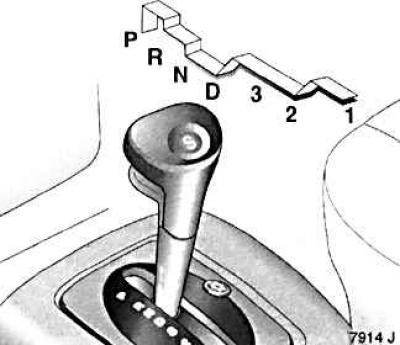
Automatic transmission control lever positions P, R and N:
R = Parking. Front wheels locked. Shift only when vehicle is stationary and handbrake is applied.
R = reverse gear. Engage only when the vehicle is stationary.
N = neutral position or idle speed.
The automatic transmission control lever can only be moved out of position P when the ignition is on and the foot brake pedal is depressed.
The engine can only be started in position P or N. When starting in position N, press the foot brake pedal or apply the handbrake.
Do not press the accelerator pedal while changing gears.
Step D
D = constant position for normal driving conditions in gears 1 to 4.
After starting the engine and engaging D, the gearbox always operates in economy driving mode.
Step 3
3 = position for driving conditions in gears 1, 2 and 3.
Step 2
2 = position for driving in 1st and 2nd gear, e.g. on a mountain serpentine; there is no switching to 3rd and 4th gears.
Step 1
1 = load stage for maximum braking force, e.g. on steep descents; no shifting above 1st gear.
Electronically controlled driving modes
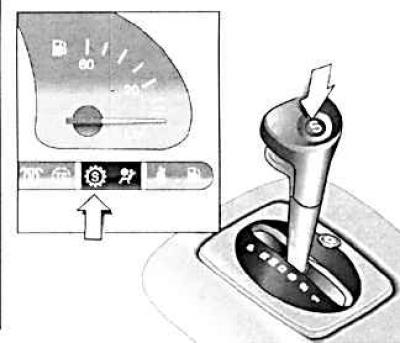
Sport driving mode, the gearbox changes gears at higher engine speeds: press the S button (
 lit).
lit).
Economy mode, the gearbox changes gears at lower engine speeds: press the S button again.
Assistance when moving away: press the button
 .
.
Engines X18XE, X20XEV, X25XE1: the automatic neutral position switch automatically shifts the gearbox to the N position to reduce fuel consumption, e.g., when stopping at traffic lights. Automatic switching to neutral position is carried out if:
- the automatic transmission control lever is in position D, 3, 2 or 1 and
- the foot brake pedal is pressed and
- the car is stationary and
- no pressure on the accelerator pedal.
As soon as the brake is released or the accelerator pedal is pressed, the car starts moving as usual.
After starting a cold engine, the operating temperature management program quickly brings the catalyst temperature to the value required for optimum emission control by delaying gear shifts (at higher engine speeds).
Adaptive programs
 – these are programs that automatically adapt gear shifting to driving conditions, such as when towing a trailer, under heavy loads and on hills.
Assistance when starting from a place

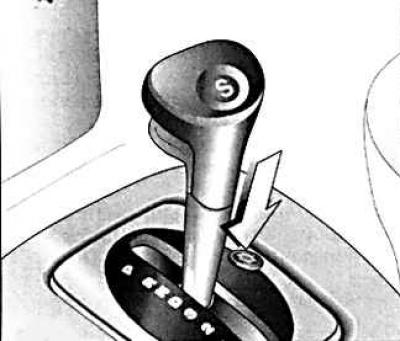
If you have difficulty on slippery roads, press the button to start moving
 , is included in P, R, N, D, 3 (switch-on indicator – ). The car will move in 3rd gear.
The hill start assist is switched off by pressing the button again
 .
.
In addition, it is possible to turn it off by:
- manual selection of stages 2 or 1;
- ignition off.
Kickdown – sharply pressing the accelerator pedal all the way down
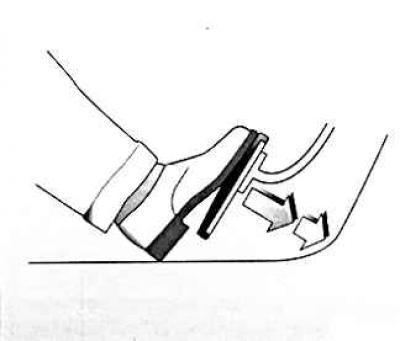
Pressing the accelerator pedal all the way down: at speeds below a certain value, the transmission shifts to a lower gear. Used for acceleration using the full power of the engine.
Additional engine braking
To use the engine braking functions when descending, turn on 3, 2 or, if the situation requires, 1 in a timely manner.
The braking action in gear 1 is particularly effective. If gear 1 is engaged at too high a speed, the gearbox will continue to operate in 2nd gear until the transition point to 1st gear is reached, for example by braking.
Stop
The engaged stage can be retained when stopping with the engine running.
When stopping on slopes, be sure to engage the handbrake or press the footbrake pedal. To prevent overheating of the gearbox, do not hold the vehicle in place by increasing the engine speed while in gear.
When parking for long periods, for example in traffic jams or at a railway crossing, stop the engine.
Before leaving the car, first apply the handbrake, then shift to P and remove the ignition key.
The ignition key is removed from the ignition switch only when the gearshift lever is in position P.
"Swinging"
To rock a car stuck in sand, mud, snow or a ditch for further movement, you can switch the control lever between D and R with the accelerator pedal slightly pressed. Keep the engine speed as low as possible and avoid sharp pressing of the accelerator pedal.
The method described above should be used only in exceptional cases.
Precise maneuvering
For precise maneuvering, for example, when parking a car, entering a garage, etc., you can use the "crawling" method by releasing the foot brake pedal.
Never press the accelerator and foot brake pedals at the same time.
Malfunction
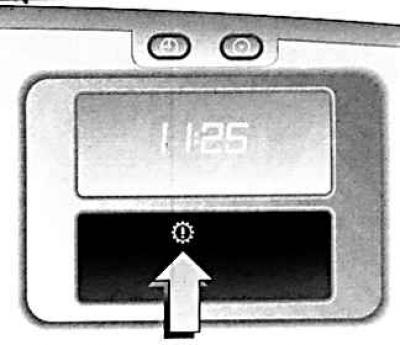
Signaling device
 lights up when the ignition is on. If it does not go out after the engine starts or lights up while driving, then there is a malfunction of the automatic transmission.
If the vehicle is equipped with a Multi-Info display, a fault message will be displayed on the display "Automatik Getriebe" ("Automatic transmission").
The gearbox no longer shifts automatically.
You can continue driving. Shift gears 1, 3 and 4 manually using the gearshift lever:
1 = 1st gear,
2 = 3rd gear,
3 = 4th gear,
D = 4th gear,
N = neutral (idling),
R = reverse,
R = parking.
To eliminate the cause, contact an authorized Opel workshop. The self-diagnostic algorithm integrated into the system allows you to quickly find the cause of the malfunction.
Power outage
Power failure, such as a dead battery. When the power supply is interrupted, it is not possible to move the automatic transmission control lever out of position P.
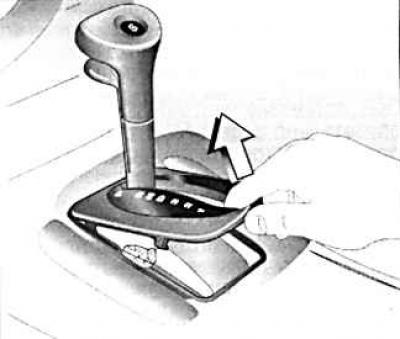
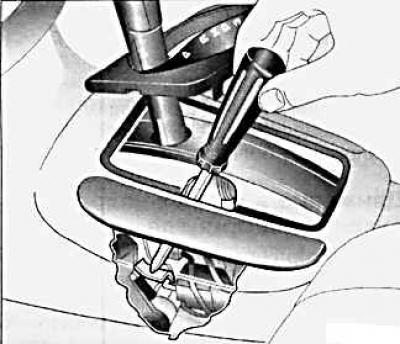
Unlocking:
1. Engage the handbrake.
2. Lift the cover on the protruding part of the floor between the front seats and turn it 90° to the right.
3. Using a screwdriver, press the pawl forward and move the automatic transmission control lever out of position P.
4. Install the cover on the protruding part of the floor between the front seats in place and secure it.
Switching to position P again will lock the lever again. The cause of the power failure must be rectified by an authorized Opel workshop.
Visitor comments