


Contents: Automatic mode ⬇ Manual installation ⬇ Air circulation mode ⬇ Set temperature ⬇ Air distribution ⬇ Amount of air ⬇ Turning off climate control ⬇ General instructions ⬇ Maintenance ⬇
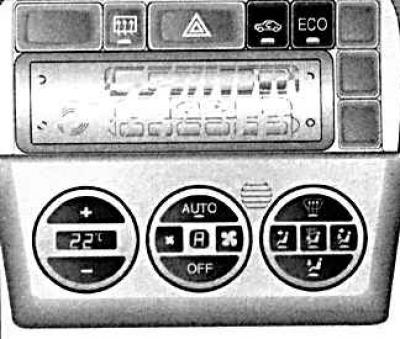
Electronic climate control ensures maximum comfort in any weather conditions, any outside temperature and at any time of year.
To ensure a constant and pleasant climate in the vehicle, the incoming air temperature, air quantity and air distribution are automatically adjusted according to the outside weather conditions.
The climate control refrigeration compressor cools the air and removes moisture.
When the refrigeration compressor is on, the air conditioner consumes power of such a magnitude that it leads to an increase in fuel consumption. If there is no need for the refrigeration compressor, then you should press the button ECO.
The air purification filter cleans the incoming air from dust and soot, as well as pollen and spores.
With the automatic air conditioning mode set, driving is possible almost all the time. If necessary, the climate control can be adjusted manually.
Climate control only works when the engine is running.
Automatic mode
Basic settings for maximum comfort:
- press the key AUTO, display and function indication are on;
- open all air nozzles;
- set the temperature on the display using the "+" or "-" keys from 22°C to 24°C.
If necessary, a higher or lower temperature can be set.
Manual installation
Under special conditions (eg frozen or fogged windows, unpleasant odours coming from outside) climate control functions can be set manually.
After turning the ignition back on, the climate control is in the previously selected settings mode.
If necessary, set the operating mode as follows:
Drying and defrosting glass
 Press (control of inclusion), the AUTO mode indicator will go out.
The temperature and airflow will be set automatically, the glass will be defrosted and dried as quickly as possible.
Return to automatic mode: press
 or AUTO.
Air circulation mode
 Press (control of inclusion), the AUTO mode indicator will go out.
Switches on when unpleasant odors come from outside. The air circulation system prevents outside air from entering, and the air inside the car circulates.
The air circulation system should only be turned on for a short period of time, as the air quality in the cabin deteriorates over time.
Return to automatic mode: press
 or AUTO.
Automatic mode without cooling (fuel economy).
ECO Press (control of inclusion), mode indication AUTO will go out.
Turn on to save fuel. In this mode, the refrigeration compressor is turned off.
The incoming air is not cooled or dried, which limits the comfort that climate control provides.
Return to automatic mode: press ECO or AUTO.
Set temperature
The set temperature can be set using the "+" or "-" keys to values between 17°C and 27°C.
When set below 17°C, it is displayed on the display LO: climate control operates continuously at maximum cooling capacity, temperature regulation is not performed.
When set above 27°C, it is displayed on the display HI: climate control operates continuously at maximum heating output, temperature regulation is not performed.
Air distribution
By pressing one of the following keys (mode indication AUTO goes out) is carried out:
 air distribution to the upper space;
 air distribution to the windshield, to the front side windows and to the front and rear footwells;
 air distribution to the headroom, front and rear footwells;
 air distribution to the front and rear footwells.
Return to automatic mode: press the corresponding key again or press AUTO.
Amount of air
 Press on the right or left, the AUTO mode indicator goes out, the fan speed increases or decreases. The display between the K keys shows the fan speed.
Return to automatic mode: press AUTO, on the display between the keys
 a is displayed.
Turning off climate control
OFF Press to turn off all climate control functions.
The air distribution settings remain in the previously selected positions.
Access to outside air can be stopped by pressing the button
 .
.
For comfort reasons, turn off the climate control (control of heating, air conditioning and cooling) should only be done if a fault occurs in the system.
Turn on climate control: press OFF or AUTO.
General instructions
Climate control works more effectively if the windows and sunroof are closed. If the car interior has become very hot after prolonged exposure to sunlight, open the windows for a while to allow the hot air to escape faster.
To ensure smooth operation, do not block the sensor openings in the climate control switch group and between the air supply openings in front of the windshield.
When the air conditioner is on, condensation forms and appears on the bottom of the car.
Maintenance
If the climate control operates unusually: Press and hold the keys simultaneously for approximately 5 seconds AUTO and OFF, the auxiliary engines will be synchronized, and the blower fan will stop for a while.
Visitor comments