
OpelBook.ru
Cars AvtoVAZ Cars Mitsubishi Cars BMW Cars Mercedes Cars Nissan Cars Toyota Cars Chevrolet
English Русский
Български
Беларускі
Український
Српски
Hrvatski
Română
Polski
Slovenský
Magyar
 |  Sitemap  |  Contacts  |    


Main Astra Corsa Insignia Kadett Omega Vectra Zafira Others Articles
Frontera A (1991-1998, petrol) Frontera B (1998-2004) Ascona C (1981-1988) Vivaro A (2001-2014)
  • Main
  • Opel
  • Vivaro A
  • Power unit
  • Diesel engine G9U
  • Centralized coolant temperature control

Centralized coolant temperature control (Opel Vivaro A)

            0

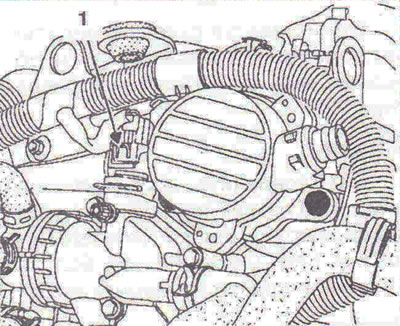
Coolant temperature sensor 1: One three-pin sensor is used to transmit the signal to the injection control unit and the coolant temperature gauge on the instrument cluster (figure 4.105).

Figure 4.105. Coolant temperature sensor 1.

Figure 4.105. Coolant temperature sensor 1.


Two contacts for transmitting coolant temperature information to the injection system control unit (contacts B E1 and B KZ) and one contact is used for indication on the instrument panel.

This system provides control of the electric fan of the cooling system via the injection system control unit. It consists of a single coolant temperature sensor that sends a signal to the fuel injection system, the electric cooling fan, the temperature gauge and the coolant temperature warning light on the instrument panel.

The injection system control unit, depending on the coolant temperature, controls the operation of the injection system, the relay for switching on the electric fan of the cooling system:

[Material copied from the portal: opelbook]
  • the electric fan switches on at low speed if the temperature exceeds 95°C and switches off when the temperature drops to 85°C;
  • the electric fan turns on at high speed if the temperature exceeds 95°C and turns off when the temperature drops to 85°C;
  • the electric fan can also be turned on (low rotation speed) for air conditioning.

The indicator light is controlled by the fuel injection system control unit. The light comes on when the coolant temperature exceeds 110°C and goes out when the temperature drops below 105°C.


This article is available at russian, bulgarian, belarusian, ukrainian, serbian, croatian, romanian, polish, slovak, hungarian
Checking the article: Meshcheryakov Damir

Share information:

Previous articles
Opel Vivaro A: Diesel engine G9U
Next articles

Removal and installation of the injection system control unit
Removal and installation the accelerator pedal position sensor
Removal and installation the high pressure accumulator protective cover
Removal and installation the pressure regulator
Removal and installation injectors
Removal and installation the high pressure fuel pump
Exhaust gas recirculation system
Removal and installation the generator
Removal and installation the starter
Cooling system


See similar ones from other Opel car manuals:
▶ Coolant Temperature Gauge Sensor Opel Astra F (1991-1998, petrol)
▶ Checking the proper functioning of the coolant temperature… Opel Corsa B (1993-2000)
▶ Engine coolant temperature indicator Opel Insignia A (2008-2017)
▶ Temperature, fuel and control lamps Opel Omega A (1986-1993)
▶ Checking the intake air temperature control (carbureted… Opel Vectra A (1988-1995, petrol)
Link to this page in different formats

Visitor comments


No comments yet


How much will 39 + 12 =


Vivaro A (2001-2014) 
  • General information
  • User manual
  • Power unit
  • Petrol engine F4R
  • Diesel engine F9Q
  • Diesel engine G9U
  • Transmission
  • Clutch and drive shafts
  • Manual gearbox
  • Chassis
  • Front suspension
  • Rear suspension
  • Brake system
  • Body
  • Exterior
  • Interior
  • Electrical equipment
  • Heating and ventilation
  • Air conditioner
  • Equipment and devices
  • Electrical diagrams
Ascona C (1981-1988) 
  • General information
  • Maintenance
  • Power unit
  • Gasoline engines
  • Diesel engines
  • Cooling system
  • Fuel and exhaust system
  • Contact ignition system
  • Contactless ignition system
  • Transmission
  • Clutch
  • Mechanical gearbox
  • Automatic gearbox
  • Drive shafts
  • Chassis
  • Steering
  • Brake system
  • Car suspension
  • Body
  • Exterior
  • Interior
  • Doors and windows
  • Electrical equipment
  • Equipment and devices
  • Power devices
  • Electrical circuits
Frontera B (1998-2004) 
  • General information
  • User manual
  • Maintenance
  • Power unit
  • Petrol engines 2.2 l
  • Petrol engines 3.2 l
  • Diesel engines 2.2 l
  • Cooling system
  • Fuel system (petrol)
  • Fuel system (diesel)
  • Ignition system
  • Transmission
  • Clutch
  • Manual gearbox MUA5C
  • Automatic gearbox 4L30E
  • Chassis
  • Suspension and axles
  • Steering
  • Brake system
  • Body
  • Exterior
  • Interior
  • Doors, locks and windows
  • Heating and air conditioning
  • Electrical equipment
  • Power devices
  • Equipment and devices
  • Lighting and signaling
  • Electrical diagrams
Frontera A (1991-1998, petrol) 
  • General information
  • Introduction to guide
  • User manual
  • Maintenance
  • Power unit
  • Engine repair
  • Lubrication system
  • Cooling system
  • Power and exhaust system
  • Engine electrics
  • Transmission
  • Clutch
  • Mechanical gearbox
  • Cardan shafts
  • Chassis
  • Brake system
  • Front suspension
  • Rear suspension
  • Steering
  • Body
  • Repair and care
  • Electrical equipment
  • Equipment and devices
  • Electrical circuits
OpelBook.ru © 2017–2026 · Mobile version · · Sitemap: EN BG BY UA RS HR RO PL SK HU · Feedback · Site search
Astra F, petrol · Astra G, petrol · Astra G · Astra H · Astra J, petrol · Corsa B · Corsa C, petrol · Corsa C · Insignia A · Kadett D · Kadett E · Omega A · Omega B · Omega B2 · Vectra A, petrol · Vectra A · Vectra B, petrol · Vectra B · Vectra C · Zafira A, petrol · Frontera A, petrol · Frontera B · Ascona C · Vivaro A ·
We want your visit to be comfortable 🤝! We use cookies 🍪 to make that happen.