


Checking, removing and installing
The coolant temperature gauge is mounted on the instrument panel and is powered by a voltage stabilizer located there (via ignition switch and fuse), and its connection to ground is carried out through the sensor.
The sensor of this indicator on 1.4 and 1.6 l engines is screwed into the intake manifold, and on 1.8 and 2.0 l engines - into the thermostat housing. The sensor has a thermal resistance, the electrical resistance of which decreases with increasing temperature. If the sensor fails, it should be replaced.
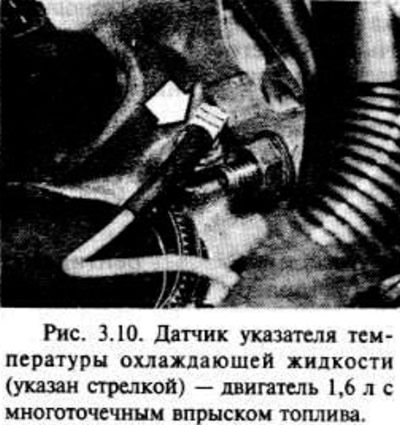
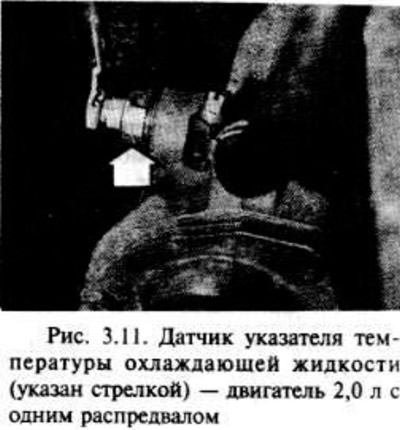
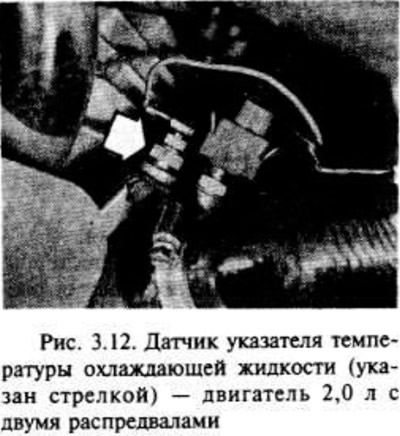
If the indicator starts to malfunction, check other devices; if they don't work either, check the power supply circuit of the instrument panel. If the readings are unstable, you need to look for a fault in the voltage stabilizer.
If the pointer is in the blue "cold" sector, disconnect the sensor wire and short it to the cylinder head ground. If the pointer of this device deflects when the ignition is turned on, then the sensor is out of order and should be replaced. If the pointer of the device does not deflect, remove the instrument panel shield (chapter 12) and check for damage to the brown/white wires between the temperature sensor and the indicator, as well as the power supply of the device. If the wiring is OK, but the device does not work, it must be replaced.
If the instrument needle is in the hot sector, disconnect the sensor wire. If the needle is in the cold sector after the ignition is turned on, the sensor is faulty and should be replaced. If the needle remains motionless, check the circuit as described above.
Partially drain the cooling system to reduce spillage.
Disconnect the negative battery terminal.
Disconnect the wire from the sensor, then unscrew it.
The sensor is installed in the reverse order of removal, taking into account the following.
Before installation, apply a layer of sealant to the sensor threads.
Add fluid to the cooling system.
After that, start the engine and check the sensor operation. Also, check for coolant leaks.
Visitor comments