


Contents: Models before 1982 ⬇ Models since 1983 ⬇ Troubleshooting ⬇ The engine stalls and won't start…⬇ The engine gets very hot ⬇ Low oil pressure ⬇ Engine noises ⬇
The maintenance intervals listed below are based on the manufacturer's recommendations. When operating the machine in adverse conditions (frequent short-distance trips, driving with a trailer, using the car as a taxi, driving on bad roads, etc.) more frequent oil changes may be necessary.
Older cars and cars with high mileage require more frequent inspections.
Once a week or before a long trip
- Engine (chapter 1)
- Check the oil level in the crankcase.
- Cooling system (chapter 2)
- Check the coolant level.
- Brake system (chapter 9)
- Check the fluid level in the hydraulic system.
- Suspension (chapter 10)
- Check the tire pressure (cold), including the spare tire.
- Electrical equipment (chapter 12)
- Check the operation of all lights, washers and horn
- Check the electrolyte level in the battery or the battery charge
- Check the fluid level in the washer reservoirs and add detergent to the water (for example, Turtle Wax High Tech Screen Wash).
Models before 1982
Every 15,000 km or once every six months (whichever comes first)
- Engine (chapter 1)
- Change the oil and oil filter.
- Cooling system (chapter 2)
- Check the tension and condition of the drive belt(s).
- Fuel and exhaust system (chapter 3)
- Check idle speed and mixture adjustment
- Clean the fuel pump mesh filter (carburetor models)
- Check the condition and reliability of the exhaust system
- Check the throttle control cable adjustment.
- Ignition system (chapter 4)
- Clean or replace the breaker contacts. Check the angle of the closed state of the contacts (early models with 1.3L engine)
- Lubricate the distributor (early models with 1.3L engine)
- Check the ignition timing.
- Transmission (chapter 6)
- Check the oil/transmission fluid level in the gearbox.
- Half shafts (chapter 7)
- Check the condition of the constant velocity joints and corrugated casings.
- Brake system (chapter 9)
- Check brake pads, drums and discs for wear
- Check the condition and reliability of the brake pipes and hoses
- Check the rear brake adjustment.
- Suspension and steering (chapters 8 and 10)
- Check tires for wear and damage
- Check the front wheel alignment angles
- Check the condition and reliability of fastening of all parts.
Every 30,000 km or once a year (whichever comes first)
In addition to or instead of the above procedures:
- Cooling system (chapter 2)
- Check the concentration of antifreeze in the coolant.
- Fuel and exhaust system (chapter 3)
- Replace the fuel filter (on injection models)
- Clean the carburetor inlet fuel filter.
- Ignition system (chapter 4)
- Replace spark plugs.
- Clutch (chapter 5)
- Check the clutch pedal adjustment.
- Brake system (chapter 9)
- Replace brake fluid (annually, regardless of mileage)
- Check the handbrake adjustment
- Check the condition of the handbrake cable drive.
- Suspension and steering (chapters 8 and 10)
- Check the rear wheel bearing adjustment
- Check the power steering fluid level.
- Electrical equipment (chapter 12)
- Check the headlight beam adjustment.
(Text copied from a web portal: Opelbook.ru)
Every 45,000 km or once every 18 months (whichever comes first)
In addition to or instead of the above procedures:
- Fuel and exhaust system (chapter 3)
- Replace the air filter
- Replace the fuel pump mesh filter (carburetor models).
- Every 2 years (regardless of mileage)
- Cooling system (chapter 2)
- Replace coolant.
Every 90,000 km or once every 3 years (whichever comes first)
In addition to or instead of the above procedures:
- Transmission (chapter 6)
- Replace the mesh filter and automatic transmission fluid.
Models since 1983
Every 15,000 km or once every six months (whichever comes first)
- Engine (chapter 1)
- Change the oil and oil filter.
Every 15,000 km or once a year (whichever comes first)
In addition to or instead of the above procedures:
- Cooling system (chapter 2)
- Check the concentration of antifreeze in the coolant
- Check the tension and condition of the drive belt(s).
- Fuel and exhaust system (chapter 3)
- Check idle speed and mixture adjustment (except for injection models since 1987.)
- Check the condition and reliability of the exhaust system
- Check the throttle control cable adjustment.
- Ignition system (chapter 4)
- Check and replace spark plugs if necessary.
- Transmission (chapter B)
- Check the oil/transmission fluid level in the gearbox.
- Half shafts (chapter 7)
- Check the condition of the constant velocity joints and corrugated casings.
- Brake system (chapter 9)
- Check brake pads, drums and discs for wear
- Check the condition and reliability of the brake pipes and hoses
- Replace brake fluid (annually, regardless of mileage)
- Check the rear brake adjustment (if applicable).
- Suspension and steering (chapters 8 and 10)
- Check tires for wear and damage
- Check the condition and reliability of fastening of all parts
- Check the front wheel alignment angles.
- Electrical equipment (chapter 12)
- Check the headlight beam adjustment.
- General inspection
- Lubricate all handles and hinges.
Every 30,000 km or once every 2 years (whichever comes first)
In addition to or instead of the above procedures:
- Cooling system (chapter 2)
- Replace coolant (every 2 years, regardless of mileage).
- Fuel and exhaust system (chapter 3)
- Replace the air filter
- Replace the fuel filter (injection models) (every 2 years, regardless of mileage)
- Replace the fuel pump mesh filter (if applicable).
- Brake system (chapter 9)
- Check the handbrake adjustment
- Check the condition of the handbrake cable drive.
- Suspension and steering (chapters 8 and 10)
- Check the power steering fluid level.
Every 60,000 km or once every 4 years (whichever comes first)
In addition to or instead of the above procedures:
- Engine (chapter 1)
- Check the condition of the camshaft timing belt and adjust its tension if necessary. It is recommended to replace the belt if you have any doubts about its condition.
- Transmission (chapter 6)
- Replace the mesh filter and automatic transmission fluid.
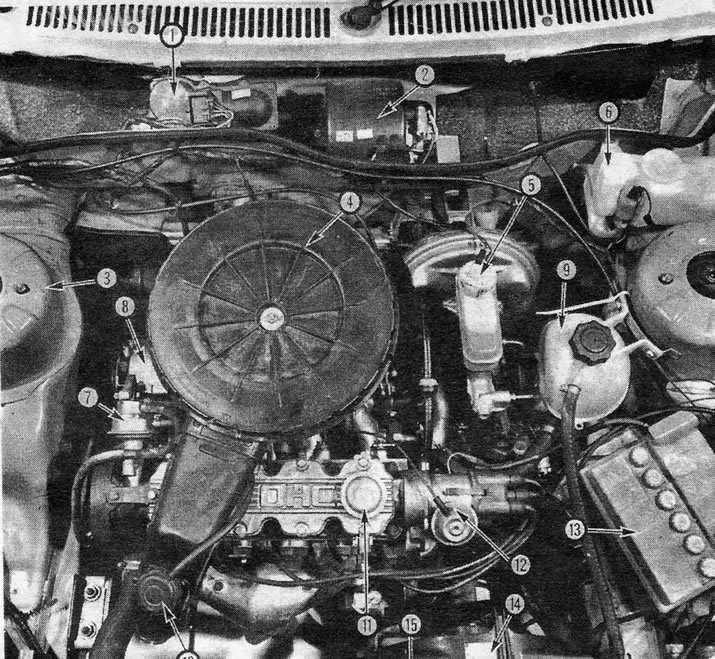
Figure 8. Engine compartment of Opel Ascona 1.3:1. Windscreen wiper motor; 2. Heater blower motor; 3. Splash guard cup; 4. Air purifier; 5. Brake servo and master cylinders; 6. Windshield washer reservoir; 7. Fuel pump; 8. Generator; 9. Expansion tank of the cooling system; 10. Vacuum block of the air intake temperature valve; 11. Oil filler plug of the crankcase; 12. Distributor; 13. Battery; 14. Radiator electric fan; 15. Bonnet lid support post.
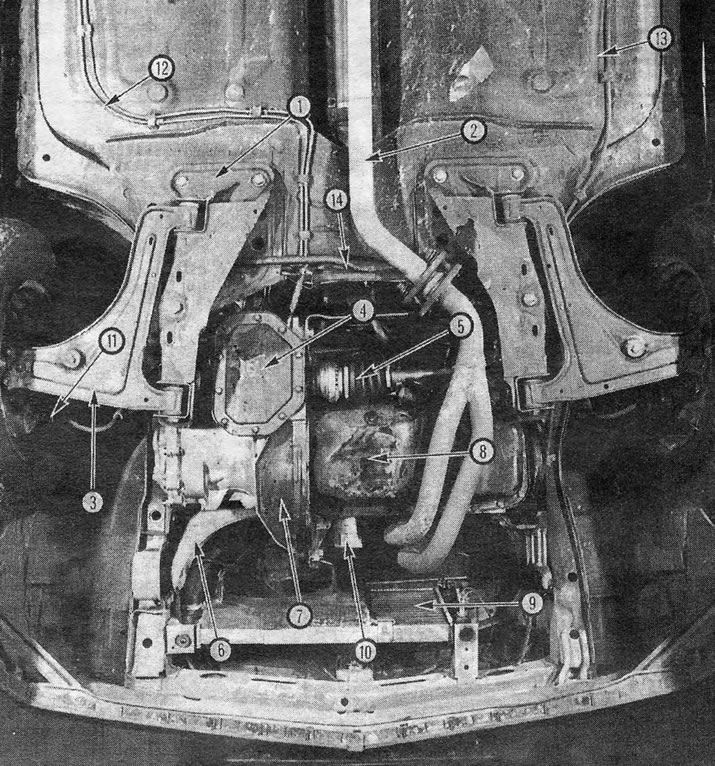
Figure 9. Front of Opel Ascona 1.3 (bottom view): 1. Suspension control arm support; 2. Exhaust pipe; 3. Suspension control arm; 4. Main gear unit cover; 5. Inner axle joint; 6. Engine/Gearbox Mounting Bracket; 7. Flywheel housing cover; 8. Pallet; 9. Radiator; 10. Oil filter; 11. Brake hose; 12. Brake pipes; 13. Fuel line; 14. Anti-roll bar.
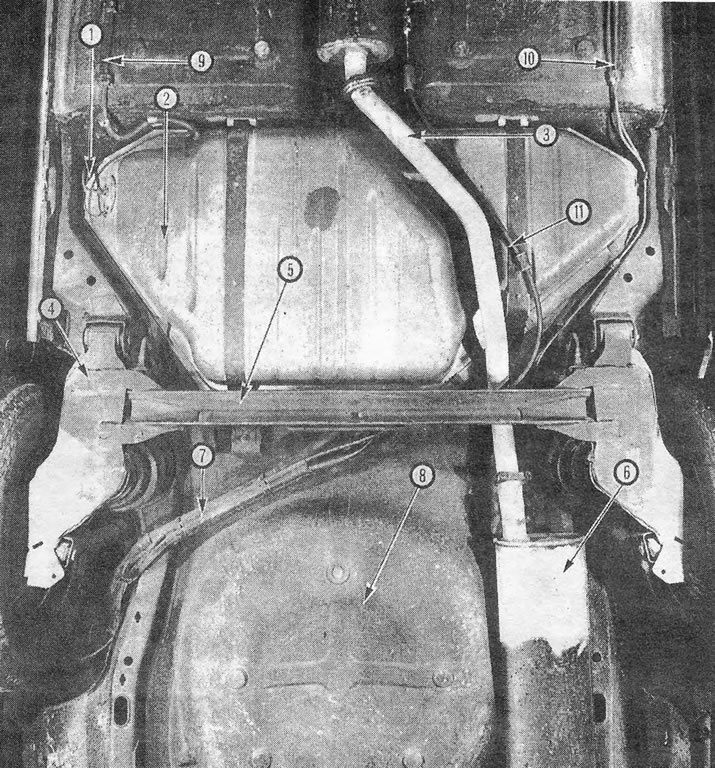
Figure 10. Rear of Opel Ascona 1.3 (bottom view):1. Fuel level sensor; 2. Fuel tank; 3. Exhaust pipe; 4. Rear suspension trailing arm; 5. Rear axle element; 6. Muffler; 7. Fuel tank filler/breather hoses; 8. Spare wheel niche; 9. Fuel line; 10. Brake pipes; 11. Handbrake cable.
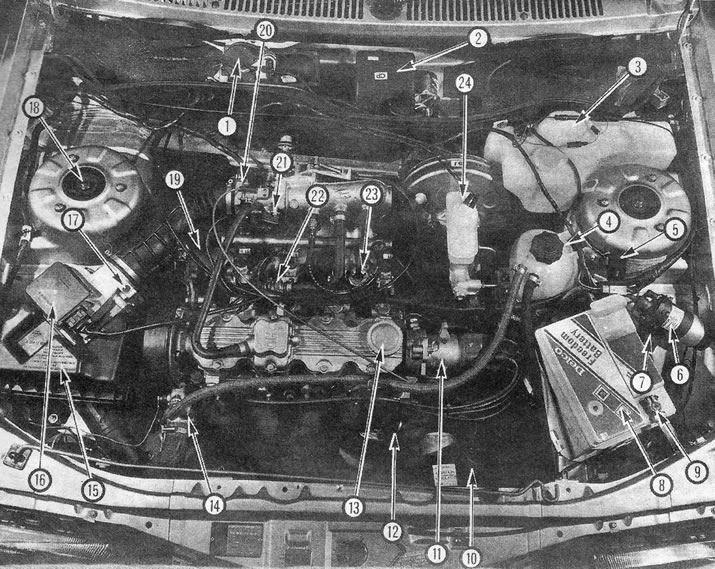
Figure 11. Engine compartment of Opel Ascona 1.8 (models before 1987.): 1. Windscreen wiper motor; 2. Heater blower motor; 3. Windshield washer reservoir; 4. Expansion tank of the cooling system; 5. Fuel injection system command relay; 6. Ignition coil; 7. Electronic ignition system control unit; 8. Battery; 9. Negative battery terminal; 10. Radiator electric fan; 11. Distributor; 12. Crankcase oil dipstick; 13. Oil filler plug of the crankcase; 14. Thermostat housing; 15. Air purifier; 16. Air flow sensor; 17. Idle mixture bypass screw; 18. Upper shock absorber mount; 19. Generator; 20. Throttle body; 21. Throttle switch; 22. Auxiliary air valve; 23. Fuel pressure regulator; 24. Master brake cylinder reservoir.
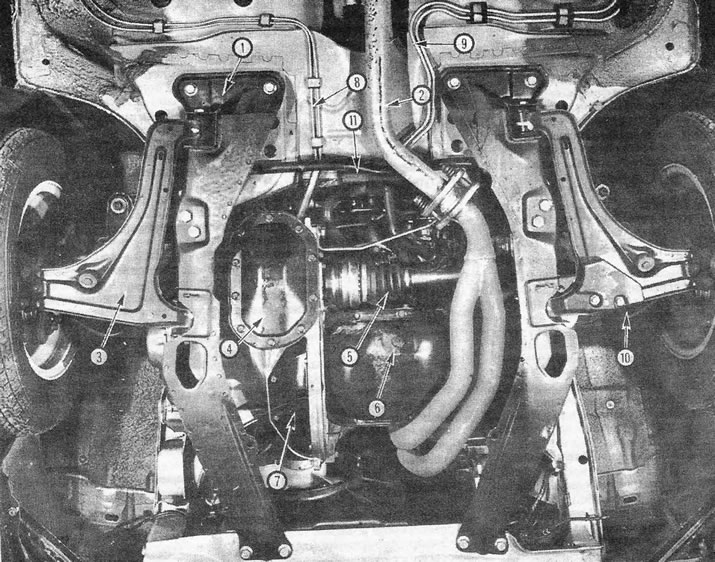
Figure 12. Front of Opel Ascona 1.8, models up to 1987 (bottom view): 1. Suspension control arm support; 2. Exhaust pipe; 3. Suspension control arm; 4. Main gear unit cover; 5. Inner axle joint; 6. Drain plug of the pan; 7. Flywheel housing cover; 8. Brake pipes; 9. Fuel lines; 10. Brake hose; 11. Anti-roll bar.
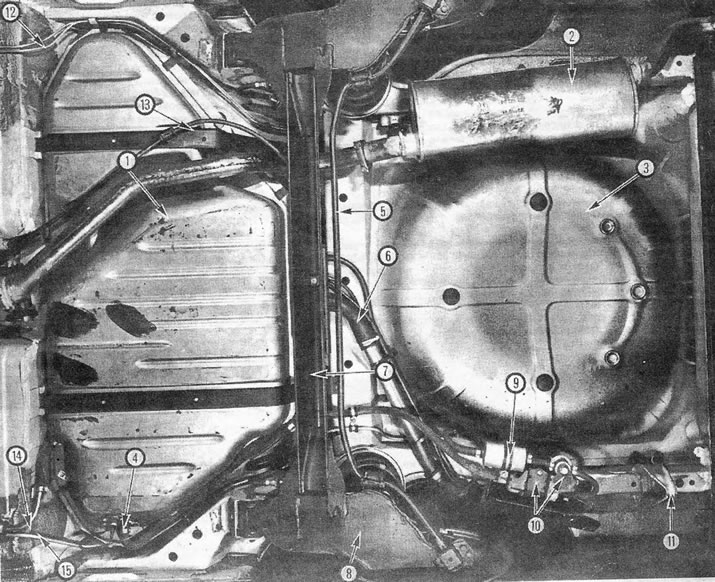
Figure 12. Front of Opel Ascona 1.8, models up to 1987 (bottom view): 1. Suspension control arm support; 2. Exhaust pipe; 3. Suspension control arm; 4. Main gear unit cover; 5. Inner axle joint; 6. Drain plug of the pan; 7. Flywheel housing cover; 8. Brake pipes; 9. Fuel lines; 10. Brake hose; 11. Anti-roll bar.
Troubleshooting
The engine will not start
- The engine does not start when the starter is turned on
- The battery is discharged (charge the battery, start it by jumping or pushing it).
- The battery terminals are loose or corroded.
- Bad battery mass (check the ground wire).
- Bad engine mass (check the ground bus).
- The starter contacts are loose or the wiring is damaged (or solenoid).
- The gear shift lever on the automatic transmission is incorrectly installed or the ignition interlock is faulty.
- The ignition/starter switch is faulty.
- Serious mechanical failure (the engine is jammed).
- Internal fault in starter or solenoid (see chapter 12).
The starter turns the engine too slowly
- The battery is partially discharged (recharge the battery, start it by jumping or pushing it).
- The battery terminals are loose or corroded.
- Bad battery mass (check the ground wire).
- Bad engine mass (check the ground busbar mount).
- The starter wiring contacts have become loose (or solenoid).
- Internal starter failure (see chapter 12).
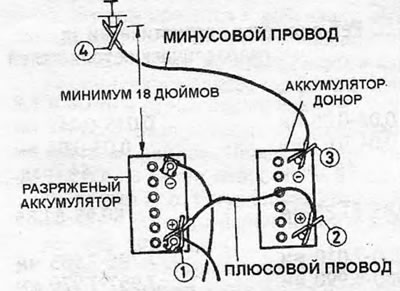
Figure 15. Wiring diagram for starting with a "cigarette lighter" (for engines with negative mass). The sequence of connecting the wires is shown by numbers.
The starter turns but does not start the engine
- The battery is dead
- The starter pinion is stuck on the clutch
- The flywheel ring gear teeth are damaged or worn.
- The starter mounting bolts have come loose.
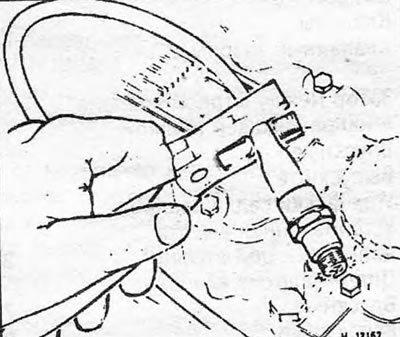
Figure 16. Crank the engine and check for spark. The candle should be held with a tool with insulated handles. For fire safety reasons, use a spare spark plug rather than one removed from the engine.
The engine turns over normally but does not start
- The high voltage wires and distributor cap are damp or dirty. Crank the engine and check for spark. If it is not there, try treating the wires and cover with a moisture dispersant, such as Holts Wet Start.
- The distributor electrodes are dirty or installed incorrectly (1.3L engine until September 1982)
- The fuel tank is empty (check fuel supply).
- Excessive suction (hot engine) or insufficient suction (cold engine)
- Spark plugs are fouled or have incorrect spark gap (remove and clean spark plugs, check and adjust spark gap).
- Other ignition system faults (see chapter 4).
- Other fuel system faults (see chapter 3).
- Poor compression.
- Serious mechanical failure (for example, the camshaft drive failed).
The combustible mixture ignites, but the engine does not start
- Insufficient suction (cold engine).
- Sucking air from the carburetor or intake manifold.
- Fuel starvation (see chapter 3).
- The ballast resistor is faulty or there is another fault in the ignition system (see chapter 4).
The engine stalls and won't start again
The engine suddenly stalls - ignition system malfunction
- Low voltage wire contacts are loose or disconnected.
- The high voltage wires or distributor cap are damp or dirty (for example, after driving through a deep puddle).
- The ignition coil or capacitor is faulty (check for spark) — 1.3 l engine until September 1982.
- Other ignition system faults (see chapter 4).
The engine misfires and then stalls - fuel system malfunction
- There is no fuel in the tank.
- The fuel pump is faulty or the fuel filter is clogged (check fuel supply).
- The fuel tank filler neck ventilation hole is clogged (when removing the tank cap, a suction is felt).
- The carburetor needle valve is stuck.
- The carburetor jets are clogged (dirty fuel).
- Other fuel system faults (see chapter 3).
Engine stalls - other reasons
- Severe engine overheating.
- Serious mechanical failure (for example, the camshaft drive failed).
The engine gets very hot
- Coolant loss due to internal or external leakage (see chapter 2).
- Thermostat is faulty.
- Low oil level.
- The brakes are sticking.
- Internal or external clogging of the radiator.
- The electric fan is not working well.
- The engine water jacket channels are clogged.
- The ignition timing is set incorrectly or the automatic ignition timing does not work.
- The mixture is too lean.
Note: Do not add cold water to an overheated engine as this may cause engine damage.
Low oil pressure
The instrument shows low oil pressure or the warning light comes on while the engine is running
- Low oil level or incorrect oil.
- The oil pressure sensor or indicator is faulty.
- The wire leading to the pressure sensor was grounded.
- The engine overheated.
- The fuel filter is clogged or the bypass valve is faulty.
- The oil pressure relief valve is faulty.
- The oil intake mesh filter is clogged.
- The oil pump is worn out or its fastenings are loose.
- Main or connecting rod bearings are worn out.
Note: Low oil pressure at idle on an older engine is not necessarily a cause for concern. It is much more dangerous when the oil pressure drops sharply while driving. In any case, you should first check the pressure sensor.
Engine noises
Premature ignition (detonation) when pressing the gas pedal
- Incorrect octane number of fuel.
- The ignition timing angle is not adjusted correctly.
- The distributor is worn out or faulty.
- The carburetor is worn out or poorly adjusted.
- Excessive carbon deposits in the engine.
The engine whistles or "squeals"
- Vacuum hose is leaking.
- Air leaking into the carburetor or through the manifold gasket.
- The cylinder head gasket is leaking.
Light knocking or rattling noise in the engine
- The valve mechanism is worn out.
- The chain is worn out (or belt) camshaft.
- The piston ring is broken (ticking sound).
Heavy knocking or banging
- Unintended mechanical contact (for example, fan blades).
- The drive belt is worn out.
- Peripheral equipment failure (generator, water pump, etc.).
- Connecting rod bearings are worn out (a strong, uniform knock, which may decrease with increasing engine load).
- The main bearings are worn out (rattling and knocking noises, may worsen with increasing engine load).
- The pistons are knocking (most noticeable when the engine is cold).
Visitor comments