


Caution! Condensation on the pump vent should not be taken into account unless there is a significant drop in its level in the expansion tank.
Cars with 4-cylinder petrol engine
Removal
1. Disconnect the negative (-) terminal from the battery.
2. Drain the coolant (see the relevant chapter).
3. Remove the timing belt (see the relevant chapter).
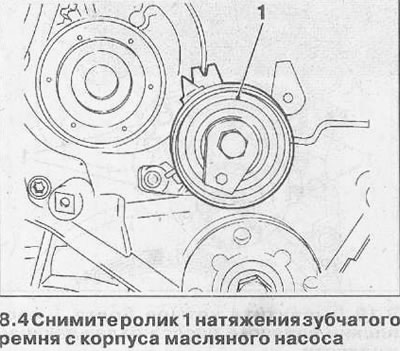
4. Remove the timing belt tension roller 1 from the oil pump housing (see illustration).
5. Release the crankshaft position sensor wire on the rear timing cover. It is recommended to mark the wire routing so that it can be routed correctly later.
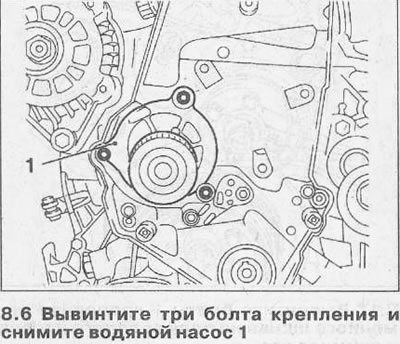
6. Unscrew the three mounting bolts and remove the water pump 1 (see illustration).
Installation
7. Clean the mating surfaces of the water pump and cylinder block and remove any remaining old seal. To prevent the water pump from "sticking" to the cylinder block, it is recommended to lubricate the sealing surfaces on the cylinder block and the sealing ring in the pump housing with a thin layer of silicone grease, such as Opel 19 70 206 (90 167 353).
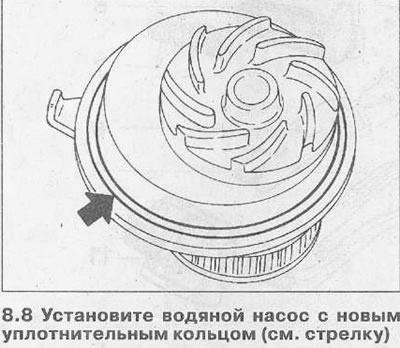
8. Install the water pump with a new sealing ring (see arrow in illustration).
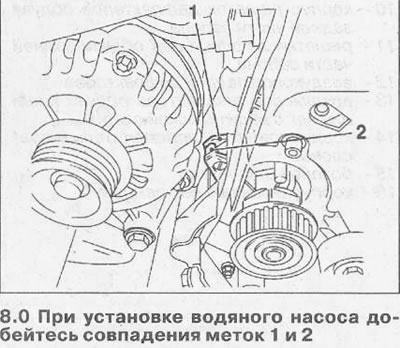
Caution! The water pump must be installed in such a way; so that mark 1 on its body coincides with mark 2 on the cylinder block (see illustration 8.0). Tighten the water pump mounting bolts to 25 Nm.
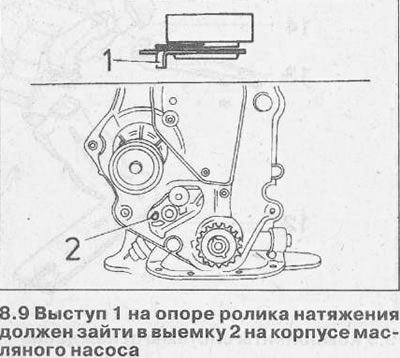
9. Install the toothed belt tension roller so that protrusion 1 on the roller support fits into recess 2 on the oil pump housing (see illustration). Tighten the roller mounting bolt to a torque of 20 Nm.
10. Route the crankshaft position sensor wire and secure it in the holders on the rear timing cover.
11. Lay and tension the timing belt (see the relevant chapter).
12. Fill the expansion tank with coolant.
13. Connect the negative (-) terminal of the battery, set the clock and enter the code into the radio.
Cars with diesel engines with a capacity of 100/120 and 130 hp.
Removal
The water pump drive in diesel-powered vehicles is performed by a V-belt. A radiator fan is installed on the front of the pump shaft.
14. Drain the coolant (see the relevant chapter).
15. Vehicles with 2.5L diesel engine. Remove the viscous coupling fan (see the relevant chapter).
16. Remove the V-belt.
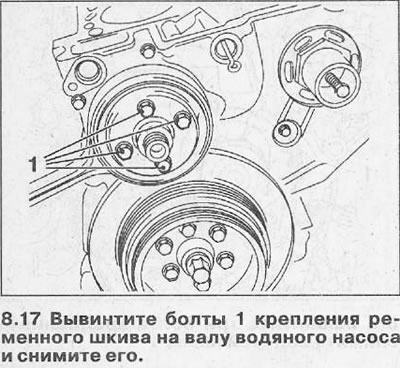
17. Unscrew bolts 1 securing the belt pulley to the water pump shaft, tensioning the V-belt to prevent the pulley from turning, and remove the pulley (see illustration)The illustration shows a 2.5L diesel engine.
18. Vehicles with a 2.5L diesel engine. Unscrew the four bolts 1 securing the coolant water pump (see illustration).
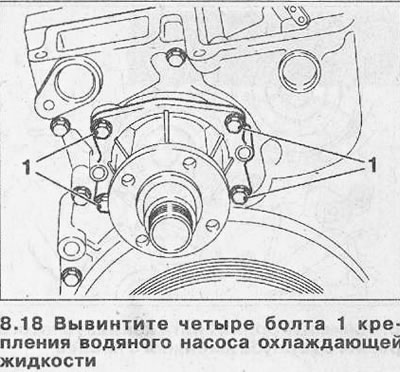
Please note: For vehicles with a 2.0/2.2L diesel engine, the water pump is secured with three bolts.
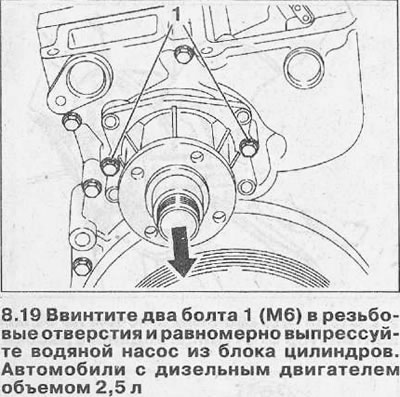
19. Cars with a 2.5L diesel engine. Screw two bolts 1 (M6) into the threaded holes and evenly press the water pump out of the cylinder block (see illustration). Do not allow the pump to become tilted.
Installation
20. Cars with a 2.5L diesel engine. Remove the bolts used to remove the water pump, replace with a new pump sealing ring and lubricate the ring with a thin layer of silicone grease, for example, Opel 19 70 206(90 167 353).
[Material copied from this portal www.OPELBOOK.ru]
21. Install the water pump with a new sealing gasket in place and tighten the mounting bolts evenly to 10 Nm. For vehicles with a 2.0/2.2 l diesel engine, the tightening torque for the water pump mounting bolts is 20 Nm.
22. Install the belt pulley on the water pump shaft and secure it with four or three bolts, depending on the engine type. For vehicles with a 2.0/2.2 L diesel engine, the tightening torque of the water pump pulley mounting bolts is 20 Nm, and for a 2.5 L engine, 10 Nm.
23. Lay and tighten the V-belt.
24. Install the radiator fan viscous coupling.
25. Fill the expansion tank with coolant and bleed the cooling system.
26. Warm up the engine and check the tightness of the hose connections and the water pump.
Visitor comments