


If brake pad replacement is necessary, always replace the pads as a set for both wheels on the same axle of the vehicle.
Check both edges of the brake shoe friction lining (3). Greater wear is usually observed on the trailing edge of the brake shoe.
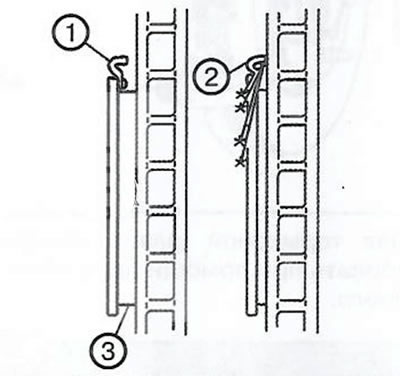
Check the thickness of the brake shoe lining (3) to ensure that the wear of all brake shoes on both wheels of the same axle of the vehicle is approximately the same.
Both the front and rear brake pads have built-in wear indicators (1). When the brake pad lining wears to the limit, the indicator starts to contact the brake disc (2), and a high-pitched squealing sound starts to be emitted during wheel rotation, signaling the need to replace the brake pads.
The brake pads must be replaced when the friction lining (3) wears down to a thickness of 2 mm from the bearing surface.
Remove the brake caliper and check the friction surfaces of the inner and outer brake pads to ensure that they are parallel. Place the brake pads with the friction surfaces facing each other and measure the gap between the surfaces. If the gap is greater than 0.13 mm along the length of the friction lining, replace the brake pads with new ones.
Make sure the brake shoe linings are in place and not damaged or excessively corroded. If linings are missing or damaged, install new ones to ensure proper brake function.
(Text copied from this portal: OpelBook.ru)
Replace the brake pads with new ones if the friction linings of the pads have separated from the backing plates.
Inspect the brake shoe friction linings for cracks, wear or damage that may cause abnormal noise or otherwise impair brake performance.
Visitor comments