


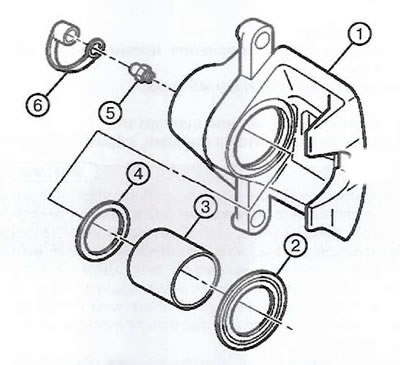
Front brake caliper:
1. Caliper body.
2. Caliper piston dust boot.
3. Caliper piston.
4. Caliper piston seal.
5. Bleeding nipple.
6. Caliper cap.
1. Inspect the brake caliper housing (1) for cracks, excessive wear and/or damage. If any defects are found, the brake caliper requires repair.
2. Check the caliper piston dust boot (2) for cracks, scoring, cuts, wear due to material aging and/or improper fit in the caliper body. If any defects are found, a complete overhaul of the caliper or its replacement is required.
3. Check for signs of brake fluid leakage around the caliper piston boot (2) and on the brake pads. If any signs of brake fluid leakage are detected, the caliper must be overhauled or replaced.
4. Check the smoothness and completeness of the piston stroke in the caliper bore. If significant force is required to move the piston or the piston jams, the caliper requires overhaul or replacement:
[Original source is on the website OpelBook.ru]
- Single-piston brake caliper: Insert the bad inner brake pad (2) or a wooden block in front of the caliper piston. Using a large C-clamp (1) installed through the caliper body (3) and against the brake pad or wooden block, slowly press the piston into the cylinder.
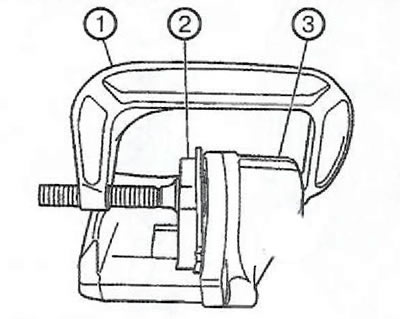
- Twin-piston brake caliper: a suitable inner brake shoe (2) or a wooden block in front of the piston. Using two C-shaped clamps (1) installed through the caliper body (3) and opposite the brake shoe or wooden block, slowly press the piston into the cylinder.
Visitor comments