


2. Clean the working surfaces of the brake disc with methyl alcohol.
3. Check the working surfaces of the brake disc for the following defects:
- Rust and/or pitting. Light rust can be removed with sandpaper. Large amounts of rust and/or pitting should be removed by re-grinding the disc.
- Cracks.
- Rainbow spots due to overheating.
4. If the working surfaces of the brake disc have one or more of the listed defects, the disc requires regrinding or replacement.
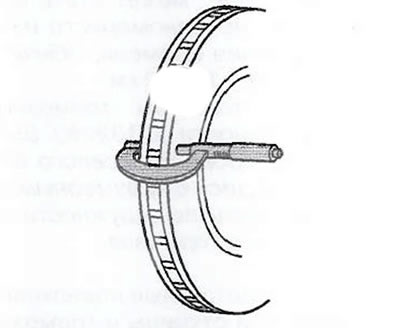
5. Using a micrometer calibrated to thousandths of a millimeter, measure the depth of wear of the working surface of the brake disc.
6. Compare the obtained wear value with the specification: maximum permissible wear of brake discs: 1.50 mm.
7. If the brake disc wear exceeds the specified value or uneven wear is observed, the brake disc must be reground or replaced with a new one.
8. Measure the thickness of the brake disc at four points equidistant from each other around the circumference of the disc. Make sure that the thickness of the disc is measured only at the working areas and at the same distance from the edge of the disc (about 13 mm) for each dimension.
9. Compare the minimum measurement value with the specification:
- Maximum permissible minimum thickness after regrinding: 28 mm.
- Brake disc reject thickness: 27 mm.
10. Calculate the change in thickness of the brake disc around the circumference and compare with the specification: maximum permissible change in thickness of the brake disc around the circumference: 0.025 mm.
Note.
- A brake disc whose thickness variation exceeds the maximum permissible value must be reground or replaced. A brake disc with excessive thickness variation around its circumference causes brake pulsation.
- After each brake disc replacement or resurfacing, the brake disc axial runout must be measured to ensure optimum brake performance.
11. If the thickness of the brake disc changes within the limits exceeding the permissible value, the brake disc must be reground or replaced with a new one.
Note.
- After each brake disc replacement or resurfacing, the brake disc axial runout must be measured to ensure optimum brake performance.
- Axial runout of the installed brake disc, exceeding the permissible value, can cause the development of uneven wear of the disc over time, usually in the range of 4800-11300 km.
- The circumferential thickness change of the brake disc must be performed before checking the axial runout. A brake disc with excessive circumferential thickness change will cause brake pulsation.
12. Check the contact surfaces of the wheel hub flange and brake disc to ensure that there are no foreign particles, corrosion or rust. If any of the above contaminants are found, do the following:
- Thoroughly clean all dirt from the contact surfaces of the wheel hub and brake disc.
- Clean the working surfaces of the brake disc with methyl alcohol.
(Material taken from an internet portal: «OPELBOOK»)
13. Install the brake disc on the wheel hub, using the marks made during removal as a guide.
14. Securely fix the brake disc to the wheel hub flange and install one of the wheel nuts (2) on the upper stud (1).
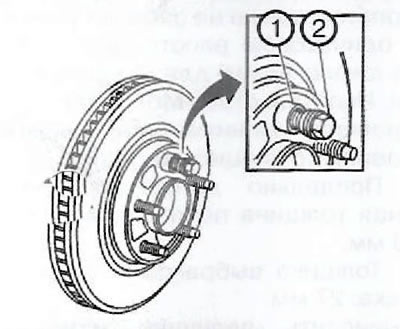
15. While continuing to hold the brake disc, tighten the wheel nut by hand,
16. Install the remaining wheel nuts onto the studs and hand tighten in a star pattern.
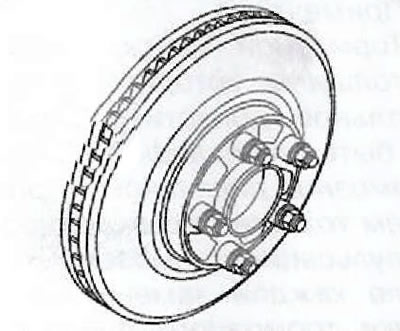
17. Tighten the wheel nuts to the specified torque to ensure proper rotor retention.
18. If the brake disc has been reground or replaced, proceed to step 24.
19. If the brake disc meets the following criteria, proceed to step 20:
- The brake disc parameters comply with the specification and the disc is reused.
- The brake disc has not been reground.
- The change in the thickness of the brake disc around the circumference does not exceed the maximum permissible value.
20. Install a GE-571-B dial indicator or equivalent onto the steering knuckle and position the feeler gauge perpendicular to the working surface of the brake disc approximately 13 mm from the outer edge of the disc.
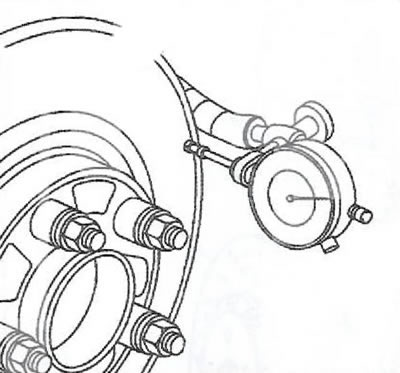
21. Measure and record the value of the axial runout of the brake disc:
- Rotate the brake disc until the minimum value is displayed, then reset the dial indicator.
- Turn the brake disc until the maximum value is displayed on the dial indicator.
- Mark the position of the brake disc relative to the wheel studs corresponding to the maximum value on the dial indicator.
- Record the obtained value of the axial runout of the brake disc.
22. Compare the obtained value of the axial runout of the brake disc with the specification: maximum permissible runout of the brake disc (front/rear): 0.05 mm.
23. If the brake disc runout is within specification, proceed to step 28. If the axial runout of the brake disc exceeds the specified value, regrind the disc until the surfaces are parallel. After regrinding the disc, proceed to step 24.
24. Install a GE-571-B dial indicator or similar on the steering knuckle and place the indicator probe perpendicular to the working surface of the brake disc approximately 13 mm from the outer edge of the disc.
25. Measure and record the value of the axial runout of the brake disc:
- Rotate the brake disc until the minimum value is displayed, then reset the dial indicator.
- Turn the brake disc until the maximum value is displayed on the dial indicator.
- Mark the position of the brake disc relative to the wheel studs corresponding to the maximum value on the dial indicator.
- Record the obtained value of the axial runout of the brake disc.
26. Compare the obtained value of the axial runout of the brake disc with the specification: maximum permissible runout of the brake disc (front/rear): 0.05 mm.
27. If the obtained value of axial runout of the brake disc exceeds the set value, replace the brake disc with a new one.
28. If the obtained value of the axial runout of the brake disc corresponds to the norm, install the brake disc with the caliper, then press the brake pedal several times to fix the brake disc in place before unscrewing the wheel nuts.
Visitor comments