


Proceed with the work only after the engine has completely cooled down!
Removal
Engines 1.4 and 1.6 l
1. Remove the timing belt cover (see section Removal and installation the timing cover).
2. Disconnect the lambda probe connector and remove it from the holder on the gearbox.
3. Loosen the mounting bolts and disconnect the inlet pipe at the exhaust manifold and at the connecting flange to the catalytic converter.
4. Remove the starter (see Chapter Engine electrical systems).
5. Loosen the two impulse sensor mounting bolts near the camshaft gear.
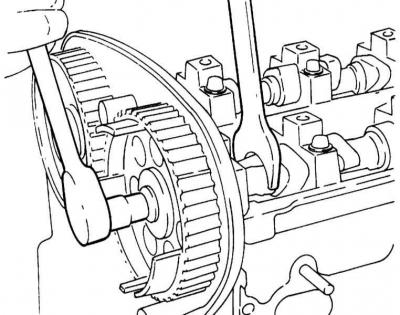
6. Unscrew the bolts securing the camshaft gears, for which hold the shafts from turning with a wrench on the lug of the first cylinder.
Holding the camshafts while removing the timing gear mounting bolts
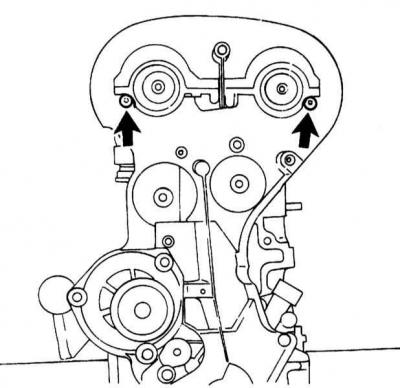
7. Remove the upper timing belt rear cover mounting bolts.
Upper timing belt rear cover mounting bolts
8. Unscrew the mounting bolts and remove both intermediate rollers of the toothed belt from the cylinder head.
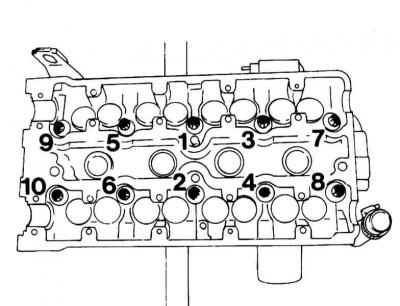
9. Loosen all cylinder head mounting bolts in the order indicated in the accompanying illustration.
The order of release of fasteners of the cylinder head
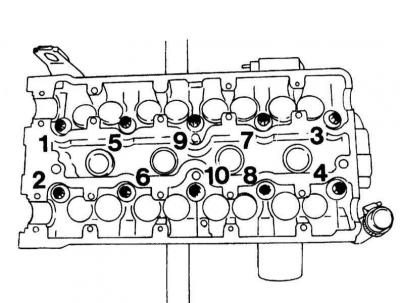
Loosening the cylinder head mounting bolts is only permitted when the engine has cooled down.
10. Remove the cylinder head with the intake manifold and exhaust manifold.
Engines 1.0 and 1.2 l
The following describes the removal and installation of the cylinder head of a 1.0L DOHC three-cylinder engine. The procedure for a 1.2L DOHC four-cylinder engine is similar. Specific instructions are provided where appropriate.
1. Release the fuel pressure (see Chapter Fuel, exhaust and emission control systems).
2. Disconnect the negative cable from the battery.
3. Remove the air filter with the MAF sensor, air intake sleeve and crankcase ventilation hose (PCV).
4. Drain the engine oil (see Chapter Vehicle settings and routine maintenance).
5. Drain the coolant (see Chapter Vehicle settings and routine maintenance).
6. Disconnect the upper and lower hoses from the radiator.
7. Disconnect the electrical connector of the oil pressure sensor, ECT and CMP sensors.
8. Unscrew the CMP sensor from the timing case.
9. Disconnect the hoses from the water pump.
10. Disconnect the stepper motor and throttle potentiometer connector.
11. Remove the throttle cable and holder.
12. Disconnect all coolant hoses, vacuum hose and PCV hose from the throttle body.
13. Disconnect the instrument panel multi-pin connector (lower).
Disconnect the battery no later than 20 seconds before this.
14. Remove the evaporator check valve with the holder.
15. Clamp the fuel hoses and disconnect them from the holder.
16. Disconnect the brake booster vacuum hose near the exhaust manifold.
17. Remove the rear wiring bracket from the intake manifold.
(The source is on the online website: «www.OPELBOOK.ru»)
18. Unscrew the upper bolt of the intake manifold support, loosen the lower support bolt.
19. Remove the lower wiring retainer from the intake manifold.
20. Disconnect the injector contact bus, pull it up and move it to the side.
21. Remove the water pump pulley mounting bolts.
22. Remove the accessory drive belt.
23. Remove the water pump pulley.
24. Remove the lower drain plug from the water pump and collect the leaking fluid in a suitable container.
25. Disconnect the hoses from the expansion tank of the cooling system.
26. Remove the reservoir from the engine compartment bulkhead.
27. Remove the cylinder head cover.
28. Unscrew the 3 mounting bolts and remove the thermostat housing cover.
29. Set the piston of the first cylinder to the TDC position (see section Repair procedures for DOHC gasoline engines without removing them from the vehicle).
The crankshaft position, which corresponds to the position close to TDC, is necessary so that the crankshaft locking pin can be easily inserted.
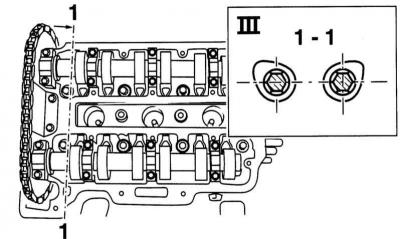
30. In the specified position, the camshaft cams that control the valve timing in the first cylinder (section 1-1) look outward at the same angle.
Orientation of cams when setting the piston of the first cylinder to the TDC position
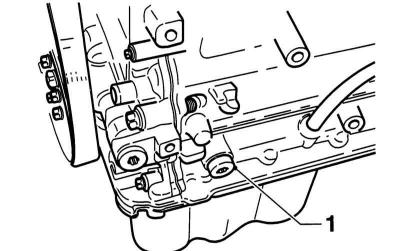
31. Unscrew the plug (1) under the crankshaft locking pin.
Plug (1) for crankshaft lock pin
32. Insert the crankshaft locking pin (1) (KM-952) into the hole in the cylinder block plate and turn the crankshaft evenly and slowly by the central bolt in the direction of engine rotation so that the locking pin enters the crankshaft groove. In this case, the crankshaft is in the TDC position of the piston of the first cylinder.
Fixtures for fixing the crankshaft (1) and camshafts (2)
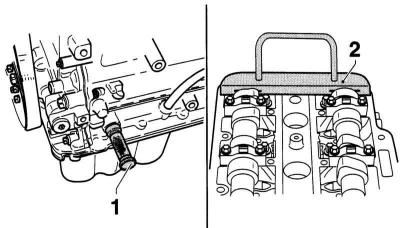
33. Fix the camshaft with a special device KM-953 (2) in the TDC position (refer to illustration).
If there is no tool (KM-954) for fixing the CMP sensor washer, use a scriber to mark the position of the intake camshaft gear in relation to the timing case and the position of the phase sensor washer in relation to the camshaft gear.
34. Unscrew the oil level dipstick guide tube and pull it upward.
35. Disconnect the lambda probe connector.
36. If equipped, disconnect the A/C compressor connector.
37. Remove the mounting bolts and disconnect the catalytic converter from the exhaust manifold. Remove the sealing gasket.
38. If equipped, unscrew the mounting bolts and disconnect the A/C compressor from the timing case.
Do not open the A/C cooling circuit. The refrigerant contained therein may cause frostbite.
39. Unscrew the mounting bolts and remove the engine retaining strips above the exhaust manifold.
40. Loosen the mounting bolts and remove the upper heat shield of the exhaust manifold.
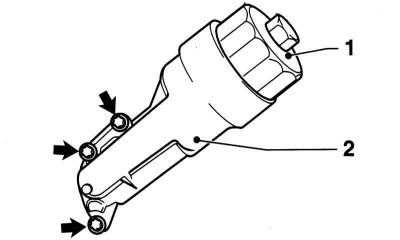
41. Remove the oil filter cover (1).
Oil filter cover and housing
Cover the catalytic converter to prevent oil from dripping onto it when removing the oil filter housing.
42. Remove the oil filter housing (2) from the cylinder block (arrow) (refer to illustration). Place plenty of rags underneath to collect any leaking oil.
43. Disconnect the EGR valve connector (1) and the temperature sensor (3).
AGR sensor connector (1), temperature sensor (3) and cooling circuit nipple (2)
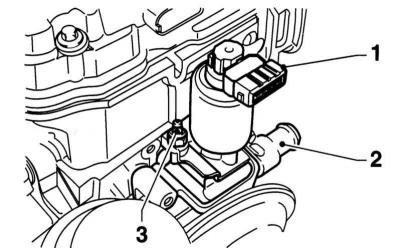
44. Disconnect the cooling system hose (2) from the EGR valve body (refer to illustration).
45. Remove the plug from the chain tensioner hole (arrow).
Timing chain tensioner plug and locking rod (2)
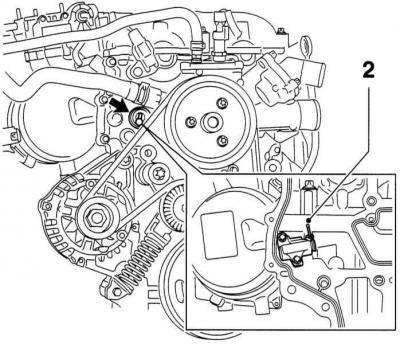
46. Press the chain tensioner back with a screwdriver and secure it with a suitable rod (2) (refer to illustration). For this purpose, you can use the KM-955 device.
47. Remove the spacer (1).
Spacer (1) and chain tensioner lock pin (2)
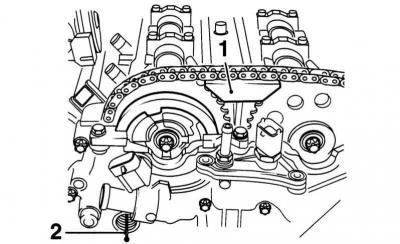
48. Loosen the camshaft sprockets. To do this, hold the camshafts with a wrench by the hexagon in the area of the valve timing cams of the first cylinder.
The camshaft locking tool is not designed to hold camshafts.
49. Remove the sprockets with the CMP sensor washer from the camshafts and remove the chain from them.
50. Hang the chain on the timing case so that it cannot fall into the case.
51. Remove the timing belt housing mounting bolts.
Timing drive housing mounting bolts
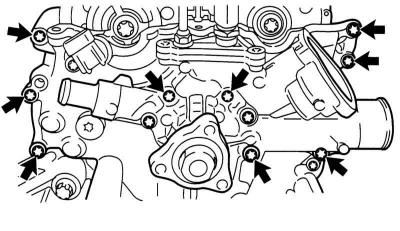
52. Remove the camshaft locking tool.
53. Loosen the cylinder head mounting bolts in sequence from 1 to 10, first a quarter of a turn, then half a turn, and then completely unscrew them.
The order of loosening the cylinder head mounting bolts
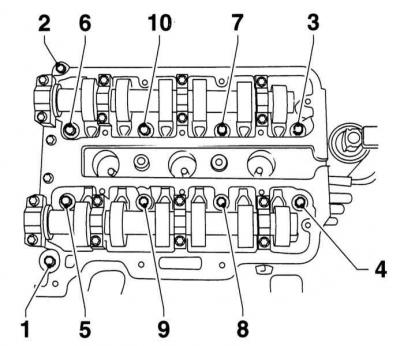
54. On the engine 1.2L DOHC loosen the cylinder head mounting bolts in sequence 1 through 12 as described above, starting with the upper left bolt (bolt (2)) (in the illustration) and then loosen the remaining bolts in a counter-clockwise spiral.
55. Press the cylinder head towards the gearbox and remove the head from the cylinder block.
The locking pin for the chain tensioner must be guided through the hole in the timing case.
56. Place the cylinder head on two wooden supports to avoid damaging the valves.
57. Remove the cylinder head gasket (1).
Cylinder head gasket
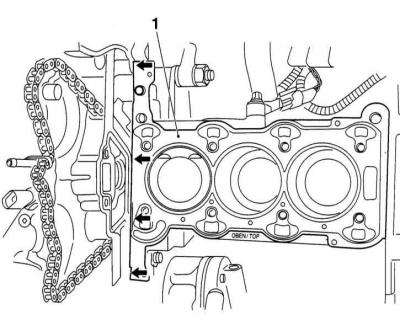
58. Bend the timing case gasket at the breakaway points (arrows) and cut the working edges of the gasket in the center (refer to illustration). Make sure that no working edges of the cylinder head gasket remain.
59. Remove all gaskets and gasket residue.
Preparing for installation
See Section Removal and installation the cylinder head.
Installation
Engines 1.4 and 1.6 l
1. Use a scraper to remove any remaining sealant from the mating surface of the cylinder block. Make sure that no dirt gets into the block holes. Cover the holes with a clean rag.
The threaded holes of the cylinder head bolts must be cleaned of oil and coolant. Blow out the holes with compressed air or remove the liquid with a screwdriver with a rag wound around it. Otherwise, cracks may form in the block when screwing in new bolts, and the tightening force values will be distorted.
2. Check the curvature of the mating surface of the cylinder block (see section General and major engine repairs of this Chapter).
3. Place a new sealing gasket without sealant on the degreased mating surface of the cylinder block. The gasket should be positioned so that none of the holes are covered. The inscription "OBEN/TOP" on the gasket should face up and towards the engine toothed belt.
4. Clean the mating surface of the cylinder head.
5. Check the distortion of the mating surface of the cylinder head (see section General and major engine repairs of this Chapter).
6. Install the cylinder head and tighten the new mounting bolts evenly until snug in the order shown on the accompanying illustration.
Cylinder head bolt tightening sequence
Be sure to use new mounting bolts.
7. The bolts should be tightened in five stages: first tighten them firmly 25 Nm, then turn them three times at the corner 90 degrees., and finally, tighten the bolts to the angle 45 degrees.
8. Tighten the rear upper timing belt cover mounting bolts with force 6 Nm.
9. Install the camshaft gears, holding the shaft from turning by the lug with a wrench. Tighten the new camshaft mounting bolt with force 65 Nm.
Be sure to use new mounting bolts.
10. Install the cylinder head cover and tighten the bolts crosswise with force 8 Nm.
11. Install the starter (see Chapter Engine electrical systems).
12. Secure the exhaust pipe to the manifold with force 25 Nm and on the connecting flange of the catalytic converter with force 18 Nm.
13. Install the timing belt (see section Removal and installation the timing belt (1.4 and 1.6 l engines)).
14. Install the front timing belt cover.
15. Tighten firmly 4 Nm fastening of the cover of high-voltage wires.
16. Further installation is carried out in the reverse order of dismantling the components.
17. Fill the cooling system (see section General information), and check and, if necessary, correct the engine oil level. If the cylinder head was removed due to damage to the sealing gasket, change the oil and filter, as the oil may contain coolant.
Engines 1.0 and 1.2 l
1. Clean the mating surfaces of the cylinder block and timing case from sealant residues. Make sure that no dirt gets into the cylinder block holes.
The threaded holes of the cylinder head bolts must be cleaned of oil and coolant. Blow out the holes with compressed air or remove the liquid with a screwdriver with a rag wound around it. Otherwise, cracks may form in the block when screwing in new bolts, and the tightening force values will be distorted.
2. Clean the mating surface of the cylinder head.
3. Check the cylinder head warpage (see section General and major engine repairs of this Chapter).
Grinding of the cylinder head is not permitted.
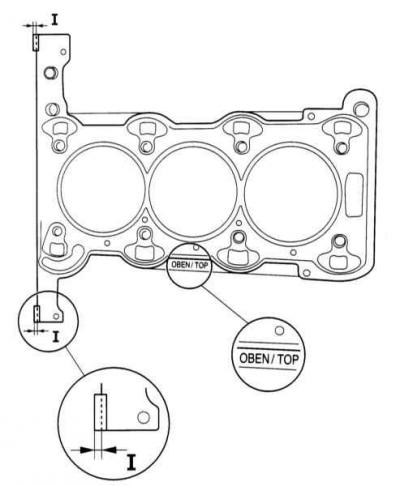
4. Cut off the tabs of the new cylinder head gaskets (size I) on the timing case side.
Cylinder head gasket cut points and top mark
5. Install the camshaft sprockets with the chain on them into the timing case.
6. Apply 2mm thick beads (1) of silicone sealant to the corners of the timing case/cylinder block.
Applying sealant (1) to the joint of the timing belt cover with the cylinder head and the timing belt housing mounting bolts
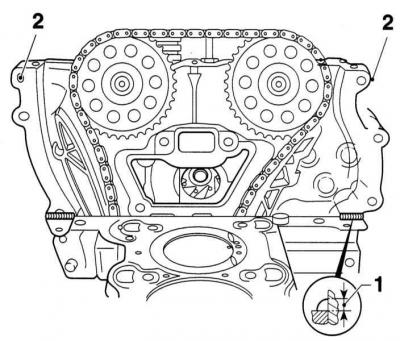
Use only OPEL sealant, ET No.90 543 772. After applying the sealant, the cylinder head and timing case must be installed and tightened with bolts within 10 minutes.
7. Install the new cylinder head gasket so that none of the holes are blocked. The "OBEN/TOP" inscription on the gasket should face up. Press the gasket in the area of the silicone sealant.
8. Insert both upper timing belt housing mounting bolts (2) on the left and right (refer to illustration).
9. Hang the sealing gasket on top with the holes on the left and right onto the bolts, and press it down in the area of the applied silicone sealant.
10. Apply the other two beads to the corners of the timing case and cylinder head gasket.
11. Insert the camshaft locking pins. If the locking pin does not fit, slowly turn the shafts by the hexagon.
12. Install the cylinder head onto the block. Make sure that the locking pin for the chain tensioner passes through the hole in the timing drive housing and the chain tensioner past the tension bar.
13. Press the cylinder head against the timing drive housing.
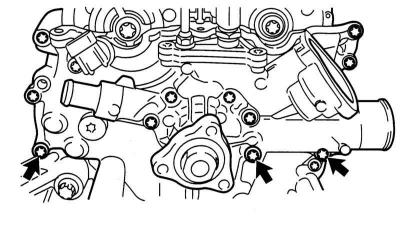
14. Screw in the 3 lower bolts securing the cylinder head to the timing drive housing and tighten them with force 8 Nm.
Lower bolts securing the cylinder head to the timing drive housing
15. Once again, using light blows from a plastic hammer, adjust the position of the cylinder head in the direction of the timing belt housing.
16. Remove the camshaft locking tool.
17. Insert new cylinder head bolts and tighten them until they are snug against the cylinder head. Then tighten the cylinder head bolts in four steps in the sequence 1 through 10: first with force 25 Nm, and then turn them three times at the angle 60 degrees.
Cylinder head bolt tightening sequence
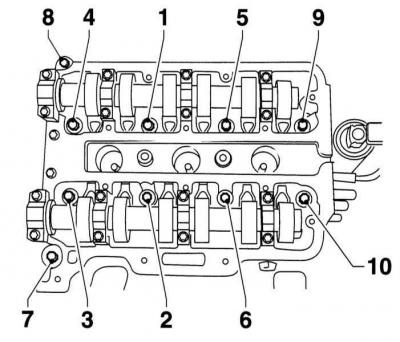
18. On the engine DOHC 1.2L tighten the cylinder head bolts in sequence from 1 to 12, also in four steps. In this case, start tightening with the central bolt in the top row of bolts and continue moving clockwise. Thus, the bolt on the left at the top (bolt (8) (in the illustration) is tightened last.
19. Loosen the 3 lower bolts securing the cylinder head to the timing drive housing again.
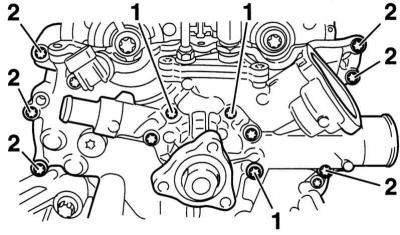
20. First tighten the bolts (1) securing the water pump to the cylinder head with force 8 Nm, and then the bolts (2) of the timing belt housing to the cylinder head with force 8 Nm.
Bolts securing the water pump (1) and timing drive housing (2) to the cylinder head
21. Install the camshaft locking tool. If the locking tool does not fit, slowly turn the camshafts using the hexagon.
22. Install the sprockets with the chain on the camshafts.
If there is no CMP sensor rotor guide, install the sprocket so that the mark made during removal coincides with the timing case.
23. Press the CMP sensor rotor onto the intake camshaft sprocket and loosely secure the sprocket with a new bolt. Tighten the bolt just enough to allow the CMP sensor rotor to still rotate.
24. Also lightly tighten the exhaust camshaft sprocket mounting bolt.
25. Insert the upper spacer and tighten it firmly 8 Nm.
26. Remove the chain tensioner retainer.
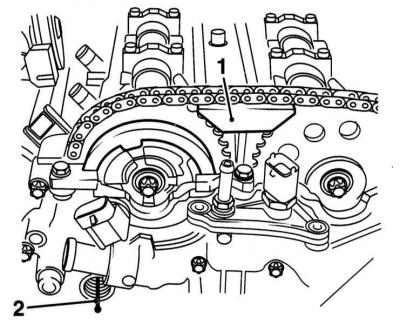
27. Install the CMP sensor rotor guide (1) (KM-954) and secure it to the timing case. If necessary, rotate the CMP sensor rotor so that the guide can be installed.
CMP sensor rotor conductor
If there is no CMP sensor rotor guide, rotate the rotor so that the mark applied before removal coincides with the mark on the camshaft sprocket. At the same time, the mark on the camshaft sprocket must coincide with the timing case. In this position, tighten the camshaft sprocket mounting bolt. At the same time, make sure that the CMP sensor rotor does not rotate relative to the camshaft sprocket.
28. Tighten the camshaft sprocket mounting bolts with force 50 Nm and tighten the bolts one more angle 60 degrees. At the same time, hold the camshaft from turning with a wrench on the hexagon.
Fixing mandrels are not permitted to be used as holding tools.
29. Remove all stop mandrels and check the valve timing. To do this, turn the crankshaft 2 revolutions in the direction of engine rotation and stop at the TDC position of the piston of the first cylinder. If in this position the stop mandrels are inserted simultaneously and without problems, the valve timing adjustment is correct.
30. Tighten the chain tensioner hole plug with force 20 Nm.
31. Install the CMP sensor with a new O-ring on the timing case.
32. Tighten the crankshaft stopper hole plug with force 60 Nm.
33. Place the coolant hose onto the AGR housing and secure it with a clamp.
34. Connect the EGR valve and temperature sensor connectors.
35. Install the oil filter housing with a new sealing ring onto the cylinder block and tighten its fasteners with force 20 Nm. Fasten the cover with a new sealing ring to the body.
36. Install the exhaust manifold upper heat shield and tighten its fasteners with force 8 Nm.
37. Install the engine retaining strips and tighten their fasteners with force 20 Nm.
38. If equipped, install the K/V compressor onto the timing case and cylinder block and tighten its fasteners with force 20 Nm.
39. Secure the catalytic converter with the new seal to the exhaust manifold by hand without tightening the mounting bolts.
40. Screw in the catalytic converter holder mounting bolts by hand, without tightening them.
41. Install the catalytic converter and tighten its fasteners with force 35 Nm, and the holder fasteners - with force 15 Nm.
42. If equipped, connect the A/C compressor connector to the holder.
43. Install the engine oil dipstick guide tube with a new gasket and tighten its fasteners to the exhaust manifold with force 8 Nm.
44. Further installation is carried out in the reverse order of dismantling the components. Tighten the fasteners with the required force.
45. To complete the installation, fill the cooling system and check and, if necessary, correct the engine oil level. If the engine was removed due to damage to the cylinder head gasket, change the oil and oil filter, as the engine oil may contain coolant.
Visitor comments