


Note: When operating the vehicle under severe conditions, the intervals between engine oil/oil filter changes should be reduced (see Section 1).
1. Regular and frequent replacement of engine oil is one of the basic procedures of preventive maintenance of the car, lying within the skill level of the average amateur mechanic. Over time, engine oil is subject to aging, which is manifested in its gradual dilution and contamination, leading to premature wear of the internal components of the engine. Although some sources recommend replacing the oil filter only with every second engine oil change, the authors of this Guide believe that, given the relative insignificance of the cost of the replacement component and the importance of the influence of its condition on the proper functioning of the engine/its efficiency, it makes sense to change the filter every time the oil is changed.
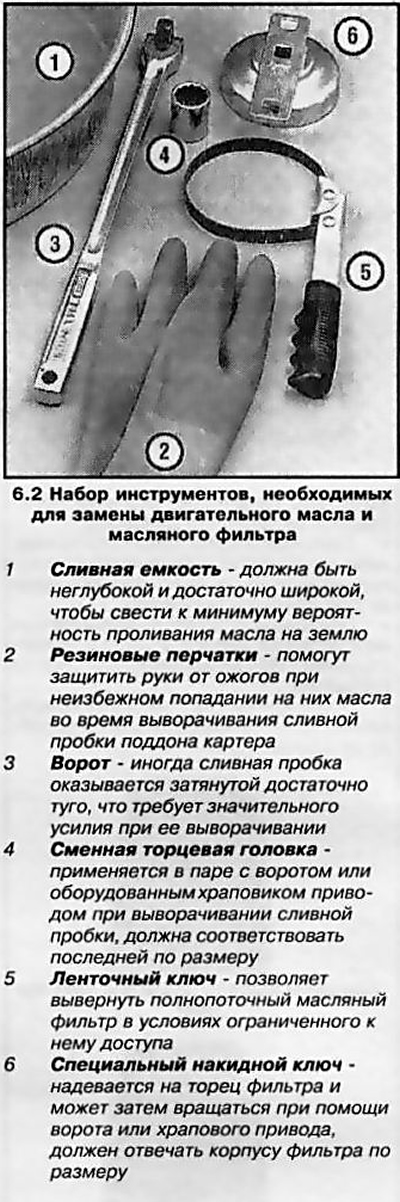
2. Make sure you have all the materials and tools needed to perform the oil and oil filter change on hand (see accompanying illustration). Also prepare a sufficient amount of rags and old newspapers to collect traces of spilled oil. Before changing the oil, the engine should be warmed up to operating temperature - hot oil has greater fluidity and better washes out sludge and sediment.
3. Oil can be removed from the engine in two ways: by pumping it out with a special syringe (devices) through the engine oil dipstick tube, or drained through the drain hole in the engine oil pan. Depending on the availability of the appropriate equipment, you can choose either of them - the first is more preferable for private garage conditions, since it does not require special lifting equipment or an inspection pit. Park the car on a flat horizontal surface, apply the parking brake lever and turn off the engine.
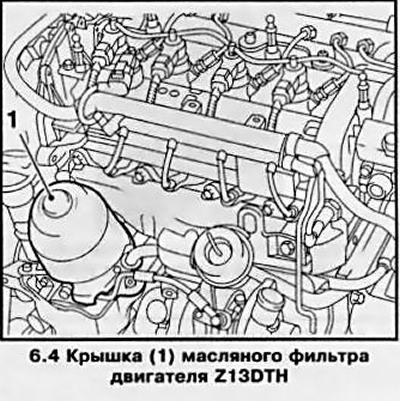
4. On the Z13DTH engine, it is necessary to first remove the engine cover (see Chapter 2). To remove the oil filter cover (see accompanying illustration) you should unscrew the two mounting bolts and the hex nut. If you need to apply significant force to unscrew the stuck bolts, use a Torx T30 head with an extension and a ratchet mechanism.
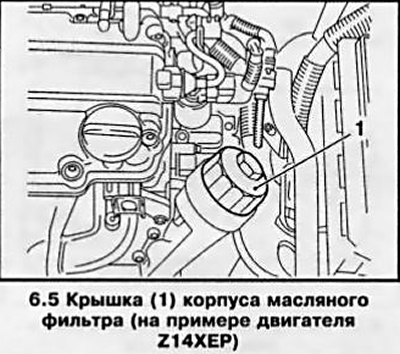
5. On other models, oil filter/oil filter housing cover (see accompanying illustration) removed using a spanner or special tools. When unscrewing the filter cover, oil begins to flow into the engine oil pan, wait until all the oil has drained from the filter and then remove the filter element. Note: Depending on the engine model, the oil filter is completely separated (see below paragraph 15) or only the filter cover with the replaceable filter element is removed (engines Z14XEP/Z22YH/Z13DTH/Z17DT (L/H)/Z19DT (J/H)). Then remove the dipstick from the tube (see section 4) and pump out the oil.
6. If there is no special syringe/device, the engine oil can be drained from the crankcase by raising the car using a lift, driving it onto an overpass, or jacking it up and placing it on supports.
Warning: Never perform any work under a vehicle supported only by the bumper or held in a raised position only by a jack!
Make sure that the vehicle is securely fixed in the raised position.
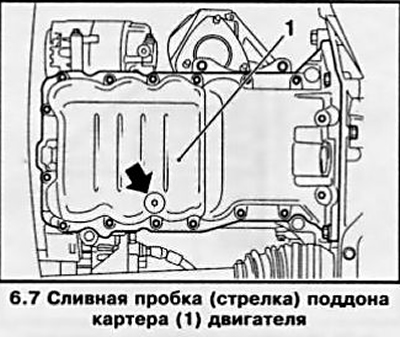
7. Get under the vehicle and familiarize yourself with the location of the oil pan drain plug (see accompanying illustration). Remember that the power unit and exhaust system components will remain quite hot during the entire procedure - think of a safe hand manipulation scheme to avoid accidental contact with hot surfaces.
8. Make sure the vehicle is level on the jack stands/lift. Remove the engine oil filler cap (see Section 4). On diesel engines with a working volume of 1.7 and 1.9 liters, it is necessary to first unscrew 4 fastening bolts and remove the service cover on the protective casing of the engine compartment. In addition, on diesel engines with a working volume of 1.9 liters, in order not to damage the flexible pipe of the exhaust system with a hot stream of leaking engine oil, it is necessary to install a protective screen and secure it with wire.
9. Place a drain container under the oil pan, so that at first the stream will flow out through the hole with a decent pressure. Trying not to touch the heated surfaces of the power unit and exhaust system components, unscrew the drain plug from the bottom of the oil pan. When performing this operation, it is recommended to wear protective rubber gloves.
10. Allow the oil to flow freely into the container, adjusting the position of the container as the flow weakens. Check the drained oil for metal filings.
11. After the oil stops flowing out of the engine crankcase, carefully wipe the drain plug with a clean rag - small metal filings may stick to it, which will immediately lead to contamination of the fresh oil.
12. Wipe the surface of the tray around the drain hole, screw the plug back into place and tighten it to the required torque (see Specifications). Don't forget to replace the copper/aluminum sealing washer on the drain plug thread.
Note: A gasket is sometimes included with a new replacement oil filter.
13. If equipped, remove the protective screen and replace the service cover. Collect any spilled oil, remove the drain pan and tools from under the vehicle. Lower the vehicle to the ground. Install the oil filter and tighten it to the appropriate torque (see below).
[Material taken from an internet portal opelbook]
Visitor comments